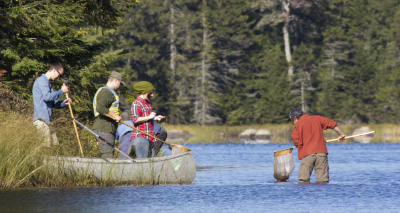
A separate course, Limnology Laboratory, EFB 525, is available for students who want more hands-on experience with sampling and aquatic organisms.
Professor: Kimberly L. Schulz
Contact information: 456/454 Illick Hall, 470-6808; kschulz@syr.edu
Office Hours: (456 Illick) Wednesdays 9:30-10:30 AM, Fridays 3:00-3:55
PM, or by appointment
Teaching Assistants:
Mike Snyder, 248 Illick Hall; 470-6949;
mdsnyder@mailbox.syr.edu;
Office hours: Wed.
10:30-11:30 AM; Thurs. 3:00-4:00 PM
Mercy Borbor, 301 Illick Hall, 470-6812,
mjborbor@mailbox.syr.edu
Office hours: Tuesdays
3:00-4:30 PM
Textbook:
The readings are meant to complement lecture material and are available
in on the website (follow link to the campus website). I would
encourage anyone interested in a career related to aquatic science to
purchase Wetzel 2001. This is an excellent reference source, and
I've included relevant pages in Wetzel (Wetzel, R.G. 2001. Limnology:
Lake and River Ecosystems. Third Edition. Academic Press) for each
lecture if you need further clarification or additional information.
Syllabus
If you are in Limnology and want to view
the power point files or the readings, go to the following
website (on campus only):
cww.esf.edu/course/kschulz/LimnologyCWW.html
| Month | Date | Day | Lecture Topic | Readings (on cww website) |
Wetzel Optional Reading | Due Date |
| Aug. | 26 | M | Introduction | Kalff | 1-7 | |
| 28 | W | Origin of lakes | Wetzel | 15-17; 23-34 | ||
| 30 | F | Origin of lakes Morphology and zonation |
Kalff | 34-42; 129-134 | ||
| Sept. | 2 | M | NO CLASS (Labor Day) | |||
| 4 | W | Hydrologic cycle | Kalff | 43-48 | ||
| 6 | F | Light in water | Wetzel | 49-69 | ||
| 9 | M | Thermal stratification and lake mixing | Various | 9-14; 71-92 | ||
| 11 | W | Water movements – physical properties | Cole | 93-128 | ||
| 13 | F | Origin of dissolved substances | Wetzel | 169-186 | ||
| 16 | M | NO CLASSES (Yom Kippur) | ||||
| 18 | W | Dissolved gases (O2, N2, CH4) | Kalff | 151-168 | ||
| 20 | F | Inorganic carbon; alkalinity and pH | Wetzel | 187-204 | LR1 | |
| 23 | M | Bacteria and biogeochemistry; microbial loop | Kalff | 397-412; 489-525 | ||
| 25 | W | Iron and redox reactions | Various | 289-306 | ||
| 27 | F | Phosphorus cycling | Various | 239-269 | PS1 | |
| 30 | M | Nitrogen cycling - guest lecture | Various | 205-237 | ||
| Oct. | 2 | W | Integration of nutrient cycling | |||
| 4 | F | Review for Exam I (questions and answers) | ||||
| 7 | M | EXAM I -- PHYSICAL AND CHEMICAL LIMNOLOGY | exam 1 key | E1 | ||
| 9 | W | Littoral biota and wetlands | Various | 527-575; 577-582; 812-820 | ||
| 11 | F | NO CLASS (FALL BREAK) | ||||
| 14 | M | Stream biota and ecology | Allen; Dodds | 17-23; 139-142; 665-710 | ||
| 16 | W | Stream Ecology II | 331-339 | |||
| 18 | F | Phytoplankton Diversity | Various | 339-358 | ||
| 21 | M | Phytoplankton - Nutrition and Ecology | Lampert | 134-139; 142-149 | ||
| 23 | W | Phytoplankton ecology II; Zooplankton diversity I | Lampert | 359-393 | ||
| 25 | F | Zooplankton diversity II | Various | 396-397; 412-416; 428-433 | ||
| 28 | M | Zooplankton ecology | Lampert | 417-428 | ||
| 30 | W | Zooplankton population dynamics | Lampert | 433-448; 468-483 | PS2 | |
| Nov. | 1 | F | Integrated plankton ecology I | Lampert | 449-460 | |
| 4 | M | Integrated plankton ecology II | Lampert | 460-464 | ||
| 6 | W | Review for Exam II Exam 2 Practice Questions and Answers | ||||
| 8 | F | EXAM II -- BIOLOGICAL LIMNOLOGY | Exam 2 Key |
E2 | ||
| 11 | M | Current topics in benthic and stream ecology | Limburg | 710-724; 832-836; 839-840 | ||
| 13 | W | Estuaries and Salt lakes | Junk, Dodds | |||
| 15 | F | Food webs and control | Lampert | 464-468 | ||
| 18 | M | Acid rain | Kalff | 269-288; 825-832; 836-839 | LR2 | |
| 20 | W | Pollution and cultural eutrophication | Dodds | |||
| 22 | F | Exotic species in aquatic systems | Mills | |||
| 25 | M | Paleolimnology and global change | Wetzel | PS3 | ||
| 27 | W | NO CLASS (Thanksgiving) | ||||
| 29 | F | NO CLASS (Thanksgiving) | 785-804 | |||
| Dec. | 2 | M | Case studies | Various | ||
| 4 | W | Case studies/Summary | Kling | |||
| TBA | 0 | Review for final exam - final practice questions |
Grading
| Problem Sets (PS1, PS2, PS3) | 15% |
| Two literature reviews (LR1, LR2) | 20% |
| Exam 1 (E1) | 20% |
| Exam 2 (E2) | 20% |
| Final Exam | 25% |
Extra Credit Opportunities:
15 'Review Questions of the
Week'
1 extra credit exam point each
Review Bonus Games Before
Tests
1-3 bonus points
Aquatic Book
review
up to 5% of course grade
(see me by 4 November to
arrange this)
Late Policy:
If you find that you have several assignments or outside obligations due on the same day, see me before the Limnology assignment is due, and we can work out a reasonable extension. If you don’t contact me before the assignment is due, I will generally accept late assignments, but at a late penalty of 10% per day. So, obviously, if you anticipate difficulty with completing an assignment, you should contact me early! I will not accept late problem sets after the answer key has been posted (usually at the next class period).Honor Code
ESF and SU students are bound by an academic honor code that details rights and responsibilities for study. You should be aware that this code provides serious sanctions for academic dishonesty (including but not limited to plagiarism and cheating). I expect that you will follow the honor code. Any violation of the honor code will result in failing the assignment and/or failing the course. If you have any questions about the ESF honor code or about what constitutes plagiarism or cheating, please either check the ESF website or come speak with me.Class Absence
If you encounter a situation beyond your control during which you will be missing 3 or more days of classes, you can contact the Office of Student Life (110 Bray, (315) 470-6660, FAX: (315) 470-4728), and they will contact all your instructors for you. Supportive documentation may be required.
Accommodations for Students with Disabilities
If you have an identified disability and will need accommodations, you should first contact Mr. Slocum in the Office of Student Life in 110 Bray Hall. He will discuss the ESF process and work with you to access supportive services. If you have a learning disability, the College will require you to provide supportive documentation and will develop an approved accommodation sheet for you. Accommodations cannot be provided until the accommodation sheet is established and we have met to discuss its applicability to this course. Accommodations cannot be provided retroactively. If you have any questions about class absences or disabilities, please contact me and/or Mr. Slocum as soon as possible. All conversations will be strictly confidential.Return to K.L. Schulz's homepage