|
Spring 2009
Lecture: MWF 10:35-11:30 am in 211 Walters Prerequisites: PSE 300, PSE 370, PSE 465 |
|
Instructors: Dr. Klaus Doelle 205 Walters Hall Phone: x6531 Email: kdoelle@esf.edu Dr. Gary M. Scott 205 Walters Hall Phone: x6501 Email: gscott@esf.edu |
Pilot Plant Coordinator: Mr. Ray Appleby 114 Walters Hall Phone: x6527 Email: rappleby@esf.edu |
Teaching Assistant: Mr. Gustavo Duarte 107 Walters hall Phone: 315-395-6751 Email: gvduarte@syr.edu
Instructor: | Dr. William Holtzman 424 Walters Hall Phone: 6506 Email: billh@a-znet.com |
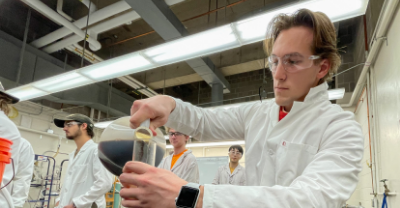
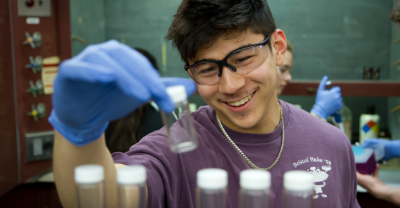
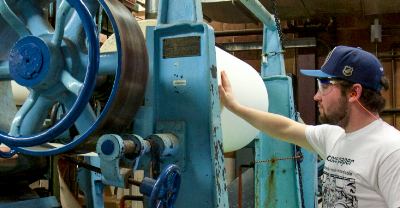
Study of the papermaking process, featuring operation of the pilot paper machine. Emphasis is on the fundamentals of stock preparation, paper machine operation, evaluation of the finished product and the collection and analysis of data to develop material and energy balance. Results of each paper machine run are evaluated in seminar-type discussions.
This course is a capstone course for the Paper Science and Engineering Curriculum. Students are expected to draw on the knowledge that they have gained both in their previous coursework and their work experiences. In addition to the technical lectures that are a part of this course, a major portion of the course deals with designing and producing certain paper grades on the pilot paper machines in Walters Hall. This work is done in a team environment. The minimum prerequisites for the the (undergraduate) course are PSE 300, PSE 370, and PSE 465. Students without these prerequisites must petition to be able to take the course.
The prerequisites for this course are PSE 300, PSE 370, and PSE 465 (or its equivalent). Specifically, each student should have a passing knowledge in the areas listed below.
Every course that a student takes should further his knowledge, building on what was learned. By the end of this course, each student should be able:
PSE 468 is a senior level course intended to be taken during your final year of college at ESF. The class is designed to help transition you from ``class-type'' assignments to ``real-world''-type assignments. Therefore, the assignments will probably be completely different from what you have experienced in the past. Specifically, this class addresses the following published learning outcomes for Paper Science and Engineering:
Pulp and Paper Manufacture Volume 7: Paper Machine Operations edited by B.A. Thorp and M.J. Kocurek (Joint Textbook Committee of the Paper Industry, 1991). The text is available from national Tappi and should be ordered individually or through the Papyrus Club well before the beginning of the semester. You will be responsible for all the material in chapters 1--16, although not all of this material will be covered in the class lectures. Although specific reading assignments may not be given, you should be reading the appropriate chapters as the semester proceeds. I expect to cover the following general topic: Introduction/Papermaking Fibers, Approach Flow Systems, White Water Handling, Formation and Consolidation, Pressing, Drying, and Calendering.
The course will consist of lectures, discussions, student oral presentations, laboratory exercises, homework, and runs on the #1 and #2 Paper Machines. I expect to have two runs on the #1 Paper Machine and 4 runs on the #2 Paper Machine. In the early portion of this course, you will be developing a plan to manage the work for the entire semester including the scheduling of the paper machine runs and assigning roles of the students. With the exception of the papermachine runs, specific tasks during the laboratory times are not assigned, but up to your discretion. The afternoon laboratory times may also be used for guest lecturers or exams as announced. As part of the project management process for the paper machine runs, we will be having weekly staff meetings (approximately 1 hour long) one afternoon per week. Seminars are periodically offered by the Paper Science and Engineering Department throughout the semester. These seminars can be given by industry and research people, graduate students, and faculty. The information given in these lectures can help you understand the latest industrial and research trends in the industry.
| 14 Janaury, 2:00-4:00 pm
| 21 January
| 4 February, 1:00-4:00pm
| 11 February, 10:35-11:30am
| 11-12 February, 1:00 to 4:00pm
| 18 February, 10:35-11:30am
| 25 February, 10:35-11:30am
| 25 February, 1:00-2:00pm
|
| 18 February
| 19 February
| 23 February
| 24 February
| #1 Paper machine Run A |
| 3 March
| 4 March
| 26-27 March
| #1 Paper machine Run B |
| 31 March
| 1 April
| 21-22 April
| |
The following section is only available to students enrolled in PSE 468. To enter the "Student Information Area," click on the button below and enter the password when prompted:
Copyright 2009, Gary M. Scott. All rights reserved.