Faculty Profile
John Farrell

Professor and Director, Thousand Island Bio Station
250 Illick Hall
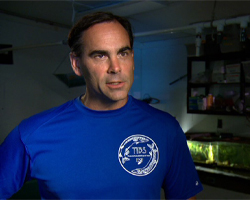
PhD SUNY College of Environmental Science and Forestry, 1998. Fisheries Ecology and Management, Aquatic Sciences, Restoration, Invasive Species.
Thousand Islands Biological Station - Thousand Islands Biological Station, Governors Island, St. Lawrence River
Teaching
EFB 486/686 Ichthyology/Advanced Ichthyology. An introduction to learn major trends and events in the evolution of fishes and to classify fishes based on current phylogenetic relationships. Identify anatomical structures and describe their function in the context of taxonomy and evolutionary change. Appreciate the adaptive significance of fish traits and their influence on survival and the ability to reproduce. Describe geographic distributions of regionally and globally important groups of fishes. Learn to sample fishes, prepared skeletons, study their early life history, reproductive ecology and physiology. Apply basic biological knowledge of fishes to conservation and management issues.
EFB 492 Senior Synthesis in Aquatic and Fisheries Science. With a focus on professionalism and communications students discuss and experience job opportunities in the aquatics field and anticipate what is expected by potential employers. Students appy for and conduct mock job interviews and focus on skill development, leadership and other important qualities in the workplace. Field trips will provide new experiences and opportunities in aquatic professions. The second part of the course will focus on problem solving with science and management and explore issues in the aquatic and fisheries realm relevant to the broader society and environmental sustainability. Spring. Prerequisite: Senior standing in the Aquatic and Fisheries Science major. Spring.
EFB 681 Aquatic Ecosystem Restoration and Enhancement, Guiding principles for ecological restoration of freshwater aquatic ecosystems focusing on effects of nutrient loading, sedimentation, flow alteration, and habitat loss. Factors leading to loss of aquatic resources and effectiveness of techniques to restore habitat and fauna are analyzed. explore recent advancements in theoretical and technical aspects of aquatic ecology and its use in management. The class includes field trips to observe current stream and wetland restoration enhancement techniques with government professionals. Students will complete a restoration design for a wetland project. Several foundational readings are assigned each week and referred to in discussion. Each student will present a case study and lead a session on a significant scientific concept, method, or sub-discipline in an area of interest involving aquatic restoration. Fall.
Research Interests
My interests revolve around the broad topic of aquatic ecology and management of aquatic resources. I use longitudinal studies and targetted research to examine ecological change and guide management and conservation initiatives. Much of my research is focused on fish ecology, coastal wetland ecology and addressing environmental problems facing freshwater ecosystems.
Publications (selected)
Wilder, M.L. J. M. Farrell, and H.C. Green. 2026. Comparing Environmental DNA (eDNA) and Live Capture Methods for Detecting Muskellunge (Esox masquinongy) in the St. Lawrence River. J. Great Lakes Research 52(1):102746
Ritz, T. & JM Farrell. 2025. Temporal patterns of young-of-year fish emigration in upper St. Lawrence River coastal wetlands in relation to environmental variation. J. Great Lakes Research 51(5):1-11.
Haws, A & JM Farrell. 2025. Pace-of-life and population structure assessment of invasive round goby in
the upper St. Lawrence River. J. of Great Lakes Research Special Issue on Great Lakes Connecting Waters (impact factor 2.5).
Leblanc JP & JM Farrell 2025. Water-level variability mediates northern pike reproduction at restored coastal habitats in the Upper St. Lawrence River, USA. Wetlands 45:31:1-6.
Johnson HA, Rondeau EB, Sutherland BS, Minkley DR, Leong JS, Whitehead J, Despins CA, Gowen BE, Collyard BJ, Whipps CM, Farrell JM, Koop BF. 2024. Loss of genetic variation and sex determination system in North American northern pike characterized by whole-genome resequencing. G3 14:10. https://academic.oup.com/g3journal.
Leblanc JP, & JM Farrell. 2023. Influence of water-level variability on fish assemblage and natural reproduction following connectivity enhancement in a Typha dominated coastal wetland, USA. Journal of Fish Biology 103:574-592.
Gallo, BD., Farrell, JM. & Leydet, BF. 2023. Initial diet influences future development paths of gut microbiota in larval northern pike (Esox lucius). Hydrobiologia (impact factor 2.6) 850, 3743–3762 (2023). https://doi.org/10.1007/s10750-023-05266-8
Wilder, M.L. J. M. Farrell, and H.C. Green. 2023. Estimating eDNA shedding and decay rates for muskellunge in early stages of development. Environ. DNA 5:251–263. (impact factor 6.2)
Gallo, B., J. M. Farrell, and B. Leydet. 2022. Northern Pike (Esox lucius) young-of-year gut microbiota and associations with wetland nursery water microbial communities in the St. Lawrence River. Aquaculture, Fish and Fisheries 2(5)384-401. (Impact factor 1.9)
Miano, A., J. P. Leblanc, and J. M. Farrell. 2021. Diet, trophic position of upper St. Lawrence River round goby giants reveals greater dependence on dreissenids with increasing body size. J. of Great Lakes Research 47:1126-1134.
Farrell, J. M. and L.A. Fuiman. 2021. IN MEMORIAM ROBERT G. WERNER 1936-2020. Fisheries 46: 45-45.
Kua, Z. X., J. C. Stella, and J. M. Farrell. 2020. Local disturbance by muskrat, an ecosystem engineer, enhances plant diversity in regionally-altered wetlands. Ecosphere 11(10):e03256. 10.1002/ecs2.32562
Leblanc, J. P., Conklyn, A, J. M. Farrell. 2020. Rapid Fin Regeneration of Age-0 Northern Pike and Implications of Fin Clips as a Marking Protocol. North Am. J. Fish. Mgmt. 40:1294-1301.
Gallo, B., Farrell, J. M., B. Leydet. 2020. Use of next generation sequencing to compare simple habitat and species level differences in the gut microbiota of an invasive and native freshwater fish species. PeerJ 8:e10237
Massa E.A., and J. M. Farrell. 2020. Improving habitat connectivity in a Typha dominated wetland shows increased larval northern pike survival. Wetlands 40:273–286.
Gallo, B., J. M. Farrell, and B. Leydet. 2020. Fisheries and the gut microbiome: Using next generation sequencing (NGS) and microbial ecology to better understand fish-microbe interactions. Fisheries 45:271-282.
Walton-Rabideau, Lédée, E. J. I., J. P. Leblanc, P. Szekeres, J. D. Midwood, A. J. Gallagher, J. M. Farrell, and Steven J. Cooke. 2020. Spatiotemporal ecology of juvenile Muskellunge (Esox masquinongy) and Northern Pike (Esox lucius) in upper St. Lawrence River nursery bays. Ecology of Freshwater Fish 29:346-363.
Leblanc, J. P., C. C. Killourhy, J. M. Farrell. 2020. Round goby (Neogobius melanostomus) and native fishes as potential nest predators of centrarchid species in the upper St. Lawrence River. Journal of Great Lakes Research 46:216–224.
Getchell, R. G., First, E. J., Bogdanowicz, S. M., Andrés, J. A., Schulman, A. T., Kramer, J., Eckerlin, G. E., Farrell, J. M., and H. Marquis. 2019. Investigation of round goby viral hemorrhagic septicemia outbreak in New York. Journal of Fish Diseases 7:1029-1033.
Walton-Rabideau, S.E., Newell, M., Jeanson, A.L., Lédée, E. J. I., Farrell, J. M., S. J. Cooke. 2019. Evaluation of tag retention, healing, growth and behavior in age-0 muskellunge Esox masquinongy following acoustic transmitter implantation. North American Journal of Fisheries Management 39:652-663.
Goretzke, M. Windle, J.M. Farrell. 2019. Range Expansion of the Western Tubenose Goby (Proterorhinus semilunaris Heckel, 1837) in eastern Lake Ontario and the upper St. Lawrence River. BioInvasion Records 8:694-698.
Neveldine, B., Leblanc, J. P., J. M. Farrell. 2019. Vegetation response and juvenile northern pike (Esox lucius) outmigration following connectivity enhancement of a Typha dominated coastal wetland. Wetlands 39:921–934.
Massa, E. A., J. M. Farrell. 2019. Prey selection by larval northern pike (Esox lucius) exposed to different zooplankton assemblages representing seasonally flooded wetland and nearshore bay habitats. Limnol. Oceanogr. 64:1200-1213.
Miano, A. J., Leblanc, J. P., J. M. Farrell. 2019. Laboratory evaluation of spawning substrate type on potential egg predation by round goby (Neogobius melanostomus). Journal of Great Lakes Research 45:390-393.
Rougemont, Q., Carrier, A., Leluyer, J., Ferchaud, A-L., Farrell, J.M., Hatin, D., Brodeur, P., Bernatchez, L., 2019. Combining population genomics and forward simulations to investigate stocking impacts: A case study of Muskellunge (Esox masquinongy) from the St. Lawrence River basin. Evolutionary Applications:1–21.
Foubert, A., C. Le Pichon, M. Mingelbier, J. M. Farrell, J. Morin, F. Lecomte. 2019. Modeling the effective spawning and nursery habitats of northern pike within a large spatiotemporally variable river landscape (St. Lawrence River, Canada). Limnol. Oceanogr. 64:803-819.
Miller, L. M., J. M. Farrell, K. L. Kapuscinski, K. Scribner, B. L. Sloss, K. Turnquist, C. C. Wilson. 2017. A Review of Muskellunge Population genetics: implications for management and future research needs. American Fisheries Society Symposium 85:385-414.
Farrell, J. M., R. G. Getchell, K. L. Kapuscinski, and S. R. LaPan. 2017. Long-term trends of St. Lawrence River muskellunge: effects of viral hemorrhagic septicemia and round goby proliferation creates uncertainty for population sustainability. American Fisheries Society Symposium 85:275-301.
Leblanc, J. P., B. L. Brown, J. M. Farrell. 2017. Increased walleye Sander vitreus egg-to-larvae survival following spawning habitat enhancement in a tributary of Eastern Lake Ontario. North American Journal of Fisheries Management 37:999–1009.
Turnquist; K. N., Wesley L., J. M Farrell, P. A. Hanchin, K. L.Kapuscinski; L. M. Miller; K.T Scribner; C. C. Wilson, and B. L. Sloss. 2017. Genetic structure of muskellunge in the Great Lakes region and the effects of supplementation on genetic integrity of wild populations. Journal of Great Lakes Research 43:1141-1152.
Getchell, R. G., E. R. Cornwell, S. Bogdanowicz, J. Andrés, W. N. Batts, G. Kurath, R. Breta, J. G. Choil, J. M. Farrell, P. R. Bowser. 2017. Complete sequences of four viral hemorrhagic septicemia virus (VHSV) IVb isolates and their virulence in northern pike fry. Diseases of Aquatic Organisms 126:211-227.
Crane, D. P., and J. M. Farrell. 2017. Trends in body condition of smallmouth bass and northern pike (1982-2013) following multiple ecological perturbations in the St. Lawrence River. Canadian Journal of Fisheries and Aquatic Sciences 74:1158–1172.
Gunderson, M. D., K. L. Kapuscinski, D. P. Crane, and J. M. Farrell. 2016. Rapid colonization of the Niagara River by non-native flowering rush Butomus umbellatus (Linnaeus, 1753). Aquatic Invasions 11:369–380.