SUNY ESF
Thousand Islands Biological Station

The Lorraine E. Lewis Thousand Islands Biological Station (TIBS) hosts an aquatic research program on ecology, conservation, and management of the St. Lawrence River with an emphasis on fisheries, faunal habitat, wetlands, limnology, and invasive species. The TIBS research program continues to advance scientific inquiry to guide management activities and understand perturbations that affect the ecosystem. Many faculty, staff and students from a variety of institutions are attracted to the unique nature of this immense river that is the natural outlet to the Laurentian Great Lakes. Long-term aquatic ecosystem monitoring and graduate and undergraduate student projects, with the support of a variety of faculty, provide a diverse ecological research portfolio with many related studies supported by extramural grants. Regional outreach activities maintain a strong ESF connection to the St. Lawrence River community and provide students and staff opportunities for information exchange.
History of TIBS
Governor's Island was named for island summer resident Thomas G. Alvord, Lieutenant Governor of New York State in 1864. James and Lorraine Lewis donated the island to SUNY ESF in 1971. The Lorraine E. Lewis Thousand Islands Biological Station (TIBS) was created in 2000 and received its first Director in 2001. Through the faculty of Environmental and Forest Biology, an important aquatic research program was developed beginning with the St. Lawrence Seaway Winter Navigation Studies in the 1970s. Research has continued through fisheries management studies with the NYS Department of Environmental Conservation (NYSDEC) from 1983 to present and now with additional grants from the US Fish and Wildlife Service Fish Enhancement Mitigation and Research Fund. Recent laboratory and boathouse renovations were completed in the summer of 2012 through a National Science Foundation grant and provide cyber infrastructure improvements linking TIBS to the Center for Integrated Teaching and Research (CIRTAS) at the ESF main campus.
The Upper St. Lawrence River Ecosystem
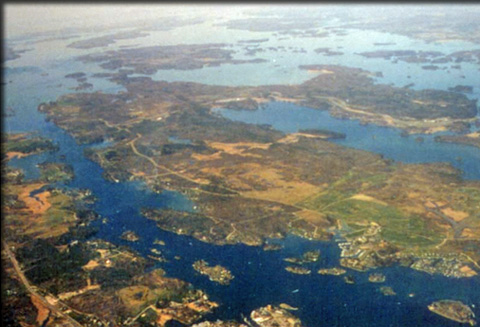
St. Lawerence River Thousand Islands
The upper St. Lawrence River consists of a complex array of habitats including over 1,800 islands, 2,000 shoals, and thousands of hectares of nearshore freshwater littoral habitats and coastal emergent wetlands. The St. Lawrence River is the only natural outlet to the Great Lakes, with a drainage basin of over 3/4 of a million square kilometers. It connects the Great Lakes to the Atlantic Ocean. It is the 10th largest river in the world in terms of flow with upper River average discharge of over 243,000 cfs!
The St. Lawrence River fish community contains a diverse array of fishes with nearly 50 species observed annually in surveys and around 85 species documented by TIBS and NYSDEC.
The St. Lawrence River is home to several popular sportfish including: muskellunge, northern pike, walleye, large mouth bass and smallmouth bass. Popular panfish species include yellow perch, rock bass, black crappie, and pumpkinseed and bluegill sunfish.
The ecosystem harbors a diverse array of aquatic and wetland plants and several NYS threatened and endangered species; examples include the lake sturgeon, pugnose shiner, common tern, bald eagle, and Blanding’s turtle. Many notable invasive species have affected the ecosystem in recent decades including dreissenid mussels, round goby, and viral hemorraghic septicemia (VHSv).