SUNY ESF
The American Chestnut Research & Restoration Project at ESF

Darling 54 Has Cleared a Major Federal Hurdle
The USDA has officially deregulated the blight-tolerant American chestnut developed at ESF, with the Animal and Plant Health Inspection Service concluding that it is unlikely to pose a greater plant pest risk than its unmodified counterpart. The decision follows a six-year federal review and removes a significant barrier on the road to restoration. While additional EPA review is still ahead before the trees can be distributed or used in wider restoration projects, today's milestone is a moment worth celebrating for everyone who has worked toward it, as ESF's announcement and American Chestnut Restoration's statement both detail.
Mission Statement
The mission of the American Chestnut Research and Restoration Project at the State University of New York College of Environmental Science and Forestry (ESF) is to conduct basic and applied research that will lead to the development of blight-tolerant American chestnut trees (Castanea dentata). Our goal is to reintroduce a population of these tolerant trees back into forest ecosystems of the eastern United States.
Overview
The American Chestnut Project has evolved from basic research into a multifaceted endeavor, including identifying plant pathogen tolerance-enhancing genes, developing American chestnut tissue culture, field testing chestnut trees, encouraging public participation through the identification of rare remnant surviving chestnut trees, collecting and exchanging viable nuts, and establishing large restoration plantations throughout New York State.
Ongoing activities include basic research on various single and pyramided tolerant-enhancing gene designs, identifying genes associated with Asian chestnut tolerance, chestnut tissue culture and gene transfer into American chestnut trees, determining genetic diversity in surviving remnant chestnut populations, greenhouse and field testing of putative resistant transgenic trees, collecting rare chestnut germplasm, and establishing germplasm archives throughout New York.
The concepts, techniques, and gene cassettes we develop for the American chestnut will have broad applications in managing diseases affecting other important tree species such as Dutch-elm disease and elm yellows (which devastated another American heritage tree, the American elm, Ulmus americana) and an emerging threat called Beech Leaf Disease (which is rapidly spreading on American beech trees throughout the eastern US.
Darling Chestnuts
Our project has produced an American chestnuts variety with enhanced blight tolerance using genetic engineering. Current varieties, referred to as 'Darling' chestnuts, shows enhanced tolerance to chestnut blight thanks to a common gene that we inserted into their genome. We hope to return these trees can be returned to their historic native range, to benefit people and local ecosystems once again.
Darling chestnuts are undergoing federal regulatory review which is required before a transgenic plant can be released. In the meantime, we are continuing research on other lines and working to scale-up our capacity to produce and distribute trees once we have regulatory approval. Much of this work is being done in collaboration with several partners including the American Chestnut Restoration, Inc.
You can find updates on the regulatory status of Darling chestnuts on our Regulatory Status page.
The Passing of Dr. Bill Powell and Dr. Chuck Maynard
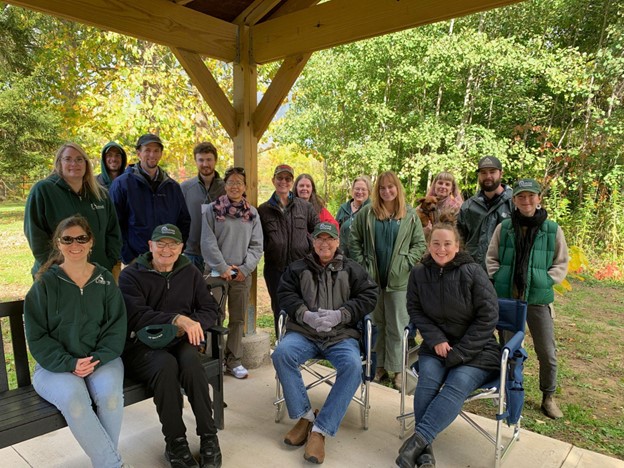
The American Chestnut Research and Restoration Project is saddened to share the news of the passing of project co-founders Bill Powell (November 2023) and Chuck Maynard (February 2024). Bill and Chuck founded the American Chestnut Research and Restoration Project in 1989 with a goal of bringing the American chestnut tree back from the brink of extinction. They both devoted their careers to this cause, with Chuck retiring in 2016 and Bill retiring in 2022. With Bill’s retirement, Dr. Andy Newhouse was appointed director of The American Chestnut Research and Restoration Project. The project continues to build on the transformative contributions from Bill and Chuck to realize the goal of restoring the iconic American chestnut tree to the landscape.
Contact Us
Do you have a question or would you like to know more about the American Chestnut Project?
Are you interested in being added to our notification list to receive news about the regulatory status of our trees?
Do you represent an organization (arboretum, botanical garden, educational or research institution, land managing organization, etc.) that is interested in working with us?