Farrell
, John M.
Senior Research Associate and the Director of the Thousand Islands Biological Station
PhD, SUNY College of Environmental Science and Forestry, 1998. Fisheries Science and Management, Aquatic Ecology, Wetlands Restoration,
Invasive Species.
253 Illick Hall
SUNY-ESF
1 Forestry Drive
Syracuse, NY 13210
Email: jmfarrell@esf.edu
Telephone: (315) 470-6990
Fax: (315) 470-6934
Teaching
- EFB 797 Aquatic Ecology and Management (1 credit) - A graduate level seminar on various topics designed to enhance students abilities in aquatic ecology and management in their areas of interest. Seminars have been held on to the process of publishing peer-reviewed literature with consideration of approach, experimental and study designs, statistical analyses, and interpretation and presentation of findings.
- EFB 681 Aquatic Ecosystem Restoration and Enhancement (2 credits) - The guiding principles for ecological restoration of freshwater aquatic ecosystems focusing on effects of nutrient loading, sedimentation, flow alteration, and habitat loss. Factors leading to loss of aquatic resources and the effectiveness of techniques to restore habitat and fauna are analyzed. Student presentation of a case study and field excursions to perturbed areas and recent restoration projects are required.
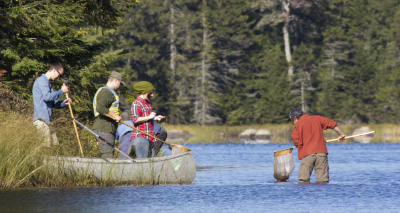
- EFB 388 Ecology of Adirondack Fishes (3 credits) - co-taught with Dr. Neil Ringler - An introduction to field-based fish ecology and management of the Adirondack and St. Lawrence River regions. Extensive field based experience with various sampling procedures and fisheries investigation techniques. Classroom and laboratory experience on introduction to theory, concepts leading to individual projects regarding aspects of local/regional questions. Taught at the Cranberry Lake Biological Station www.esf.edu/clbs with field excursions to the Salmon River and the Thousand Islands Biological Station www.esf.edu/tibs.
Research Interests
My interests revolve around the broad topic of aquatic ecology and management of aquatic resources. I am interested in developing biological understanding to improve management and stewardship. Much of my research is focused on fish ecology, coastal wetland ecology and environmental problems facing the upper St. Lawrence River, a major north-temperate river ecosystem.
Recent Publications
- Farrell, J. M., C. Skov and A. P. Nilsson. 2008. Preface to an International Pike Symposium: Merging Knowledge of Ecology, Biology, and Management for a Circumpolar Species. Hydrobiologia 601:1-3.
- Murry, B. A., J. M. Farrell, M. K. Schulz, and M. Teece. 2008. The effect of egg size and nutrient content on larval performance: implications to protracted spawning in northern pike (Esox lucius Linnaeus, 1758). Hydrobiologia 601:71-82.
- Cooper, J.E., J.V. Mead, J. M. Farrell, and R. G. Werner. 2008. Coexistence of pike (Esox lucius) and muskellunge (E.masquinongy) during early life and the implications of habitat change. Hydrobiologia 601:41-53.
- Nilsson, C. Skov, and J. M. Farrell. 2008. Current and future directions for pike ecology and management: a summary and synthesis. Hydrobiologia 601:137-141.
- Farrell, J. M., R. M. Klindt, J. M. Casselman, S. R. LaPan, R. G. Werner, and A. Schiavone. 2007. Development, implementation, and evaluation of an international muskellunge management strategy for the upper St. Lawrence River. Environmental Biology of Fishes 79:111-123.
- Murry, B. A., and J. M. Farrell. 2007. Quantification of native muskellunge nursery: influence of body size, fish community composition, and vegetation structure. Environmental Biology of Fishes 79:37-47.
- Smith, B. V., J. M. Farrell, H. B. Underwood, and S. Smith. 2007. Year class strength of St. Lawrence River northern pike. North American Journal of Fisheries Management 27:481-491.
- Farrell, J. M., J. V. Mead, and B. A. Murry. 2006. Protracted spawning of St. Lawrence River northern pike (Esox lucius): simulated effects on survival, growth, and production. Ecology of Freshwater Fish 15:169-179.
- Bosworth, A., and J. M. Farrell. 2006. Genetic divergence among northern pike from spawning locations in the Upper St. Lawrence River. North American Journal of Fisheries Management 26:676-684.
- Murry, B. A., J. M. Farrell, P. Smyntek, and M. Teece. 2006. Effect of lipid extraction on the interpretation of fish community trophic relationships determined by stable carbon and nitrogen isotopes. Canadian Journal of Fisheries and Aquatic Sciences 63:2167-2172.
Graduate Students Past and Present
- Geof Eckerlin, PhD (began 1/09); MS (completed 12/08) Effects of viral hemorraghic septicemia (VHS) on smallmouth bass during ontogeny: the role of condition and stress on susceptibility and virulence.
- Jarrod Hughes, MS (began 1/08), Restoration of critical reproductive habitat for walleye.
- Kevin Kapusinski, PhD (began 8/06), Great Lakes muskellunge (Esox masquinongy) genetic structure, reproductive ecology, and interaction with invasive round goby (Neogobius melanostomus) and rudd (Scardinius erythrophthalmus)
- Scott Schluter, MS (in progress), Movements and habitat use of stocked Lake sturgeon in the Oswegatchie River, NY. (Currently with US Fish and Wildlife Service)
- Alison Halpern, PhD (in progress), co-advised with Dr. Donald Leopold. Effects of hydrologic management and introduced European Frog's-Bit (Hydrocharis morsus ranae) on coastal wetland vegetation communities. (currently Executive secretary of the WA State Noxious Weed Control Board)
- Katie Woodside, MS (completed 5/09), Development and application of models predicting young of the year muskellunge presence and abundance
- Brian Kelder, MS (completed 5/08) Walleye spawning site selection in a Lake Ontario tributary: A predictive tool to guide management (currently a Fisheries Scientist
through the Environmental Defense Fund Puleston Fellow at the Seatuck Environmental Association)
- Brent Murry, PhD (completed 12/06), Early life history and community structure of large river fishes. (Currently Research Assistant Professor in the Department of Biology, Central Michigan University)
- Jason A. Toner, MS (completed 5/06), Muskrat house abundance and cattail use in the upper St. Lawrence River: modeling the effects of water level regulation. (currently an Environmental Science teacher at Nottingham High in Syracuse)
- Thomas Hughes, MPS (completed 5/06), Walleye populations in eastern Lake Ontario and the St. Lawrence River. (currently employed as a Natural Resources Biologist with the NYS Office of Parks, Recreation, and Historic Preservation)
- Aaron D. Bosworth, MS (completed 8/04), Northern pike spawning strategy in the upper St. Lawrence River: empirical evidence using microsatellite markers. (currently Regional Fisheries Manager with Washington Department of Fish and Wildlife)
- Molly Beland (Rippke), MS (completed 12/03), Holocene vegetation dynamics of an upper St. Lawrence River coastal wetland and surrounding uplands: effects of climate change and anthropogenic disturbance. (currently Biologist with Michigan Department of Environmental Protection)
- Molly A. Connerton, MS (completed 5/03), Double crested cormorant predation on northern pike in the Eastern basin of Lake Ontario and the upper St. Lawrence River. (Currently Biologist with the US Army Corp of Engineers)