ESF Logo
State University of New York
College of Environmental Science & Forestry

Faculty of Environmental & Forest Biology


Charlie and Myrna Hall
Charlie, along with wife Myrna,
teaches Systems Ecology and
Geographical Modeling courses
and  workshops at SUNY-ESF
and in many locations in
Latin America.

Charles A.S. Hall
Professor

354 Illick Hall
1 Forestry Drive
Syracuse, New York 13210
Phone: 315-470-6870
Fax: 315-470-6934
Email: chall@esf.edu

Oil from Algae? (Viewpoint in the journal BioScience)

Special issue of Sustainability on EROI

New Springer energy '100 pager' book series edited by Charles Hall

Depletion and Frakking Technology (C-Realm podcast)

It's About Stuff (C-Realm podcast)

Charles Hall Appears on the Discovery Channel VIDEO

2-hour radio interview summarizing Charlie's thoughts on energy and economics: "Its about stuff"

n y timesNew School of Thought Brings Energy to 'the Dismal Science' - New York Times Interview, 10/23/2009

Biophysical Economics website

Revisiting the Limits to Growth After Peak Oil American Scientist, Volume 97

Ecology in Times of Scarcity April 2009 / Vol. 59 No. 4, BioScience

Jean Laherrere

Global Environment Course Videos on iTunes U (must have iTunes installed)

EROI Institute (site upgrade underway - please visit Biophysical Economics website)

What do we really know about global oil resources? A journey to the source (Visit with Jean Laherrere)

Peak Oil, EROI & Your Financial Future - Powerpoint Lecture (PDF version)

What's New

Dr. Hall is one of the experts who took part in POWERING THE FUTURE, a four-hour special series produced by Discovery Studios, that premieres Saturday, July 17, from 8 to 10 PM and Sunday, July 18, from 8 to 10PM (ET/PT). Hosted by Dr. M. Sanjayan, lead scientist at The Nature Conservancy, the special closely examines where our energy could come from and how we are striving to create a clean, limitless, secure supply of energy. Hall was filmed in Peurto Rico and California.Special issue of Sustainability on EROI


TOP
PUBLICATIONS

Recent and some "classic" papers in each subject, in most cases with downloadable PDFs:

Energy | Economics | Ecology


TOP
RESEARCH

I am a systems ecologist, and all of my life's varied research reflects my interest in understanding and developing computer simulation models of how complex systems of nature and humans and nature operate. My original work was in relatively undisturbed rivers and lakes and then in estuaries. Subsequently, I became increasingly interested in studying systems of humans and nature using ecosystems perspectives, that is, by studying material and energy flows. Most of my work these days is in the tropics. Increasingly I am interested in synthesizing with my wife GIS and simulation modeling to make what we call geographic modeling. For example, I have recently completed a book synthesizing environmental, agricultural and economic information for the country of Costa Rica on a 1 km by 1 km grid cell basis. Nevertheless I continue to work on various aspects of natural tropical forest and temperate stream ecosystems. For example, may students (both grad and undergrad) and I have recently undertaken a new project in a Puerto Rican rain forest using professional free climbing equipment and a LiCor CO2 meter to measure photosynthesis and respiration of the forest at 100 meter altitudinal levels from the bottom to the top of the Luquillo Mountains.

My principal interest, always in energy, has recently been given a boost through private funding. We have established an EROI (Energy return on investment) Institute and are rapidly expanding our energy analyses, for example spatial analyses of corn ethanol net energy, EROI for global oil and gas production and modeling the US and global economy as peak oil comes and passes. You can see more information on my energy site.

My recent talk in PowerPoint EROI: definition, history and future implications (about 13 MB)

Another talk THE GREAT SCIENTIFIC COVERUP OF THE MOST IMPORTANT ISSUE IN WESTERN CIVILIZATION (about 48 MB)

For more information on one of my most recent publications go to AcademicPress (Quantifying Sustainable Development).

TOP
TEACHING

General:  I am interested in teaching about real, complex systems. My focus is ecosystems, including human-dominated ecosystems that are generally taught (incompletely, I feel) within the aegis of economics. I believe in lecturing interspersed with Socratic interactions and hands-on application of ideas and procedures. The reading and homework assignments for my courses tend to be intense, and I have written the textbooks for each of my courses. I love teaching at ESF because our students (who range in brightness from very to moderate) all know why they are in my classes, want very much to learn what I am teaching, and almost all will go on in fields related to what I teach.

Graduate Program:  I have a very active and international graduate student program. Presently I have students from the U.S., China, Ecuador, Germany, Korea, Mexico and Thailand. Nearly all use computers and GIS very intensively. Projects are in pure ecology (often of tropical forests or streams) or in examining the relation of humans and resources. In the past, my programs have been well funded and many of my students have been supported, but Federal and State cutbacks are making it much more difficult to support graduate students. Thus, increasingly, my students have to bring their own support.

EFB 496, Section 6, Topics in Environment and Forest Biology, Fall 2004 Top
Syllabus (Word format)

EFB 516 - Ecosystems - 3 credits - Spring Top
This course is about ecosystems, what they are, where different types are found and about the ways that the physical environment has led to the specific types of ecosystems found in different parts of the globe. Specific sections in energy flow and nutrient cycling follow. The second half of the course examines specific ecosystems types in some depth. Generally I focus on estuaries and tropical forests for this part, these being the ecosystem types I am most familiar with.

EFB 518 - Systems Ecology - 4 credits - Fall Top
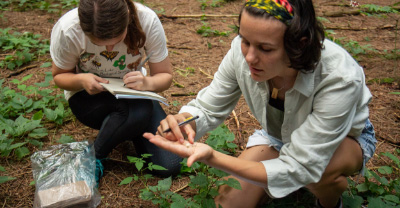
Not for the faint-hearted or the lazy. Systems Ecology introduces the student to a whole new philosophy for thinking about and analyzing nature. One product is the learning of how to develop your own computer models of nature. "Modeling is the formalization and testing of our assumptions about how a system works." We start with a two-day field trip where we study the energy budget of an upstate New York forest or (generally) stream. Then for the rest of the semester the students are given increasingly complex computer-based assignments in which they build models from that data. The final product is your own computer model of a subject of your interest. This course is often followed by my wife's course on geographical modeling, which combines modeling with GIS.

EFB 522 - Environment, Resources and Development - 2 credits Top
This course is about the ecology of human-dominated ecosystems including cities, agricultural areas, fisheries and so on. In some respects it is a synthesis of ecology and economics, although it would be incorrect to call it ecological economics. Basically, after a review of concepts of value and of neoclassical economics, we examine the strengths and weaknesses of using ecosystems procedures (i.e., analyzing energy and material flows and their control) to study human-dominated systems.

lu4b.jpg (10564 bytes)
Human-dominated landscape in Costa Rica

TOP
SERVICE

Most of my service activity is oriented towards teaching and research activity in the developing world, especially Latin America. I have taught Systems Ecology and Geographical Modeling (with my wife Myrna) in Argentina, Bolivia, China, Costa Rica and Mexico. I have also run workshops and seminar series in Italy, Finland and Sweden. I have done limited consulting work on many things, including NAFTA, fisheries, impacts of power facilities and so on. I am on the editorial board of Ecological Economics and was recently on the Editorial Board of Conservation Ecology and served as the representative of the Ecological Society of America to the American Association for the Advancement of Science.

TOP
SOFTWARE

My DOS-based Costa Rica Land Use, Agriculture, and Environmental Simulation is available for download (364 KB).  Simply click on the following link, save the self-extracting file to your hard drive, then execute the file to expand it.  Check out the READ.ME file for details on how to run the simulation.

TOP
Main project at present

Building a new energy course and an EROI Institute. For example you can visit a series of recent papers summarizing our energy return on investment for various fuels by going to my publication list and looking under 2008.

DOWNLOAD COSTA RICA


Puerto Rican Rainforest
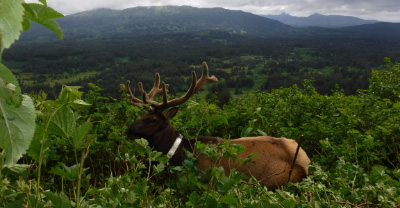
Tropical rainforest


"...all of my life's varied research reflects my interest in understanding and developing computer simulation models of how complex systems of nature and humans and nature operate."


| Return to EFB Faculty List | Return to EFB Home Page | Return to ESF Home Page |

| Return to ENERGY | Return to Systems Ecology Lab | Return to Wei's Climate Modeling |

| Return to Luquillo Experimental Forest Site |