esficon.gif (5641 bytes) State University of New York
                College of Environmental Science and Forestry


Department of Environmental and Forest Biology


gr_bannr.gif

Research

Publications

Links

Awards, Honors and Other

    Teaching

·    Hydroclimatic Effects on Ecosystem Response


Myron J. Mitchell

Distinguished Professor and Director of Council on Hydrologic Systems Science

Department of Environmental and Forest Biology
210 Illick Hall
1 Forestry Drive
SUNY-ESF
Syracuse, New York 13210-2788


Telephone (315) 470-6765
FAX (315) 470-6996
E-mail:
mitchell@syr.edu

 Myron.jpg (84728 bytes)


RESEARCH

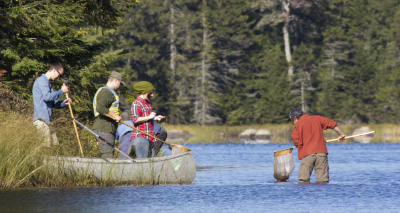
My research program is focused on biogeochemical cycles with an emphasis on forest ecosystems, but also includes work on freshwater. Recent work has included evaluations of the role of nitrogen, sulfur and other major elements in watersheds. This work has included a multidisciplinary approach that includes work with biogeochemistry, hydrology and stable isotopes. All of the projects are collaborative efforts including scientists at the College of Environmental Science and Forestry as well as other institutions including Cornell University, Hokkaido University (Japan), Institute of Ecosystem Studies, Kyoto University (Japan), Oregon State University, Technische Universitat Dresden (Germany), United States Geological Survey, University of Calgary (Canada), University of Maine, University of Waterloo (Canada), University of West Virginia, SUNY-Buffalo, SUNY-Cortland and Syracuse University. My research group is composed of graduate students, technicians and postdoctoral associates. Close cooperation and integration is an important goal in the research efforts of all members of the research team. Field research has included studies at the Huntington Forest in the Adirondack Mountains of New York, Catskill Mountains of New York, Tug Hill Region of New York, Hubbard Brook Experimental Forest in the White Mountains of New Hampshire, Red Canyon Creek in Wyoming, Croton Watershed of New York, Bear Brook Watershed in Maine, Oneida Lake and Lake Erie. I am also involved with doing regional comparisons of biogeochemical processes that most have recently focused on watersheds in the eastern United States, Japan and Europe. I have been a Visiting Professor at Kyoto University in Japan. I have also studied in Germany with support from the Deutscher Akademischer Austausch Dienst (DAAD).


PUBLICATIONS (>200)

Some Recent Examples:


Bushey, J.T., C.T. Driscoll, M.J. Mitchell, P. Selvendiran and M.R. Montesdeoca. 2009. Mercury transport following storm events from a northern forest landscape. Hydrological Processes (in press).


Campbell, J.L., L.E. Rustad, E.W. Boyer, S.F. Christopher, C.T. Driscoll, I.J. Fernandez, P.M. Groffman, D. Houle, J. Kiekbusch, A.H. Magill, M.J. Mitchell, and S.V. Ollinger. 2009. Consequences of climate change for biogeochemical cycling in forests of northeastern North America. Canadian Journal of Forest Research 39:264-284.


Inamdar, S.P., J. Rupp and M.J. Mitchell. 2009. Groundwater flushing of solutes at wetland and hillslope positions during storm events in a small glaciated catchment in western New York, USA. Hydrological Processes (in press).


Piatek, K.B., S.F. Christopher, and M.J. Mitchell. 2009. Spatial and temporal dynamics of stream chemistry in a forested watershed. Hydrological Earth Syst. Science 13:423-439.


Christopher, S.F., H. Shibata, M. Ozawa, Y. Nakagawa, and M. Mitchell. 2008. The effect of soil freezing on N cycling: Comparison of two headwater subcatchments with different vegetation and snowpack conditions in the northern Hokkaido Island of Japan. Biogeochemistry 88:15-30.


Mitchell, M.J., S.W. Bailey, J.B. Shanley and B. Mayer. 2008. Evaluating storm events for three watersheds in the northeastern United States: a combined hydrological, chemical and isotopic approach. Hydrological Processes 22:4023-4034.


Shanley, J.B., B. Mayer, M.J. Mitchell and S.W. Bailey. 2008. Annual and event variations in 34S values of stream sulfate in a Vermont forested catchment: implications for S sources and cycling. Science of the Total Environment 604:262-268.


Inamdar, S.P., J. Rupp and M.J. Mitchell. 2008. Differences in dissolved organic carbon (DOC) and nitrogen (DON) responses to storm-event and groundwater conditions in a forested western New York.  Journal of American Water Resources Association 44:1-16


Page, B.D., T.D. Bullen and M.J. Mitchell. 2008. Influences of calcium availability and tree species on the cycling of Ca isotopes in soil, vegetation, and stream water. Biogeochemistry 88:1-13.


Page, B.D. and M.J. Mitchell. 2008. Influences of a calcium gradient on soil inorganic nitrogen in the Adirondack Mountains, New York. Ecological Applications 1604-1614.


Page, B.D. and M.J. Mitchell. 2008. The influence of American basswood (Tilia Americana) and soil calcium concentrations on nitrification rates in a northern-hardwood forest. Canadian Journal of Forest Research 38:667-676.


Campbell, J.L., M.J. Mitchell, B. Mayer, P.M. Groffman and L.M. Christenson. 2007. Mobility of nitrogen-15-labeled nitrate and sulfur-34-labeled sulfate during snowmelt. Soil Science Society of America Journal 71:1934-1944.


Christopher, S.F., M.J. Mitchell, M.R. McHale, E.W. Boyer, D.A. Burns, C. Kendall. 2008. Factors controlling nitrogen release from two forested catchments with contrasting hydrochemical responses. Hydrological Processes 22:46-62.


Driscoll, C.T. K.M. Driscoll, M.J. Mitchell, D.J. Raynal, K. Roy. Impacts of Long-range Emissions of Air Pollution on Adirondack Ecosystems. 2008. In: W.P. Porter, R.S. Whaley and J.D. Erickson (eds.). Light from an Adirondack Prism: The Greater Experiment in Conservation Syracuse University Press, Syracuse, NY (in press).


Inamdar, S.P. and M.J. Mitchell. 2007. Contributions of riparian and hillslope waters to storm runoff across multiple catchments and storm events in a glaciated forested watershed. Journal of Hydrology 341: 116-130.


Inamdar, S.P. and M.J. Mitchell. 2007. Storm event exports of dissolved organic nitrogen (DON) across multiple catchments in a glaciated forested watershed. Journal of Geophysical Research 112, G02014, 18 p.


Inamdar, S.P. and M.J. Mitchell. 2007. Sulfate exports from multiple catchments in a glaciated forested watershed in western New York, USA. Environmental Monitoring and Assessment 139:227-245.


Ito, M., M.J. Mitchell, C.T. Driscoll, R.M. Newton, C.E. Johnson, and K.M. Roy. 2007. Controls on surface water chemistry in two lake-watersheds in the Adirondack region of New York: differences in nitrogen solute sources and sinks. Hydrological Processes 21:1249-1264.


Lovett, G.M., D.A. Burns, C.T. Driscoll, J.C. Jenkins, M.J. Mitchell, L. Rustand, J.B. Shanley, G.E. Likens and R. Haeuber. 2007. Who Needs Environmental Monitoring? Frontiers in Ecology and the Environment 5:253-260.


McGee, G.G., M.J. Mitchell, D.J. Leopold and D.J. Raynal. 2007. Comparison of soil nutrient fluxes from tree-fall gap zones of an old-growth northern hardwood forest. Journal of Torrey Botany Society 134:269-280.


McGee, G.G., M.J. Mitchell, D.J. Leopold, D.J. Raynal and M.O. Mbila. 2007. Relationships among forest age, composition and elemental dynamics of Adirondack northern hardwood forests. Journal of Torrey Botany Society 134:253-268.


Mitchell, M.J. and C. Alewell.  2007.  Sulfur Transformations and Fluxes.  P. 757-764 In: W. Chesworth (ed.) The Encyclopedia of Soil Science Springer-Verlag. Dordrecht.


Novák, M.,  M.J. Mitchell, I. Jahttp://pubs.acs.org/images/entities/ccaron.gifková, F. Buzek, J. Schweigstillová, L. Erbanová, R. Phttp://pubs.acs.org/images/entities/rcaron.gifikryl, and D. Fottová. 2007. Processes affecting oxygen isotope rations of atmospheric and ecosystem sulfate in two contrasting forest catchments in Central Europe. Environmental Science and Technology 41(3):703-709.


Schroth, A.W., B.C. Bostick, M. Graham, J.M. Kaste, M.J. Mitchell and A.J. Friedland. 2007. Sulfur species behavior in soil organic matter during decomposition. J. Geophys. Res. 112.G04011,doi:10.1029/2007JG000538.


Campbell, J., M.J. Mitchell and B. Mayer. 2006. Isotopic assessment of NO3- and SO42- mobility during winter in two adjacent watersheds in the Adirondack Mountains, New York. J. Geophys. Res. 111, GO4007.


Christopher, S.F., B.D. Page, J.L. Campbell and M.J. Mitchell. 2006. Contrasting biogeochemistry in two adjacent catchments: The contributions of soil Ca and forest vegetation in affecting spatial and temporal patterns of NO3 in surface waters. Global Change Biology 12:364-381.


Inamdar, S.P. and M.J. Mitchell. 2006. Hydrologic controls of storm-event exports of dissolved organic carbon (DOC) and nitrate across catchment scales. Water Resources Research, 42, Wo3421, doi:10.1029/2005WR004212, 16 p.


Inamdar, S.P., N. O’Leary, M.J. Mitchell, J.T. Riley. 2006. The impact of storm events on solute exports from a glaciated forested watershed in western New York, USA. Hydrological Processes 20:3423-3439.


Mitchell, M.J., K.B. Piatek, S. Christopher, B. Mayer, C. Kendall and P. McHale. 2006. Solute sources in stream water during consecutive fall storms in a northern hardwood forest watershed: a combined hydrological, chemical and isotopic approach. Biogeochemistry 78:217-246.


Ogawa, A., H. Shibata, K. Suzuki, M.J. Mitchell and Y. Ikegami. 2006. Relationship of topography to surface water chemistry with particular focus on nitrogen and organic carbon solutes within a forested watershed in Hokkaido, Japan. Hydrological Processes 20:251-265.


Campbell, J.L., M.J. Mitchell, P.M. Groffman, L.M. Christenson. 2005. Winter in northeastern North America: an often overlooked but critical period for ecological processes. Frontiers in Ecology 3(6):314-322.


Hafner, S.D., P.M. Groffman, and M.J. Mitchell. 2005. Leaching of dissolved organic carbon, dissolved organic nitrogen, and other solutes from coarse woody debris and litter in a mixed forest in New York State. Biogeochemistry 74:257-282.


Ito, M. M.J. Mitchell, C.T. Driscoll and K.M. Roy. 2005. Factors affecting acid neutralizing capacity in the Adirondack region of New York: a solute mass balance approach. Environmental Science and Technology 39:4076-4081.


Ito, M., M.J. Mitchell, C.T. Driscoll and K.M. Roy. 2005. Nitrogen input-output budgets for lake-watersheds in the Adirondack region of New York. Biogeochemistry 72:283-314.


Mitchell, M.J. 2005. Review of Book: “E. Matzner (editor): Biogeochemistry of forested Catchments in A Changing Environment, A German Case Study”, Journal of Plant Nutrition and Soil Science 168:145-146.


Park, J.H., M.J. Mitchell, C.T. Driscoll. 2005. Winter-time climatic control on dissolved organic carbon export and surface water chemistry in an Adirondack forested watershed. Environmental Science and Technology 39:6993:6998.


Piatek, K.B., M.J. Mitchell, S.R. Silva and C. Kendall. 2005. Sources of nitrate in Adirondack surface water during dissimilar snowmelt events.  Water, Air and Soil Pollution 165:13-35.


Shanley, J.B., B. Mayer, M.J. Mitchell, R.L. Michel, S. Bialey and C. Kendall. 2005. Tracing sources of streamwater sulfate during snowmelt using S and O isotope ratios. Biogeochemistry 76:161-185.


Watmough, S.A., J. Aherne, C. Alewell, P. Arp, S. Bailey, T. Clair, P. Dillon, L. Duschesne, C. Eimers, I. Fernandez, N. Foster, T. Larsson, E. Miller, M.J. Mitchell and S. Page. 2005. Sulphate, nitrogen and base cation budgets at 21 forested catchments in Canada, the United States and Europe. Environmental Monitoring and Assessment 109:1-36.


Bailey, S.W., B. Mayer, and M.J. Mitchell.  2004. Evidence for the influence of mineral weathering on stream water sulphate in Vermont and New Hampshire. Hydrological Processes18:1639-1653.


Campbell, J.L., J.W. Hornbeck, M.J. Mitchell, M.B. Adams, M.S. Castro, C.T. Driscoll, J.S. Kahl, J.N. Kochenderfer, G.E. Likens, J.A. Lynch, P.S. Murdoch, S.J. Nelson and J.B. Shanley.  2004.  Input-output budgets of inorganic nitrogen for 24 forest watersheds in the northeastern United States: A review.  Water, Air and Soil Pollution 151:373-396.


Chen, L., C.T. Driscoll, S. Gbondo-Tugbawa, M.J. Mitchell and P.S. Murdoch.  2004.  The application of an Integrated Biogeochemistry Model (PnET-BGC) to five forested watersheds in the Adirondack and Catskill Regions of New York.   Hydrological Processes 18:2631-2650.


Inamdar, S., S.F. Christopher and M.J. Mitchell.  2004.  Export mechanisms for dissolved organic carbon and nitrate during summer storm events in a glaciated forested catchment in New York, USAHydrological Processes 18:2651-2661.


 Lovett, G.M. and M.J. Mitchell. 2004. Sugar maple and nitrogen cycling in the forests of eastern North America. Frontiers in Ecology and the Environment 2:81-88.


Mitchell, M.J. and C.T. Driscoll (eds). 2004. Special Issue: Interrelationships between atmospheric deposition and landscape features of forest catchments in regulating surface water biogeochemistry. Hydrological Processes 18:2615-2755.


Driscoll, C.T., K.M. Driscoll, M.J. Mitchell and D.J. Raynal.  2003.   Effects of acidic deposition on forest and aquatic ecosystems in New York State .   Environmental Pollution123:327-336.


Driscoll, C.T., K.M. Driscoll, K.M. Roy and M.J. Mitchell.  2003.   Chemical response of lakes in the Adirondack region to declines in acidic depositionEnvironmental Science and Technology 37:2036-2042.


Fitzhugh, R.D., G.E. Likens, C.T. Driscoll, M.J. Mitchell, P.M. Groffman, T.J. Fahey and J.P. Hardy.  2003.  The role of soil freezing events in interannual patterns of stream chemistry at the Hubbard Brook Experimental ForestEnvironmental Science and Technology 37:1575-1580.


Forrester, J.A., G.G. McGee and M.J. Mitchell.  2003.  Effects of beech bark disease on aboveground biomass and species composition in a mature hardwood forest, 1985 to 2000Journal of Torrey Botanical Society 130:70-78.


Ito, M., M.J. Mitchell and C.T. Driscoll.  2003.  Response to Discussion on "spatial patterns of precipitation quantity and chemistry and air temperature in the Adirondack region of New York."  Atmospheric Environment 37:135-138.


McHale, M.R., C.P. Cirmo, M.J. Mitchell and J.J. McDonnell.  2004.   Wetland nitrogen dynamics in an Adirondack forested watershedHydrological Processes 18:1853-1870.


Mitchell, M.J.  2003.  Episodic Acidification.  In: Jay H. Lehr and Jack Keeley (eds).  Encyclopedia: Surface and Agricultural Water.  John Wiley and Sons. P.3-5.


Mitchell, M.J., C.T. Driscoll, S. Inamdar, G. McGee, M. Mbila and D. Raynal.  2003.  Nitrogen biogeochemistry in the Adirondack Mountains of New York: hardwood ecosystems and associated surface waters.   Environmental Pollution 123:355-364.


Park, J., M.J. Mitchell, P.J. McHale, S.F. Christopher and T.P. Myers.   2003.  Impacts of changing climate and atmospheric deposition on N and S biogeochemistry in a forested watershed of the Adirondack Mountains, New York State.   Global Change Biology 9:1602-1619.


Christenson, L.M., G.M. Lovett, M.J. Mitchell and P.M. Groffman.   2002.  The fate of nitrogen in gypsy moth frass deposited to an oak forest floorOecologia 131:444-452.


Gbondo-Tugbawa, S.S., C.T. Driscoll, M.J. Mitchell, J.D. Aber and G.E. Likens.  2002.  A model to simulate the response of a northern hardwood forest ecosystem to changes in S deposition.   Ecological Applications 12:8-23.


Ito, M., M.J. Mitchell and C.T. Driscoll.  2002.  Spatial patterns of precipitation quantity and chemistry and air temperature in the Adirondack Region of New YorkAtmospheric Environment 36:1051-1062.


Likens, G.E., C.T. Driscoll, D.C. Buso, M.J. Mitchell, G.M. Lovett, S.W. Bailey, T.G. Siccama, W.A. Reiners, C. Alewell.  2002.  The biogeochemistry of sulfur at Hubbard BrookBiogeochemistry 60:235-316.


Lovett, G.M., L.M. Christenson, P.M. Groffman, C.G. Jones, J. Hart and M.J. Mitchell.  2002. Insect defoliation and nitrogen cycling in forests.   BioScience 52:335-341.


McHale, M.R., J.J. McDonnell, M.J. Mitchell and C.P. Cirmo.  2002.   A field based study of soil- and groundwater nitrate release in an Adirondack forested watershedWater Resources Research 38 (4):1029/2000WR000102 (17 pages).


Mitchell, M.J., G. McGee, P. McHale and K.C. Weathers. 2001. Experimental design and instrumentation for analyzing solute concentrations and fluxes for quantifying biogeochemical processes in watersheds. Paper Presented at The 4th International Conference on Long Term Ecological Research (LTER) in East Asian and Pacific Region, Lake Hovsgol, Mongolia, July 2-5, 2001. (http://www.esf.edu/hss/mongolia/)


TEACHING

I teach undergraduate and graduate courses in Environmental Biogeochemistry. I have also led a variety of seminars on topics ranging from historical analysis to isotope use. I teach an undergraduate seminar in ecology.


Current Courses:

EFB 415 Ecological Biogeochemistry

EFB 610 Ecological Biogeochemistry

EFB 497 Ecology Seminar


Cross-disciplinary Seminar in Hydrological and Biogeochemical Processes

Semester 2008

4:00 – 5:00 p.m.

Moon 110 (ESF Campus)


·    Schedule


Awards and Honors

Visiting Scholar for The University of Calgary (1983); Fulbright Travel Fellowship to New Zealand (1983-1984); Fellow of the American Association for the Advancement of Science (1992); Sigma Xi Outstanding Faculty Research Award (1994);  Visiting Professor, Kyoto University, Japan (1996); Co-chair for Gordon Conference on Hydrobiogeochemistry of Forested Catchments (1997); SUNY Chancellor's Research Recognition Award (2002);Deutscher Akademischer Austausch Dienst (2004); Exemplary Researcher Award by SUNY-ESF (2006).


Other

Ecology Panel, NSF (1989-1992); Board of Directors of Upstate Freshwater institute (1989-present); Bristol-Myers Squibb Community Advisory Council (1997-2003);  Chair of EFB Committee on Promotion and Tenure (1997-1999);  Environmental Geochemistry and Biogeochemistry Panel, NSF (1999). Ecosystem Panel, NSF (2000-2004); Northeast Ecosystem Research Cooperative, member of coordination committee (2000-2004); Consortium of Universities for the Advancement of Hydrologic Sciences, Incorporated (CUAHS), alternate representative for ESF (2001-present); Leader of Urban Ecosystems Integrated Systems Development Team of New York Environmental Quality Systems Center (2001-present);  Graduate Program Director of EFB (2002-2007); Member of International Scientific Committee for Acid Rain 2005 (Prague, Czech Republic); Board Member of Research Foundation of State of New York (2005-present); Member of the EPA's Clean Air Scientific Advisory Committee (CASAC) Review Panel on Secondary Standards for NOx and SOx (2007-present); Commissioner on NYS Governor's Commission on Higher Education (2007-present); Member of SUNY Higher Education Advisory Committee (2007-present).


OTHER LINKS FOR M.J. MITCHELL


 Council on Hydrologic Systems Science


Biogeochemical and Hydrological Research at Huntington Forest


Real Time Data Monitoring

Hubbard Brook Experimental Forest

Upstate Freshwater Institute (UFI)

Croton Watershed of New York


http://www.esf.edu/image/gr_bannr.gif

Gr_ball.gif (209 bytes)  Back to EFB faculty list