Home | Gateways | Academics | Admission | Directories | Site Index SEARCH:

Quantitative Methods in Forest Science and Management
M.S., M.P.S. & Ph.D.

Quantitative techniques are useful in managing forest resources and conducting research on forests. The developed topics of emphasis within the Quantitative Methods (QM) Study Area in the Department of Forest and Natural Resources Management are:

Natural resource sampling

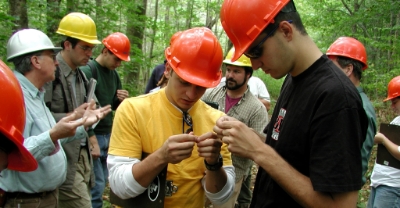
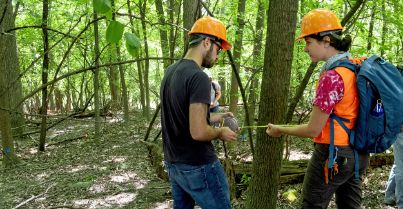
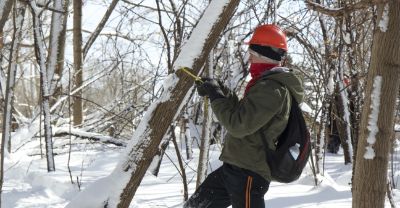
Natural resource sampling is the science of collecting and analyzing data to describe collective properties of populations. These populations may be forest stands, lakes, wetlands, stream segments, plant or animal populations, environmental organizations, or recreational users. Sampling objectives typically address questions of status (current values of population attributes) and/or trends (persistent change over time). Sampling applications span a range of spatial and temporal scales from a one-time inventory to estimate timber volume or residual stand damage to long-term monitoring of natural resources over extensive geographic regions. Potential research areas extend beyond traditional forest inventory methods to include environmental monitoring, urban forest sampling, sampling for landscape characterization and change, and map accuracy assessment. Collaborative research and learning opportunities may be created with ESF's strong programs in plant ecology, conservation biology, wildlife biology, remote sensing, and geographic information technology.

Operations analysis and optimization models

Study in operations analysis and optimization models focuses on the development and use of analytical and quantitative techniques to support decision-making for the management of forested ecosystems. Computer simulation and other analysis techniques facilitate understanding of both the bio-physical and socio-economic aspects of ecosystem function, as well as providing a means of investigating the interactions between these two and other aspects of ecosystem function. Optimization models including control or game theory and linear, integer, non-linear, and dynamic programming provide guidance in forest ecosystem decision-making by identifying efficient and feasible means of allocating scarce resources. The primary goal of our work is the application of operations analysis and optimization models to practical forest ecosystem management problems. Study in operations analysis and optimization models draws on courses and faculty both within the QM study area and elsewhere at ESF and Syracuse University. Often students decide to combine several QM interest topics to form their plan of graduate study (e.g., operations analysis and sampling, optimization models and forest growth and yield modeling).

Forest growth and yield modeling

Forest growth and yield (G&Y) models are tools used by forest managers to estimate the current and future status of the forest resources they are managing in order to understand the interactions between the bio-physical capacity of forest ecosystems and management activities. The primary goal of G&Y research within the QM study area is the development and application of statistical methods and techniques used to predict how forest stands and individual trees change over both temporal and spatial scales. This research has focused on:

  • Traditional approaches to forest G&Y modeling, including yield tables, volume equations and developing allometric relationships,
  • Modeling competition-density effects on stand yield,
  • Understanding the role of competition on the growth between and within individual trees,
  • Investigating the effects of silvicultural treatments, including fertilization, thinning, vegetation control and site preparation, on forest growth, and
  • Modeling the spatial distribution within and temporal dynamics of mixed-species stands.

Students interested in G&Y research will draw on courses within the QM study area, elsewhere at ESF, and at the SU Applied Statistics Program. Students can combine studies in G&Y modeling with several other QM interest topics to form their plan of graduate study.

Participating Faculty:

Bevilacqua, Eddie, Associate Professor
Forest Mensuration, Tree-ring Analysis, Applied Statistics, Growth and Yield Modeling
301 Bray Hall. 315-470-6697, ebevilacqua@esf.edu

Newman, David, Professor, Chair
Forest Resources Economics and Policy
320 Bray Hall, 315-470-6534

Stehman, Stephen V., Professor
Statistics, Environmental Sampling, Map Accuracy Assessment
322 Bray Hall, 315-470-6692, svstehma@mailbox.syr.edu

Wagner, John E., Associate Professor and Graduate Education Coordinator
Forest Resource Economics
304 Bray Hall. 315-470-6971, jewagner@esf.edu

Zhang, Lianjun, Professor
Forest Biometrics, Quantitative Silviculture
323 Bray Hall, 315-470-6558, lizhang@esf.edu

The QM Study Area has a limited number of teaching assistantships and the competition for this funding is very intense. Consequently, most graduate students are funded through research assistantships. The research assistantships are usually a part of a research grant received by one of our faculty members. For more information on the availability of these research assistantships, please contact the individual faculty members listed above.

Contact Us

John E. Wagner
Associate Professor of Forest Resource Economics
Graduate Education Coordinator - FNRM
320 Bray Hall, One Forestry Drive
Syracuse, NY 13210-2788
Phone: (315) 470-6971
Fax: (315) 470-6535


State University of New York College of Environmental Science and Forestry
SUNY-ESF | 1 Forestry Drive | Syracuse, NY 13210 | 315-470-6500
Copyright © 2008 | Information | Webmaster