SUNY ESF
Soil Respiration Between Roots and Decomposers

Differentiating Soil Respiration Between Roots and Decomposers
By Kikang Bae, SUNY ESF, PhD
This provides an update to: soil respiration in young and old stands in northern hardwood forests, NH.
Background
 The northeastern United States has been receiving dramatically elevated nitrogen deposition
for many decades. This chronic fertilization could result in increase forest growth
and carbon sequestration. Soil carbon storage is expected to increase as a result
of N pollution, but changes in soil pools are difficult to measure. Instead, we studied
carbon fluxes. We measured soil respiration (the loss of carbon from soils by root
respiration and microbial respiration, or decomposition) in sites with N addition
treatments. We distinguished the response of root respiration from that of decomposers
by creating plots free of tree roots by trenching.
The northeastern United States has been receiving dramatically elevated nitrogen deposition
for many decades. This chronic fertilization could result in increase forest growth
and carbon sequestration. Soil carbon storage is expected to increase as a result
of N pollution, but changes in soil pools are difficult to measure. Instead, we studied
carbon fluxes. We measured soil respiration (the loss of carbon from soils by root
respiration and microbial respiration, or decomposition) in sites with N addition
treatments. We distinguished the response of root respiration from that of decomposers
by creating plots free of tree roots by trenching.
Methods
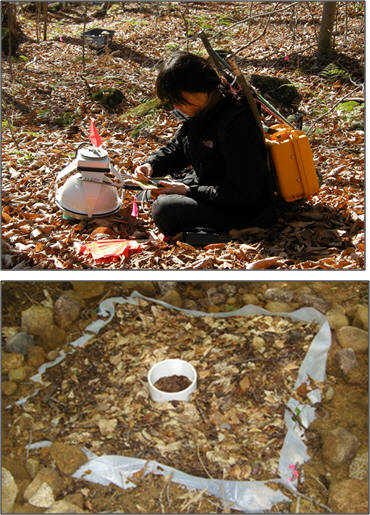
Soil respiration was measured every three to four weeks from May to October using an IRGA system (LI-8100, see above right). In each stand, 5 points were measured in each of four plots (control, N, P, and N+P treatments Stands were in the Bartlett Experimental Forest (BEF), Hubbard Brook Experimental Forest (HB) and Jeffers Brook (JB), in stands of different ages at each of the three sites. One trench (1.8 x 1.8 m, 50 cm depth) was dug per plot in BEF and JB in 2010 to sever and exclude roots from future measurement (see below right).
Results:
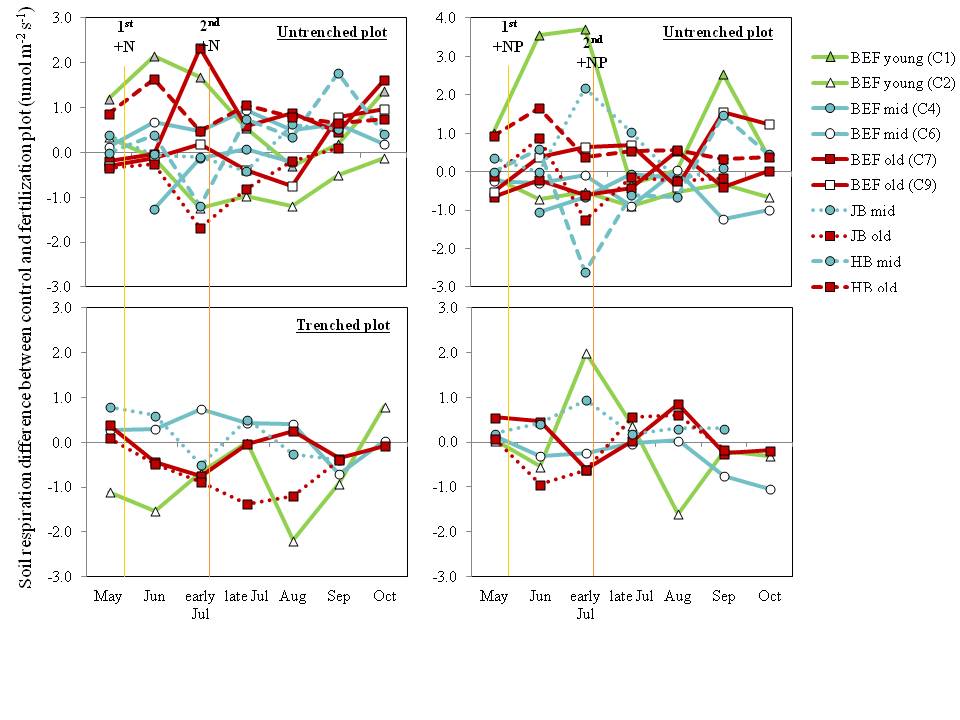
There was not a significant effect of N fertilization on soil respiration in the first year of treatment (P = 0.42 for N; P = 0.37 for NP). There was also no effect of fertilization on soil microbial respiration, as measured in trenched plots (P = 0.61 for N; P = 0.43 for NP). Soil respiration responses to fertilization were unaffected by forest age (P > 0.22) or site (P > 0.39) in either untrenched or trenched plots (see below).
Future Directions
We will continue to monitor soil respiration in response to additions of N and P, as well as other responses, including microbial N transformations, tree biomass accumulation, litter production, foliar resorption, root production and sap flow.