| Home | Gateways | Academics | Admission | Directories | Site Index | SEARCH: |
100-499: Undergraduate courses for which no graduate credit may be given.
500-599: Graduate courses designed expressly for areas of specialization in post-baccalaureate programs. Qualified undergraduate students may enroll by permission of the instructor.
600-699: Graduate courses designed expressly for advanced levels of specialization. Undergraduate students with a cumulative grade point average of 3.000 or better may enroll in these courses with an approved petition.
700-999: Advanced graduate level courses for which no undergraduate students may register. Shared resources courses, designated as 400/500 or 400/600, are designed when the topic coverage of both courses is the same. Separate course syllabuses are developed expressly differentiating the requirements and evaluative criteria between the undergraduate course and the graduate course. No type of cross-listing may be offered unless approved by the ESF faculty.
PSE 132. Orientation Seminar: Paper Science and Engineering (1)
One session per week of lecture, discussion, and/or exercises. Introduction to campus resources available to ensure academic success. Introduction to PSE as a field of inquiry and career path. Fall.
PSE 201. The Art and Early History of Papermaking (3)
Two hours of lecture and three hours of studio per week. This paper-making course provides a historical (Asia – Far East) and artistic per-spective in both lecture and studio formats. History lectures will include the influence of paper art form in non-Western cultures. Studio lessons may vary but generally will include historical papermaking by hand as well as more modern techniques in the creation of paper art forms. Fall.
PSE 300. Introduction to Papermaking (3)
Three hours of lecture per week. Historical and commercial consider-ation of the paper industry. Technology of papermaking with emphasis on stock furnish, stock preparation and paper machine operation. Introductory discussions of papermaking materials and formation and reactions of a fibrous web. Fall.
PSE 302. Pulp and Paper Laboratory Skills (1)
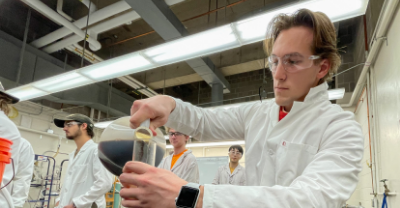
Three hours of laboratory per week. Introduction to the laboratory skills necessary for subsequent PSE courses as well as necessary "survival" skills for their summer and co-op work experiences. Skills covered include pulp sampling and analysis, freeness, consistency, handsheet preparation, and physical and optical testing. A demon-stration run of the pilot paper machine is part of this course. Fall.
Pre- or co-requisite: PSE 300 (concurrent registration).
PSE 304. Mill Experience (2)
Twelve weeks full time pulp or paper mill employment approved by the Department between the junior and senior years. The student must submit a comprehensive report to fulfill this requirement. Fall, Spring and Summer. Pre- or co-requisites: PSE 300, PSE 302.
PSE 305. Co-op Experience (2)
One semester full-time pulp or paper mill experience. Work experi-ence as an engineering intern on company-assigned projects. Trad-itionally, the student works for a semester and adjacent summer also taking PSE 304. The student must submit a comprehensive report and give a presentation to fulfill this requirement. Fall and Spring.
Pre- or co-requisites: PSE 300, PSE 302.
PSE 350. Pulping and Bleaching Processes (3)
Three hours of lecture. Technological and chemical consideration of pulping and bleaching of raw materials used in the paper industry. Includes consideration of the pulping and bleaching processes and related chemistry. Discussions of related operations, e.g., chemical recovery, are included. Spring.
Pre- or co-requisites: PSE 300, FCH 221, FCH 223.
PSE 351. Pulping and Bleaching Laboratory (2)
One hour lecture and three hours laboratory per week. Discussion of: pulping and bleaching processes, effect of chemical and physical variables on the wood components and pulp properties, and the chemistry involved. Experiments in pulping, bleaching and pulp evaluation. Spring.
Pre- or co-requisites: FCH 223, FCH 360, PSE 350.
PSE 361. Engineering Thermodynamics (3)
Three hours of lecture per week. Principles of classical thermo-dynamics applied to engineering practice. First and second laws; heat effects; property functions and their correlation; physical and chemical equilibrium; solutions and mixtures; power and refrigeration cycles. Thermodynamic analysis of processes and systems via case studies and computer simulation. Spring.
Prerequisites: MAT 296, FCH 152, PHY 211.
Note: Credit will not be granted for both PSE 361 and ERE 561.
PSE 370. Principles of Mass and Energy Balance (3)
Three hours of lecture per week. Conservation of mass and energy applied to steady-state and dynamic process units and systems. Problem analysis and solution; computational techniques. Thermo-dynamic data and their use; real vs. perfect gases; steam properties; psychrometry. Fall.
Pre- or co-requisite(s): PHY 211, MAT 296 (or concurrent), FCH 152.
PSE 371. Fluid Mechanics (3)
Three hours of lecture per week. Fluid statics. Principles of mass, energy and momentum balance. Bernoulli’s equation. Application to pipe flows, flow measurement and porous media. Movement of particles in fluid media. Rheology of fluids and suspensions typical in the pulp and paper industry (pulps, black liquor, etc.). Filtration and sedimen-tation of fibrous and particulate suspensions. Characteristics of pumps. Flow systems with economic considerations. Fall.
Prerequisites: PHY 211, MAT 296, FCH 152.
Note: Credit will not be granted for both PSE 371 and ERE 571.
PSE 372. Heat Transfer (3)
Two hours of lecture and/or demonstration per week. The study of heat transfer including conduction, convection, radiation and their applications in industry. Heater and heat exchanger design and selection, and industrial evaporation. Spring.
Prerequisites: PSE 370, PSE 371.
PSE 436. Pulp and Paper Unit Operations (3)
Two hours of lecture and three hours of laboratory per week. Applications of momentum, heat, and mass transfer to operations in the pulp and paper industry. Topics include pulp flow, heater and heat exchanger design, black liquor evaporation, humidification, steam systems, paper and pulp drying, gas absorption, pulp washing, leaching, and extraction. Laboratory exercises include paper drying, pulp washing and cleaning, heat exchanger operations, and gas absorption for liquor preparation. Spring. Prerequisites: PSE 361, PSE 370, PSE 371, BPE 335.
PSE 456. Management in the Paper Industry (3)
Three hours of lecture per week. Provides the student with inter-active contact with active executives in the paper and allied industries. The student will develop and present studies of business cases in discussion forum to the class. An understanding of how general managers operate to manage an entire organization will be presented by visiting experts, class participation, group presentations, written papers and examinations. Spring. Note: Credit will not be granted for both PSE 456 and ERE 676.
PSE 465. Paper Properties (4)
Three hours of lecture, three hours of laboratory and discussion per week. Evaluation and study of the physical, optical, and chemical properties of paper and the interrelationships existing among paper manufacturing methods, papermaking additives test results and the ultimate properties desired in the finished paper. Fall.
Prerequisite: PSE 300.
Note: Credit will not be granted for both PSE 465 and ERE 677.
PSE 466. Paper Coating and Converting (3)
Three hours of lecture per week. Evaluation and study of various coating materials and processes used by the paper industry. Intro-duction to polymers and their use in converting operations. Study of materials and equipment used in converting operations, fundamentals and parameters which control their use, effects on final properties of papers. Spring. Prerequisite: PSE 465.
Note: Credit will not be granted for both PSE 466 and ERE 678.
PSE 467. Papermaking Wet End Chemistry (3)
Three hours of lecture per week. Provides the student with the funda-mental principles of colloid and surface chemistry as they relate to the interaction of papermaking materials and chemical additives in the wet end of a papermachine system. The topics of retention of fine solids and dewatering are addressed in detail. Application of the various topics presented during the course are made during a pilot papermachine trial. Spring.
Prerequisite: Senior status in paper science and engineering program or permission of instructor.
PSE 468. Papermaking Processes (3)
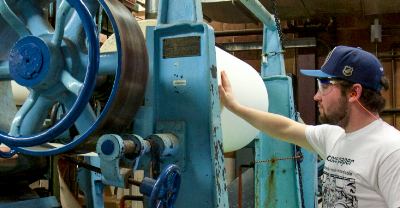
One hour of lecture, six hours of laboratory per week. Laboratory study of the papermaking process, with emphasis on operation of the semi-commercial Fourdrinier paper machine. Emphasis is on the fundamentals of stock preparation, paper machine operation, evaluation of the finished product, and the collection and analysis of data to develop material and energy balances. Results of each paper machine run are evaluated in seminar-type discussions. Spring.
Prerequisites: PSE 300, PSE 370, PSE 465.
Note: Credit will not be granted for both PSE 468 and ERE 679.
PSE 473. Mass Transfer (3)
Three hours of lecture per week. The study of mass transfer, humid-ification, air conditioning, drying, gas absorption, distillation, leaching, washing and extraction. Fall. Prerequisites: PSE 370, PSE 371, PSE 372.
PSE 477. Process Control (3)
Three hours of lecture per week. Presents an introduction to the principles of process control. Linear analysis, LaPlace transforms, and nonlinear simulation are presented and applied to feedback, and feedforward control. Examples of process simulation, accuracy and stability of control are drawn from paper industry processes. Fall.
Prerequisite: APM 485 or equivalent.
Note: Credit will not be granted for both PSE 477 and ERE 667.
PSE 480. Engineering Design Economics (3)
Three hours of lecture per week. Engineering analysis of modern plant practice in the pulp and paper, chemical and related industries. Operating costs, profitability criteria, optimization techniques and evaluation of alternatives. Modeling and computer simulation of process units and systems; use of typical software. Design exercises and case studies. Spring.
Prerequisites: PSE 370, MAT 296.
PSE 481. Engineering Design (3)
Three hours of lecture per week. Design-project procedure; data sources and development. Application of simulation and computer-aided design to process synthesis and plant layout. Formulation and solution of original design problems. Fall. Prerequisites: PSE 371, PSE 372, PSE 480.
Pre- or co-requisite: PSE 473.
PSE 496. Special Topics (1-3)
Lectures, conferences and discussions. Specialized topics in chemistry, chemical engineering and physics as well as topics pertaining to management as related to the pulp, paper, paperboard and allied industries. Fall and Spring.
PSE 498. Research Problem (1-4)
The student is assigned a research problem in pulping, bleaching, refining, additives, quality control of paper or paper products, or chemical engineering. The student must make a systematic survey
of available literature on the assigned problem. Emphasis is on
application of correct research technique rather than on the results of commercial importance. The information obtained from the literature survey, along with the data developed as a result of the investigation, is to be presented as a technical report. Fall, Spring and Summer.
BPE 132. Orientation Seminar (1)
One hour lecture per week and three-day orientation. Introduction to campus resources available to ensure academic success. Introduction to bioprocess engineering as a field of inquiry and career path. Fall.
Note: Credit will not be granted for both BPE 132 and PSE 132 (both undergraduate and graduate versions of the same course).
BPE 304. Summer Internship in Bioprocess Engineering (2)
Twelve weeks full time bioprocessing employment approved by the Department between the junior and senior years. The student must submit a comprehensive report and give a presentation to fulfill this requirement. Summer.
Prerequisite: PSE 370 or equivalent.
BPE 305. Co-op Experience in Bioprocess Engineering (2)
One semester full-time bioprocessing experience as an engineering intern on company-assigned projects. Typically, the student works for a semester and adjacent summer also taking BPE 304. The student must submit a comprehensive report and give a presentation to fulfill this requirement. Fall and Spring.
Prerequisite: PSE 370 or equivalent.
BPE 310. Colloid and Interface Science (3)
Three hours of lecture per week. Basic principles of colloidal and interfacial science. Foundation and theoretical understanding as applied in bioseparations, transport phenomena, chemical/bio-chemical/biological processes. Spring.
Prerequisites: PSE 370, PSE 361, FCH 152, and EFB 103 or equivalent.
Co-requisite: BPE 335.
BPE 335. Transport Phenomena (3)
Three hours of lecture per week. Principles of heat and mass transfer as applied to the bioprocess industries. Topics include conduction, convective heat and mass transfer, diffusion of both steady-state and transient situations, analogies for heat and mass transfer, boundary layers, porous media transport, heat and mass transfer analyses. Discussion of specific bioprocess examples. Spring.
Credit will not be granted for both BPE 335 and ERE 534.
Prerequisites: PSE 370, PSE 371.
BPE 336. Transport Phenomena Laboratory (1)
Three hours of laboratory per week. Introduction to report writing and laboratory safety. Experiments on fluid mechanics, heat transfer, diffusion, and convective mass transfer as applied to the bioprocess industries. Data analysis and data presentation in oral and written form are required. Spring.
Prerequisites: PSE 370 and PSE 371 or equivalents.
Co-requisite: BPE 335 (or prerequisite).
BPE 420. Bioseparations (3)
Three hours of lecture per week. Major unit operations used for the separation, purification and recovery of products from complex mixtures. Separation processes including sedimentation, filtration, centrifugation, membrane ultra-filtration, nanofiltration, ion exchange processes, chromatographic separations. Fall.
Credit will not be granted for both BPE 420 and ERE 502.
Prerequisite: BPE 310.
BPE 421. Bioprocess Kinetics and Systems Engineering (3)
Three hours of lecture per week. Topics in biochemical kinetics and reaction engineering are discussed including their application to microbiological systems used for bioprocessing. Batch and continuous biochemical reactor designs. The role of agitation in gas and solids delivery and heat removal for inclusion in design decisions. Impact of engineering parameters and design decisions on operability and economics. Fall.
Prerequisite: BPE 320.
BPE 440. Bioprocess and Systems Laboratory (3)
One hour of lecture and six hours of laboratory per week. Measurement and analysis of bioprocess systems, including steady-state and dynamic modeling of systems. Investigation of various bioprocesses including fermentation, enzymatic reactions, and reactive processes involving lignocellulosic materials. Spring.
Prerequisite: BPE 420 and BPE 421.
BPE 441. Biomass Energy (3)
Three hours of lecture per week. Historical, current and future uses
of biomass as a source of renewable energy for the production of bioenergy, biofuels and bioproducts. Characteristics of biomass, their conversion to different forms of energy and end products, and an assessment of their sustainability. Spring.
Prerequisite: ESC 325, ESC 335 or permission of instructor.
Note: Credit will not be granted for both BPE 441 and ERE 641.
BPE 481. Bioprocess Engineering Design (3)
Three hours of lecture per week. Methods for estimating capital investment, operating costs and return on investment for bio-processes. Bioprocess flow sheet synthesis, operability, process simulation, optimization techniques, and preparation for a bioprocess design project. Spring.
Prerequisite: PSE 480.
BPE 498. Research Problem in Bioprocess Engineering (1-4)
Independent study. The student is assigned a research problem
in bioprocess engineering. The student must make a systematic survey of available literature on the assigned problem. Emphasis
is on application of correct research techniques rather than on discovery of results of commercial importance. The information obtained in the literature survey, along with the data developed
as a result of the investigation, is to be presented as a technical report. Fall, Spring, and Summer.
ERE 221. Engineering Mechanics—Statics (3)
Three hours of lecture per week. Forces and vectors, moments, equi-valent force systems, free bodies, structures, section properties. Fall.
Prerequisites: Integral calculus and general physics.
ERE 222. Engineering Mechanics—Dynamics (2)
Two hours of lecture per week. Kinematics and kinetics of particles and rigid bodies; rectangular, normal and tangential, radial and transverse components; translation and rotation; force and acceleration; impulse; momentum; work and energy; impact. Spring.
Prerequisites: Statics and Calculus II.
ERE 223. Statics and Dynamics (4)
Four hours of lecture per week. This course provides fundamental principles, methods and applications of engineering mechanics. Development and discussion of analytic models for rigid-body mechanics are used to apply theories. Rigid bodies of a practical nature and at rest or in motion are covered. Fall.
Prerequisites: Algebra, derivative and integral calculus.
ERE 225. Engineering Graphics (1)
One three-hour session each week over the semester utilizing lecture, discussion and hands-on practice to achieve the goals of basic under-standing and skill with graphics for the purposes stated. Introductory course in graphics as a communication language and analytic/design tool for engineers. Fall and Spring.
Prerequisites: Trigonometry and computer literacy.
ERE 296. Special Topics in Engineering (1-3)
Provides experimental, interdisciplinary, or special coursework at the freshman and sophomore levels within the field of environmental resources engineering. Subject matter and course format vary from semester to semester and section to section. Fall and Spring.
ERE 310. Environmental Measurements and Spatial Information (3)
Two hours of lecture and three hours of laboratory per week. Fundamental concepts for properly collecting data and information about environmental variables. Collecting spatial information is emphasized through consideration of maps, aerial photographs and other imagery, and field surveying procedures. Spring.
ERE 351. Basic Engineering Thermodynamics (2)
Four hours of lecture per week, first half of the semester. Principles of energy conservation and conversion: first and second laws. Relation to PVT behavior, property functions, equilibria, and heat and mass transfer. Introduction to engineering problem analysis and computer methods. Spring.
Prerequisites: Physics, general chemistry and calculus. Not for credit to students who have successfully completed FCH 360 or equivalent.
ERE 362. Mechanics of Materials (3)
Three hours of lecture per week. Theories of stress, deformation and stability of common structural materials subjected to various force systems. Spring.
Prerequisites: Integral calculus and statics.
ERE 371. Surveying for Engineers (4)
Three hours of lecture and three hours of laboratory per week. The principles of plane surveying and position determination for engineers. Subject matter areas include introduction to the theory of measure-ment and errors, reference surfaces, coordinate systems and datums, horizontal and vertical measurements, traversing and computations, construction surveying including circular and parabolic curves, property and public land surveys, the analysis and treatment of systematic and random errors, foundations and applications of global positioning systems. Laboratory fieldwork and computations culminate in a topographic map. Fall.
Prerequisite: Calculus.
ERE 385. Mechanical Design (3)
Three hours of lecture per week. The principles of operation and design of mechanical systems common in engineering. Solution of equipment design using such components as springs, gears, motors and transmissions. Strength, reliability and economy are considered. Design projects are oriented to current concerns in construction, environment, and manufacturing. Spring.
Prerequisite: ERE 221; Co-requisites: ERE 222, ERE 362.
ERE 440. Water Pollution Engineering (3)
Two hours of lecture and three hours of laboratory per week. Intro-duction to the physical, chemical and biological parameters of wastewater treatment processes and to the principles of the unit operations involved. Study of the design parameters and design procedures of wastewater treatment systems. Fall.
Prerequisite: Physics.
ERE 441. Air Pollution Engineering (3)
Three hours of lecture and discussion per week. Study of the chemical, physical and meteorological principles of air pollution and its control. Local and global effects of air pollution. The atmospheric survey. Examination of the operating principles and design parameters of the various air pollution control systems. Air quality and emission standards. Fall and Spring.
Prerequisites: FCH 360, MAT 397, PSE 371.
ERE 445. Hydrologic Modeling (3)
Three hours of lecture per week. Deterministic and stochastic models of hydrologic phenomenon. Model development and the use of computer programming to construct, manipulate, and interpret hydrologic models. Theoretical and analytical approaches to describing hydrologic processes, including precipitation, evapotranspiration, infiltration, surface runoff, percolation, groundwater movement and discharge, and streamflow. Distributed, semi-distributed, and lumped parameter models and techniques for model calibration and validation. Fall.
Pre- or co-requisite(s): Introductory computer programming.
Note: Credit will not be granted for both ERE 445 and ERE 645.
ERE 450. Introduction to Geographic Information Systems (3)
Two hours of lecture and three hours of laboratory per week. Definition, development and general concepts of Geographic Information Systems (GIS). Topics will include data acquisition and specification, data processing, data manipulation, and analysis, information output, and selecting and implementing GIS. Fall.
Note: Credit will not be granted for both ERE 450 and ERE 550.
ERE 496. Special Topics (1-3)
Lectures, readings, problems and discussions. Topics in environ-mental or resource engineering as announced. Fall and/or Spring.
ERE 501. Bioprocess Microbiology (3)
Two hours of lecture and three hours of laboratory/discussion per week. Topics include general microbiology, enzymology, enzyme kinetics, biochemistry, metabolic regulation, microbial growth and product formation (with general stoichiometry), media formulation and bioprocess design including batch, fed-batch, and continuous modes, techniques for product recovery and purification, and mam-malian cell lines/culture. Microbiological growth media, batching, and the operation of bench-top bioreactors and various analytical instrumentation. Fall.
Prerequisites: Permission of instructor; basic understanding of chemistry and biology; appropriate quantitative skills.
ERE 502. Bioseparations (3)
Three hours of lecture per week. Cell disruption, solid liquid separa-tions, centrifugation, chromatographic techniques (gel filtration, affinity, ion exchange), and membrane processes. Extraction. Crystal-lization and drying. Aseptic filtration. Fall.
Prerequisite: ERE 501.
Note: Credit will not be granted for both ERE 502 and BPE 420.
ERE 503. Bioprocess Plant Design (3)
Three hours of lecture per week. Topics covered include integration of process and support systems and equipment; concepts of facility design integrating Good Manufacturing Practice (GMP), equipment and systems cleanability, people flow, product protection, capital investment, and operating costs. This course will focus towards facility design in the biopharmaceutical industry. Spring.
Prerequisites: ERE 502, ERE 542 or equivalents.
ERE 506. Hazardous Waste Management (3)
Three hours of lecture and discussion per week. Systematic control of generation, storage, transport, treatment and disposal of hazardous waste. Applicable hazardous waste regulations. Pollutant transport mechanisms. Technology design to investigate, control emissions and remediate sites. Urban economic redevelopment impacts. Fall.
Pre- or co-requisite(s): Chemistry and biology. Permission of instructor for seniors in good standing.
ERE 511. Ecological Engineering in the Tropics (3)
One hour of discussion per week with intensive spring break field study in a Caribbean country. Principles of ecological engineering for ecosystem restoration and pollution control. Field trips to pristine and degraded ecosystems including: humid tropical cloud forests, coastal mangrove, dry mountain forests, and coral reefs to identify target functions for nature and society, observe degradations, and develop sustainable restoration designs. ERE 511 students will perform the additional work of writing a 15 page research paper. Spring
Credits will not be granted for FEG 311 and ERE 511 (both undergraduate and graduate versions of the same course).
Prerequisites: 1 course in calculus, biology, and chemistry
This course description was added after the publication of the printed College catalog.
ERE 515. Production and Operation Management (3)
Three hours of lecture/discussion per week. Basic productivity issues and simulation modeling. Topics include basic productivity theories, construction productivity tools, and the discrete-event simulation model. Through independent research students select construction activities and develop a computer simulation model to optimize construction operations by identifying and correcting inefficient operation. Spring.
Prerequisite: Three credits of any physical or analytical engineering, or permission of instructor.
Note: Credit will not be granted for both ERE 515 and WPE 315.
ERE 519. Green Entrepreneurship (3)
Three hours of lecture/discussion per week. Explore challenges and goals of creating a start-up venture in environmental science or tech-nology. Recognize trends in the marketplace, and where commercial opportunities can be created. Analyze feasibility and potential to create a sustainable venture. Other topic areas include critical success factors and key start-up issues unique to science and technology firms. Spring.
Pre- or Co-requisites: FOR 207 Introduction to Economics or equivalent; or permission of instructor.
ERE 525. Construction Methods and Equipment (3)
Three hours of lecture/discussion per week. Analysis of heavy con-struction operations and related environmental concerns. Production calculations, means and methods selection and operating costs of heavy construction equipment are addressed. The economics of equip-ment use are analyzed. The use of a digitizer in earthwork quantity takeoff is explored. The outcome of the course is to select the most cost efficient and performance efficient method and equipment. A term paper is required. Fall.
Note: Credit will not be granted for both ERE 525 and WPE 350.
ERE 531. Construction Safety (3)
Three hours of lecture/discussion per week. Occupational Safety and Health practices in the construction industry. An overview of the U.S. Department of Labor, Occupational Safety and Health Regulations,
29 CFR 1910 and 29 CFR 1926. Comprehensive review of: general safety and health requirements, hazard communication, confined space entry, lockout/tagout programs, workplace violence, personal protective equipment, fire protection, signs and barricades, rigging, small tools — hand and power, welding and cutting, electrical, fall protection, scaffolding, cranes, mobile equipment, excavation and trenching, steel erection, stairways and ladders and permissible exposure limits. A term paper is required. Fall.
Note: Credit will not be granted for both ERE 531 and WPE 331.
ERE 534. Transport Phenomena (3)
Three hours of lecture per week. Principles of heat and mass transfer as applied to the bioprocess industries. Topics include conduction, convective heat and mass transfer, diffusion of both steady-state and transient situations, analogies for heat and mass transfer, boundary layers, porous media transport, heat and mass transfer analysis. Discussion of specific bioprocess examples. Spring.
Note: Credit will not be granted for both BPE 335 and ERE 534.
ERE 535. Cost Engineering (3)
Three hours of lecture/discussion per week. Statistics, cost of money, rates of return, cash flow, budget development, cost tracking, productivity and progress, constructability and value engineering, change control and risk analysis. Synthesis research report on a cost engineering topic required. Fall.
Note: Credit will not be granted for both WPE 335 and ERE 535.
ERE 540. Engineering Hydrology and Hydraulics (3)
Three hours of lecture per week. Introduction to water resources engineering. Hydraulics processes explored include pipe flow, open-channel flow, flows within control structures, and flow through porous media. Hydrologic processes explored include scaling rainfall across time and space, computing the timing and magnitude of watershed run-off, and routing flood waves through detention basins and streams. Engineering analysis to link hydrologic and hydraulic systems and use probability distributions to access the system failure. Spring.
Note: Credit will not be granted for both FEG 340 and ERE 540.
ERE 542. Bioreaction Engineering (3)
Three hours of lecture/discussion per week. Bioprocess kinetics, reaction engineering, mass and energy balances, stoichiometry, enzyme kinetics, growth and product synthesis kinetics, mass transfer effects, bioreactor analysis and design, instrumentation and control, batch processing, bioreactor scale-up, agitation, oxygen delivery, heat removal and kinetics of sterilization (clean and sterilization in place – CIP and SIP). Spring.
Prerequisites: Mass and Heat Transfer, or Transport Phenomena
Note: Credit will not be granted for both ERE 542 and PBE 421.
ERE 543. Construction Estimating (3)
Three hours of lecture/discussion per week. Definition and explanation of estimating/bidding theory and process. The processes for reviewing and interpreting contracts, specifications and blueprints as well as their role in the estimating/bidding process. Perform a quantity take-off. Create a final estimate/bid, including the appropriate General Conditions and Markups. Several projects based on the concepts listed above as well as utilizing either a spreadsheet or Timberline Precision Estimating. A term paper describing how the relevant topics of the course fit a specific industry application, and production of an additional project based on Timberline Precision Estimating software or equivalent are required. Spring.
Prerequisites: Estimating experience or permission of instructor.
Note: Credit will not be granted for both ERE 543 and WPE 343.
ERE 548. Open Channel Hydraulics (3)
Three hours of lecture and discussion per week. Classroom instruction and exercises introduce advanced concepts in open channel hydraulics, including the energy and momentum principles, critical flow, uniform flow, flow profiles, and unsteady flow, as appropriate. Students will prepare a research paper describing their work on an independent project. Fall.
Note: Credit will not be granted for both FEG 448 and ERE 548.
Pre- or co-requisites: Fluid mechanics or permission of instructor.
ERE 550. Introduction to Geographic Information Systems (3)
Two hours of lecture and three hours of laboratory per week. Defini-tion, development and general concepts of Geographic Information Systems (GIS). Topics will include data acquisition and position specification, data processing, data manipulation, and analysis, information output, and selecting and implementing GIS. Readings with written assessment will be assigned from the current literature. Participation in a group project is required. Fall.
Note: Credit will not be granted for both ERE 450 and ERE 550.
ERE 551. GIS for Engineers (3)
Two hours of lecture and three hours of laboratory per week. Intro-duction to fundamental concepts in geographic information systems (GISs) with a focus on engineering applications. Fundamental concepts and development of geographic information systems including models and georeferencing systems used to represent and characterize spatial data. Data processing including collection and preprocessing, data management, spatial analysis and manipulation, and data output. Necessity and utility of spatial data in engineering design analysis. Fall.
Prerequisite: Calculus.
Co-requisite: ERE 371 or equivalent.
ERE 552. Fundamentals of Remote Sensing (3)
Two hours of lecture and three hours of laboratory per week. Principles and techniques of environmental remote sensing including potentials, limitations, instrumentation and unique requirements. Procedures and principles of acquiring, analyzing and using a wide range of imagery types for environmental applications and design. Both qualitative and quantitative interpretation procedures are presented. Oriented for multidisciplinary participation. Fall or Spring.
Prerequisites: Physics and calculus or permission of instructor.
Note: Credit will not be granted for both FEG 352 and ERE 552.
ERE 561. Engineering Thermodynamics (3)
Three hours of lecture per week. Principles of classical thermo-dynamics applied to engineering practice. First and second laws; heat effects; property functions and their correlation; physical and chemical equilibrium; solutions and mixtures; equations of state. Compressible flow. Electrolyte solutions. Thermodynamic analysis of processes and systems via case studies and computer simulation. Compressible flow and/or thermodynamics of electrolyte solutions. Spring.
Prerequisites: Physics and Calculus.
Note: Credit will not be granted for both PSE 361 and ERE 561.
ERE 563. Photogrammetry I (3)
Two hours of lecture and discussion; three hours of laboratory and discussion per week. Basic photogrammetric and photo interpretation concepts as a means of acquiring reliable data for engineering and management planning. Potentials, limitations, instrumentation and unique requirements are considered. Spring.
Prerequisite: ERE 371.
Note: Credit will not be granted for both FEG 363 and ERE 563.
ERE 565. Principles of Remote Sensing (4)
Three hours of lecture and three hours of laboratory and discussion per week. Introduction to water resources engineering. A qualitative and quantitative introduction to the fundamentals of acquiring, analyzing and utilizing remote sensing data. Introductory concepts and methods in digital image processing and photogrammetry. Spring.
Prerequisite: ERE 371 Surveying for Engineers or permission of instructor.
Note: Credit will not be granted for both FEG 365 and ERE 565.
ERE 566. Global Positioning Systems I (1)
Three hours of lecture per week for the first six weeks of the semester. Introduction to the Global Positioning System (GPS). Practical use of GPS receivers capable of positioning points to 1 to 5 meters. Planning of GPS surveys, collection of GPS observations and use of GPS software on personal computers to determine positions of targets of interest. Demonstration of porting collected GPS data to a geographic information system. Fall.
Prerequisites: ERE 371 and computer literacy.
Pre- or co-requisite(s): ERE 371 or equivalent and computer literacy.
ERE 570. Principles of Mass and Energy Balances (3)
Three hours of lecture per week. Conservation of mass and energy applied to steady-state and dynamic process units and systems. Problem analysis and solution; computational techniques. Thermo-dynamic data and their use; real vs. perfect gases; steam properties; psychrometry. Computer simulation of steady and non-steady state process systems. Fall.
Prerequisites: Physics, Calculus, and General Chemistry.
Note: Credit will not be granted for both PSE 370 and ERE 570.
ERE 571. Fluid Mechanics (3)
Three hours of lecture per week. Fluid statics. Principles of mass, energy and momentum balance. Bernoulli’s equation. Application to pipe flows, flow measurement and porous media. Movement of particles in fluid media. Rheology of fluids and suspensions typical in the pulp and paper industry (pulps, black liquor, etc.) Filtration and sedimentation of fibrous and particulate suspensions. Characteristics of pumps. Flow systems with economic considerations. Analysis of some papermaking operations such as drainage, dewatering, vacuum dewatering and wet pressing. Fall.
Prerequisites: Physics, Chemistry, Calculus.
Note: Credit will not be granted for both PSE 371 and ERE 571.
ERE 580. Coordinate Systems for GIS (1)
One hour of lecture per week. Basic principles and procedures related to earth coordinate systems. Topics include ways to specify locations, reference systems (datums), common earth coordinate systems, coordinate transformations, and general approaches to determining location in the field. Spring.
Pre- or co-requisites: Mathematical preparation in geometry, trigonometry, analytical geometry. Knowledge or experience with mapping or GIS.
ERE 585. Microscopy and Photomicrography (3)
Two hours of lecture, one hour of demonstration, and three to five hours of laboratory per week. Principles of light microscopy and photomicrography with extensive laboratory practice. Fall.
Prerequisite: Permission of instructor.
ERE 596. Special Topics (1-3)
Lectures, conferences, discussions and laboratory. Topics in environ-mental and resource engineering not covered in established courses. Designed for the beginning graduate student or selected upper-division undergraduate. Fall and/or Spring.
ERE 610. Computer-Aided Design and Drafting (3)
One-half hour lecture, two-and-one-half hour laboratory per week; and a minimum of six hours additional laboratory is required. This course introduces the student to the fundamentals of computer-aided design and drafting. It covers the commands needed to create a two-dimensional drawing, with particular emphasis on techniques used in the design profession applications. The requirements for the course include completing self-tutorials, creating drawings and the completion of two major projects.
Prerequisite: General knowledge of manual drafting.
Note: Credit will not be granted for both WPE 410 and ERE 610.
ERE 612. River Classification (3)
Three hours of lecture per week, conducted at river field sites while gathering data and in computer clusters analyzing data. Alternative theories of river classification are presented, and the Rosgen method is applied through Level II. Students classify based on pattern, profile dimension, and substrate of the river, measured using standard field tools. Channel geometry and flood flow frequency are computed using USGS data. ERE 612 students will perform the additional work of writing a 15 page research paper. Fall
Credits will not be granted for FEG 412 and ERE 612 (both undergraduate and graduate versions of the same course).
Prerequisites: engineering hydrology and hydraulics
This course description was added after the publication of the printed College catalog.
ERE 615. Lean Project Management (3)
Three hours of lecture/discussion per week. Lean production theory and the Lean project management system and their relations to the Architect, Engineering, and Construction industries. Topics include the Toyota production system, lean principles, the Last Planner System, and supply chain management. Through independent research students learn how to identify and improve the value stream of the construction process. Fall.
Prerequisite: Three credits of management or permission of instructor.
Note: Credit will not be granted for both ERE 615 and WPE 415.
ERE 630. Computer Applications in Construction Management (1-3)
Guided individual study. Projects that will be estimated, scheduled or managed exclusively by industry-standard, construction-related soft-ware, including Timberline Precision Estimating, Quest Earthworks, Quest for Contractors, Primavera Project Planner, SureTrak Project Manager by Primavera and Expedition by Primavera. A final report with annotated bibliography is required. Spring.
Prerequisite: Permission of instructor.
Note: Credit will not be granted for both ERE 630 and WPE 430.
ERE 641. Biomass Energy (3)
Three hours of lecture per week. Historical, current and future uses
of biomass as a source of renewable energy for the production of bioenergy, biofuels and bioproducts. Characteristics of biomass, their conversion to different forms of energy and end products and an assessment of their sustainability. Spring.
Prerequisite: ESC 525, ESC 535 or permission of instructor.
Note: Credit will not be granted for both BPE 441 and ERE 641.
ERE 643. Water Pollution Engineering (3)
Two hours of lecture and three hours of laboratory per week. Introduction to the physical, chemical and biological parameters of wastewater treatment processes and to the principles of the unit operations involved. Study of the design parameters and design procedures of wastewater treatment systems. Fall.
Prerequisites: Physics and CHE 356 or permission of instructor.
Note: Credit will not be granted for both ERE 440 and ERE 643.
ERE 645. Hydrologic Modeling (3)
Three hours of lecture per week. Deterministic and stochastic models of hydrologic phenomenon. Model development and the use of computer programming to construct, manipulate, and interpret hydrologic models. Theoretical and analytical approaches to describing hydro-logic processes, including precipitation, evapotranspiration, infiltration, surface runoff, percolation, groundwater movement and discharge, and streamflow. Distributed, semi-distributed, and lumped parameter models and techniques for model calibration and validation. Fall.
Pre- or co-requisite(s): Introductory computer programming.
Note: Credit will not be granted for both ERE 445 and ERE 645.
ERE 652. Remote Sensing Interpretation (3)
Two hours of lecture supplemented with individual and group projects per week. Principles and procedures for processing modern remote sensing imagery for extracting useful information. Types and charac-teristics of modern sensors, geometric transformation and restoration, enhancement and interpretation of digital imagery, and fundamental aspects of assessing the accuracy of remote sensing analyses. Spring.
Prerequisite: ERE 552 or equivalent.
ERE 653. Construction Planning and Scheduling (3)
Three hours of lecture/discussion per week. The use of Gantt, Activity on Node, Precedence Diagram, PERT and Linear schedules. Identification of activities and duration analyses of these activities. Update schedules, plan and assign resources, plan cost and schedule. Schedule development is performed both manually and with industry accepted software. A term paper describing how the relevant topics of the course fit a specific industry application and an additional project utilizing the software are required. Fall.
Prerequisite(s): Estimating experience and/or equivalent scheduling experience.
Note: Credit will not be granted for both ERE 653 and WPE 453.
ERE 654. Construction Project Management (3)
Three hours of lecture/discussion per week. How to define and properly identify company organizational structures. Project delivery systems, integration of estimating, bidding, scheduling and cost control into the management process. How safety, quality control, value engineering, procurement, labor relations and insurance and bonding requirements are integral parts of a construction project.
A term paper describing how the relevant topics of the course fit a specific industry application and a project based upon Expedition project management software are required. Spring.
Prerequisites: ERE 653, equivalent experience or permission of instructor.
Note: Credit will not be granted for both ERE 654 and WPE 454.
ERE 658. Construction Contracts and Specifications (3)
Three hours of lecture/discussion per week. The types of construction contracts used in the construction industry from the owner, contractor, subcontractor and supplier viewpoints. Types of required insurance and the remedies available to contractors are presented. The process of bidding and negotiating from the legal perspective is covered along with contract administration. Specifications are introduced by type and the requirements of each type are discussed based on current industry-accepted standards. A term paper describing how the relevant topics of the course fit a specific industry application is required. Spring.
Prerequisite: Permission of instructor.
Note: Credit will not be granted for both ERE 658 and WPE 455.
ERE 664. Photogrammetry II (3)
Two hours of lecture and three hours of laboratory per week. General analytic photogrammetry including interior and exterior orientation systems, intersection space resection and orientation. Correction of photo coordinates for film deformation, lens distortions, atmospheric refraction and earth curvature. Introduction to photogrammetric plotters. Planning photogrammetric projects and designing optimum procedures for selected photogrammetric tasks. Fall.
Prerequisite: ERE 563.
Note: Credit will not be granted for both FEG 464 and ERE 664.
ERE 667. Process Control (3)
Three hours of lecture per week. Presents an introduction to the principles of process control. Linear analysis, LaPlace transforms,
and nonlinear simulation are presented and applied to feedback, and feedforward control. Examples of process simulation, accuracy and stability of control are drawn from paper industry processes. Process identification using numerical techniques and MATLAB. Fall.
Prerequisite: Differential Equations.
Note: Credit will not be granted for both PSE 477 and ERE 667.
ERE 670. Principles of Pulping and Bleaching (3)
Two hours of lecture and three hours of laboratory per week plus literature study of assigned topics, independent project planning and/
or laboratory study. Discussion of pulping and bleaching processes. Effects of chemical and physical variables on the wood components and pulp properties; chemistry involved. Experiments in pulping and bleaching and pulp evaluation. Spring.
Prerequisites: Organic, physical and analytic chemistry.
ERE 672. Colloidal and Interface Science Applications in Papermaking (3)
Three hours of lecture per week. Provides the student with the funda-mental principles of Colloidal and Interface Science as it relates to the interaction of papermaking materials and chemical additives in the wetend of a papermachine system. The topics of retention of fine solids and dewatering are addressed in detail. Spring.
Pre- or co-requisite: Physical chemistry.
ERE 676. Management in the Paper Industry (3)
Three hours of lecture per week. Provides the student with interactive contact with active executives in the paper and allied industries. The student will develop and present studies of business cases in discussion forum to the class. An understanding of how general managers operate to manage an entire organization will be presented by visiting experts, class participation, group present-ations, written papers, and examinations. The student will critically review selected literature and present their findings. Spring.
Note: Credit will not be granted for both PSE 456 and ERE 676.
ERE 677. Paper Properties (4)
Three hours of lecture, three hours of laboratory per week and discussion plus evaluation of literature, independent project planning and/or laboratory study. Evaluation and study of the physical, optical and chemical properties of paper and the interrelationships existing among paper manufacturing methods, papermaking additives, test results and the ultimate properties desired in the finished paper. Fall.
Prerequisite: Permission of instructor.
Note: Credit will not be granted for both PSE 465 and ERE 677.
ERE 678. Paper Coating and Converting (3)
Three hours of lecture per week. Evaluation and study of the various coating materials and processes used by the paper industry. Intro-duction to polymers and their use in converting operations, funda-mentals and parameters which control their use, effects on final properties of papers. Spring.
Prerequisite: ERE 677.
Note: Credit will not be granted for both PSE 466 and ERE 678.
ERE 679. Papermaking Processes (3)
Two hours of lecture and three hours of laboratory per week. Study of the papermaking process from theoretical and practical standpoints featuring the operation of the pilot paper machines. Emphasis is on the fundamentals of stock preparation and paper machine operations, papermaking process and product design, evaluation of the finished product, and the collection and analysis of process data. An inde-pendent project is required in conjunction with the undergraduate paper machine runs. Spring.
Pre- or co-requisite(s): PSE 300, PSE 370, ERE 677.
Note: Credit will not be granted for both PSE 468 and ERE 679.
ERE 682. Transport Processes (3)
Two hours of lecture and three hours of laboratory per week. The relationship between wood structure and wood permeability, moisture movement, and heat transfer. Fire retardant and wood-preservation treatments. Wood drying. Unsteady-state transport processes. An advanced laboratory problem with report in wood-moisture relation-ships, wood drying, the relationship between wood permeability and treatability, or wood preservative treatments. Spring.
Prerequisite: WPE 387 or permission of instructor.
Note: Credit will not be granted for both ERE 682 and WPE 326.
ERE 685. Transmission Electron Microscopy (5)
Two hours of lecture, two hours of laboratory/demonstration per week, minimum of ten hours of individual laboratory. The theory
and operation of the transmission electron microscope including specimen preparation, photographic technique and interpretation
of micrographs. Spring.
Prerequisite: Permission of instructor.
ERE 686. Wood-Water Relationships (3)
Two hours of lecture and three hours of laboratory per week. Relationship between wood moisture content and the environment, electrical and thermal properties, theories of moisture sorption, hygro-scopic swelling and shrinking, thermodynamics of moisture sorption, mechanism of moisture movement as it relates to activation theory. Laboratory exercises will complement the theoretical topics discussed in the lecture. Fall.
Prerequisite: Permission of instructor.
ERE 691. Air Pollution Engineering (3)
Three hours of lecture and discussion per week. Study of the chemical, physical and meteorological principles of air pollution and its control. Local and global effects of air pollution. The atmospheric survey. Examination of the operating principles and design parameters of the various air pollution control systems. Air quality and emission standards. Fall
Prerequisites: Physics and CHE 356 or permission of instructor. Note: Credit will not be granted for both ERE 441 and ERE 691.
ERE 760. Analytical Photogrammetry I (3)
Two hours of lecture and three hours of laboratory per week. Mathematical theory of photogrammetry including space resection, orientation, intersection and aerial triangulation. Spring.
Prerequisites: FEG 363, APM 360 and FEG 464.
ERE 770. Biodegradation of Wood (3)
Two hours of lecture and one hour of demonstration/discussion per week. Biology of lignocolous fungi and their effects on wood properties. Anatomical, chemical and biotechnological aspects of the three major types of wood decay. Spring.
Prerequisite: Permission of instructor.
ERE 785. Scanning Electron Microscopy (5)
Two hours of lecture/demonstration/laboratory per week. Ten hours of independent laboratory experience per week. The theory and operation of the scanning electron microscope including specimen preparation, photographic technique and interpretation of micrographs. Fall and Spring. Prerequisite: Permission of instructor.
ERE 796. Advanced Topics (1-3)
Lectures, conferences, discussions and laboratory. Advanced topics
in forest engineering, paper science and engineering, and wood products engineering. Fall and/or Spring.
Prerequisite: Permission of instructor.
ERE 797. Seminar (1-3)
1.) Forest engineering topics. 2.) Paper science and engineering topics. 3.) Wood products engineering topics. Fall and Spring.
ERE 798. Research in Environmental and Resource Engineering (Credit hours to be arranged)
1.) Independent research topics in forest engineering.
2.) Independent research topics in paper science and engineering. 3.) Independent research topics in wood products engineering. Fall, Spring and Summer.
ERE 898. Professional Experience/Synthesis (1-6)
A supervised, documented professional work experience in the Master of Professional Studies degree program. Fall, Spring or Summer.
Prerequisite: Approval of proposed study plan by advisor, Depart-ment, and any sponsoring organization.
ERE 899. Master’s Thesis Research (Credit hours to be arranged)
Research and independent study for the master’s degree and thesis. Fall, Spring and Summer.
ERE 999. Doctoral Thesis Research (Credit hours to be arranged)
Research and independent study for the doctoral degree and dissertation. Fall, Spring and Summer.