| SEARCH: | ||
| HOME | GATEWAYS | ACADEMICS | ADMISSION | DIRECTORIES | VISIT | LOG IN | SITE INDEX | ||
| Home | Gateways | Academics | Admission | Directories | Site Index | SEARCH: |

The PSE option in the Paper and Bioprocess Engineering program offers areas of study in:
Pulping and Bleaching Processes (M.S., Ph.D.)
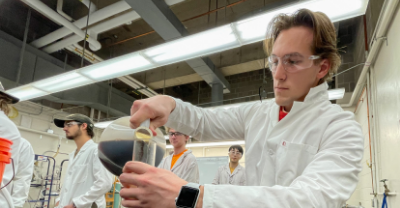
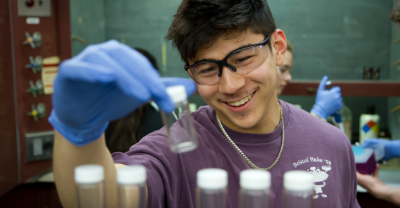
This area of study focuses on chemical relationships and reactions basic to the manufacture and bleaching of pulp, as well as some papermaking operations. Courses in theoretical and applied chemistry are indicated, as well as specialized courses addressed directly to pulping and bleaching. Research centers on these same topics, currently stressing new and improved processes to increase energy efficiency and reduce environmental impact. These include studies on the pre-extraction of wood chips to produce acetic acid from acetyl groups, production of hydrogen and carbon monoxide from gasification of wood and pulping effluents, delignification and brightening with oxygen, hydrogen peroxide and ozone, enzyme treatment of effluent streams, mechanisms of carbohydrate reactions, and photosensitization of bleached pulps.
Colloidal Chemistry and Fiber Flocculation (M.S., Ph.D.)
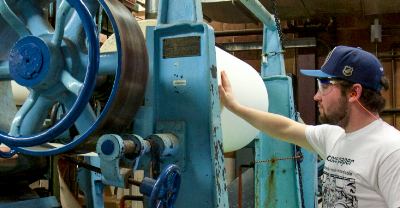
This study area deals with colloidal phenomena in the papermaking process, in particular the interaction among fibers, fine particles, polymeric additives, and electrolytes in stock preparation and sheet formation. Research topics fall into two categories: fundamental colloidal behavior of particles and behavior of paper stock on the paper machine. In the latter, extensive use is made of pilot plant facilities in Walters Hall. Current research projects include non-sulfur pulping, biopulping, chemicals and energy as byproducts, effects of wet pressing and press drying on sheet properties, pulping of tropical woods, and computer simulation and control of papermaking. Supporting this work is an experimental pulp and paper mill with two complete paper machines, a pressurized refiner and extensive auxiliary equipment.
Fiber and Paper Physics (M.S., Ph.D.)
Mechanical behavior of fibers, paper and board, and other fiber networks and composites depends upon variables of material, process and structure at all levels, especially structural anisotropy. Recommended courses focus on mechanical and chemical engineering, mechanics of materials, physics, mathematics and statistics, microscopy, and wood and fiber properties. Research topics are basic in nature, designed to describe and model quantitatively the properties and behavior of fibers and fibrous structures. Current projects include studies of transient moisture sorption by paper materials, the effect of moisture on mechanical properties, influence of sheet structure on properties, use of image processing to characterize deformational behavior of paper, and determination of elastic constants of paper.
Process and Environmental Systems Engineering (M.P.S., M.S., Ph.D.)
Process engineering links research with development, design, operation, and optimization of manufacturing methods and equipment, seeking improvement through technological innovation consistent with environmental and resource stewardship. Principles of engineering science and mathematics are applied to analysis and dynamic modeling of units and systems, with increasing use of computers in both research and professional practice. Research here includes process dynamics and control, studies of new pulping and bleaching processes, characterization and treatment of waste streams, byproduct recovery, and computer simulation of paper-processing systems. The extensive laboratories and pilot plant in Walters Hall are strongly supported by computing facilities and expertise on campus. Appropriate advanced courses in engineering, mathematics and computer science are available to suit individual student interests and needs.
Pulp and Paper Technology (M.P.S.)
Studies in this area deal closely with processes involved in the manufacture of pulp and paper. Courses concerned with this subject are central to a student’s program, extended and enriched with selected courses in chemistry, polymers, chemical engineering, process control, applied mathematics, and computer applications. Current research projects include non-sulfur pulping, biopulping, chemicals and energy as byproducts, effects of wet pressing and press drying on sheet properties, pulping of tropical woods, and computer simulation and control of papermaking. Supporting this work is an experimental pulp and paper mill with two complete paper machines, a pressurized refiner and extensive auxiliary equipment.