Skip to main contentSkip to footer content
 

Faculty Profile
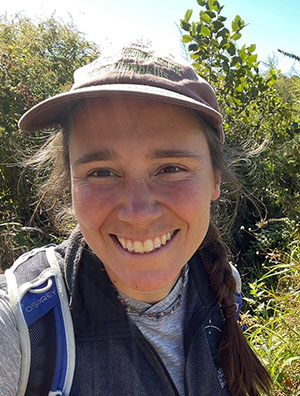
Christine Georgakakos

Orange horizontal rule

Christine  Georgakakos

Assistant Professor

Department of Environmental Resources Engineering
425 Baker Laboratory

[email protected]
315-470-4733

Research Profile

Christine joined the Department of Environmental Resources Engineering after completing a USDA postdoctoral fellowship with the Ecohydrology Lab at the University of Connecticut. Christine’s research interests center on the intersection of water quality and sustainable agriculture. Her work focuses on transport of contaminants associated with livestock agriculture and human activity.  Her current projects assess mobility and impact of antimicrobials in aquatic and soil environments of dairy farms in the northeast at small watershed scales. Christine is also interested in mitigating off-farm nutrient transport through assessment of agricultural best management practices.  In the classroom, she incorporates teaching-as-research projects and frameworks into her courses to assess best practices.

Project Website

Please see Christine's research website for more details on her work. 

Current Graduate Advisees
Kaitlyn CunninghamKaitlyn Cunningham
[email protected]

  • Degree Sought: MS
  • Graduate Advisor(s): Georgakakos
  • Area of Study: Environmental Science

Personal Statement
Having decided to study environmental chemistry, I sought out research opportunities in Dr. Alison Keimowitz’s lab at Vassar College studying lead and mercury contamination in sediment cores upwind and downwind of the Poughkeepsie Incinerator. I learned sample preparation techniques such as nitric acid-based digestion to extract lead from solid into liquid phase, and I explored analytical techniques such as Direct Mercury Analysis and ICP-MS. Additionally, I completed my undergraduate thesis in Dr. Keimowitz’s lab, where I analyzed lead contamination in soil, tap water, and paint from two residential locations in Poughkeepsie and Newburgh, NY. By investigating both the concentration and isotope signatures of the lead in my samples, I was able to incorporate ICP-MS and XRF into my work. Unfortunately, we found significant lead in both the paint and soil from the case study locations, with matching isotope signatures. Such contamination is not easy to remediate, especially for the average resident in these cities. To address this, I further tested to see if dilution by organic addition, or mixing grass clippings back into the soil, could be a viable remediation technique. My focus on dilution by organic addition as a form of phytoremediation was novel for the Vassar chemistry department. This was the beginning of my interest in the study of environmental contaminants and how they behave. For the complexity and originality of my thesis, I was nominated and inducted into the research honor society Sigma Xi at the completion of my thesis. My undergraduate research pushed me to pursue a career centering on environmental contaminants and monitoring. I started with the United States Geological Survey New York Water Science Center at the Coram office on Long Island, NY to explore many sides of water quality research and monitoring. During my time here, I honed my skills in equipment maintenance and troubleshooting as the site operator for four continuous real-time water quality and water level elevation monitors along the north shore of Long Island. From in situ temperature, dissolved oxygen, specific conductance, pH, turbidity, and Chlorophyll probe calibration and transmission troubleshooting to data analysis and management, I loved seeing the water quality data through from equipment deployment to result communication. At the USGS, there are three levels of checks performed by three individuals on continuous data to ensure it met the USGS’s high quality data standards: analyst, approver, and auditor. I was both the analyst for the sites I oversaw in the field and the approver for a number of other sites across New York State. I will bring these standards of data quality and understanding of quality control to graduate school and beyond. I also supported many diverse discrete sampling efforts across many environmental matrices, from the collaborative DEC Hudson River. Transect Project sampling for metals and PCBs from Yonker to Albany and the EPA Long Island Sound Study Costal Acidification Project to sampling untreated municipal water supply wells for pharmaceuticals and Per- and Polyfluoroalkyl Substances (PFAS) in Suffolk County and sampling for the National Water Quality Assurance study in Nassau County. These projects gave me the field experience needed to be thorough and flexible when dealing with contaminant sampling. A particularly formative project was during my first year at the USGS, when I helped with a groundwater PFAS and 1,4-Dioxane monitoring project. I was involved with everything from site selection to data management. The results of this project were highly anticipated as deep groundwater is the primary drinking water supply of Long Island and is now published as a data release. Together, these sampling campaigns established my connection with contaminants of emerging concern (CECs) and introduced me to their chemical and ecological interactions. CECs are a loosely defined class of under-studied environmental contaminants often persistent in the environment with potentially detrimental human and environmental health effects, even at low concentrations. CECs became a personal motif, connecting my various projects at the USGS. I led the sampling team to test for pesticides in shallow groundwater in the agricultural east end of Long Island and for PFAS, pharmaceuticals, hormones, and other wastewater indicator compounds in the influent, effluent, and surrounding environmental waters of several Suffolk County Wastewater Treatment plants. Beyond wastewater and groundwater, I also sampled the Peconic and Carmans Rivers of the Pine Barrens region for pharmaceuticals, pesticides, nutrients, and other inorganic contaminants. I found the question of CECs distribution intriguing, between my personal fascination with chemical behavior and the many unknowns this topic poses. My time sampling CECs inspired me to pursue graduate level studies with the fate and transport of CECs in the hydrosphere at the center of my project.

Graduate Research Topic
Pharmaceuticals, Personal Care Products, and Pesticides Transport on a Watershed Scale: Emerging Contaminants of Owasco Lake Watershed.

Favorite Quote
"The dragon advances." The Cradle Series by Will Wight.

Home Page

Rikesh RasailiRikesh Rasaili
[email protected]

  • Degree Sought: MS
  • Graduate Advisor(s): Georgakakos
  • Area of Study: Environmental Resources Engin

Armita Valizadeh AlaviArmita Valizadeh Alavi
[email protected]

  • Degree Sought: PHD
  • Graduate Advisor(s): Daley and Georgakakos
  • Area of Study: Environmental - Resource Engr