Nathaniel Lord ’26: Forest Health
Seeing the Forests and the Trees
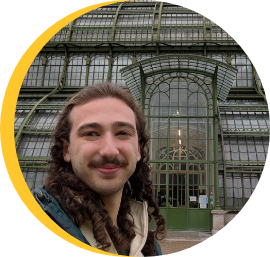
Nathaniel Lord has conducted research at ESF every semester except his first. As a freshman, he ran a transformation experiment with a gene conferring resistance to American chestnut blight. He moved on to beech leaf disease, replicating the disease cycle and exploring associated microbes through in-vivo inoculation techniques.
Research is the core of Lord’s ESF experience. The opportunity, he acknowledges, is unique. “At a big school, the research departments are bloated, and it’s difficult to get a spot. At ESF, if you want to get involved, you schedule a meeting with a professor, and they’ll likely take you on.”
He discovered research after coming to ESF, but he found the school through his love of trees. Growing up, he spent most of his time in the town forest, getting to know each tree individually. But with intimacy came the recognition of imperfection and the desire to protect. “The more I knew the forest around me, the more I saw signs of blight and decay. When I found I could study forest health at ESF, it was the only school I applied to.”
Lord directs his research toward defending American forests from invasive species. He wants to apply the skills he learned on the American Chestnut Restoration Project to the American beech. “If I can study these pathogens and solve these problems, it will be very meaningful for me,” he said.
Lord’s research would not have been possible without scholarships. They gave him time to study and the leisure to think. They also enabled him to present his research at the New York State Invasive Species Expo and the Northeastern American Phytopathological Society (APS) conferences. “The aid I received at ESF let me get my future started,” he said.
Lord wants to pursue a PhD, but he’s waiting until funding for science regains its former footing. In the meantime, he’ll be working with an arboricultural company as a plant health care specialist, applying injections against beech leaf disease. “I’ll be learning how to save a species, one tree at a time,” he explains.