The Ecology of Healing
By Judy Gelman Myers
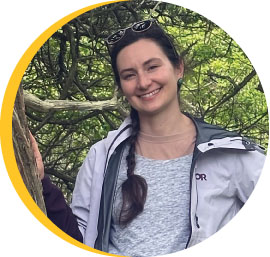 For Olivia Kurtz, ecology is the study of intimate relationships. A Ph.D. candidate
at ESF in conservation biology, she investigates relationships between species, relationships
between people, and relationships between people and the land where they live.
For Olivia Kurtz, ecology is the study of intimate relationships. A Ph.D. candidate
at ESF in conservation biology, she investigates relationships between species, relationships
between people, and relationships between people and the land where they live.
“We can’t look at ecology with humans outside of it, so restoring the ecosystem means examining our relationships within it,” Kurz said.
Like many others, Kurtz came to ESF after reading Dr. Kimmerer’s Braiding Sweetgrass. Having earned an M.S.Ed. in Museum and Childhood Education from Bank Street and a B.A. in comparative literature at Barnard, she thought SUNY ESF, with its Center for Native Peoples and the Environment, would be an ideal place to nurture her desire to care for the land and to share her knowledge with others.
Inspired by what she learned there, Kurtz applied for an internship with the Native Land Conservancy in Massachusetts. While working on a biocultural restoration plan for lands recently returned to Wampanoag stewardship, and learning from Indigenous knowledge holders, restoration practitioners, and community members, she developed many of the ideas and questions that guide her dissertation.
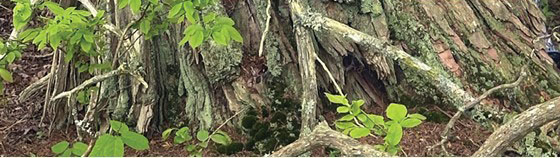
Kurtz designed an original project and research for her Ph.D. dissertation. Her primary focus are mycorrhiza, the symbiotic connection between plant roots and fungi. Specifically, she researches Atlantic white cedar and their mycorrhiza in the cedar swamps that remain in southeastern Massachusetts, ninety-eight percent of which were destroyed when colonial settlers replaced them with cranberry bogs and development. Today, many groups are working to restore Atlantic white cedar swamps on retired cranberry bogs.
When Kurtz began work on her thesis, she found that only one paper had been written on Atlantic white cedar mycorrhiza in the last 25 years. To fill the knowledge void, she conducts greenhouse experiments, fieldwork, and labwork that test the differences in cedar growth and mycorrhizal colonization between soils from retired cranberry farms and soils from natural cedar swamps. Her goal is to find whether these fungal communities are different, and if so, what factors drive that difference.
One of her thesis chapters includes a germination experiment with soft-stem bulrushes, which, along with cedar, are used in building traditional dwellings of the Wampanoag people of southeastern Massachusetts. Being of settler ancestry growing up on Wampanoag territory in Cape Cod, Kurtz hopes her research will be helpful to restoration efforts and to the Indigenous peoples who live there in reciprocity with that land.
Her fieldwork was largely funded by a Lowe-Wilcox scholarship. The monies enable her to conduct DNA metabarcoding that will allow her to characterize the fungal communities of Atlantic white cedar mycorrhiza.
Kurtz is the first to conduct this type of research. She hopes that her findings will be useful in the restoration of Atlantic white cedar swamps and other wetlands. Likewise, she hopes that her bulrush experiments will be directly applicable to three river restoration projects planned on rivers where she mapped and sampled bulrush with Conservancy interns.
Kurtz believes that when people connect more deeply with the land they live on, our society will move towards being more earth-centric and place-based. Says Kurtz, “That’s what we ultimately need for true healing and ecological restoration.”