A Tribute to TIBS
 On a warm sunny day, Nels and Deborah Magnuson boat to their dock on Chippewa Point,
two miles from their cottage on the St. Lawrence River. Sometimes a bald eagle or
osprey flies overhead. At the dock Nels swims while Deborah reads, they eat the cheese
and crackers they brought along. The air is soft, the mood quiet and peaceful. A loon
hoots nearby.
On a warm sunny day, Nels and Deborah Magnuson boat to their dock on Chippewa Point,
two miles from their cottage on the St. Lawrence River. Sometimes a bald eagle or
osprey flies overhead. At the dock Nels swims while Deborah reads, they eat the cheese
and crackers they brought along. The air is soft, the mood quiet and peaceful. A loon
hoots nearby.
Except for a 13-year detour to Ann Arbor and Detroit, Michigan, the Magnusons have lived in New York State their whole lives. Nels grew up playing in the streams and seashore on the north shore of Long Island. He first encountered the St. Lawrence when he was in high school. Deborah’s family still lives in western New York, where she grew up. Today, their kids and grandkids play in the St. Lawrence at the cottage they bought 30 years ago.
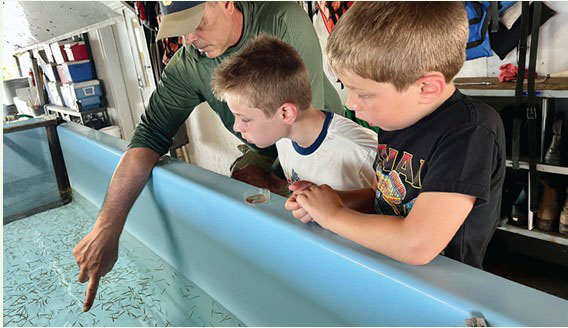
Dr. John Farrell showing the Magnusonʼs grandsons, Logan and Cameron, muskies at TIBS.
The Magnusons care deeply for the St. Lawrence and the people who protect it. Their love for the river inspired them to give to several organizations, including the Thousand Islands Land Trust, the Antique Boat Museum — and ESF’s Thousand Islands Biological Station (TIBS). Though they met as undergraduates at Syracuse University and neither attended ESF, the Magnusons contributed generously to TIBS, gifting the station with a new research vessel and an endowed scholarship for a summer intern.
Nels first met TIBS director John Farrell when he assisted with the restoration of a wetland at Chippewa Point near property they own. Years ago, the wetland was cut in two by a road, blocking the flow of the water. Farrell was directing the construction of channels and culverts beneath the road to reconnect the wetland.
Both Nels and Deborah’s careers included the protection of the environment. While working as an attorney at the NYS Department of Environmental Conservation, Nels met other ESF scientists and researchers. As a professional engineer, Deborah’s work included the design of structures at wastewater treatment plants. Over the years their interest in conservation grew.
Folks who deeply cherish the gifts of the natural world often enjoy a deep appreciation for the other gifts they’ve been given in life. For the Magnusons, that translated into their two impactful contributions to TIBS. The research vessel, a boat selected by John Farrell, gives staff and students more space and accessibility for their work on the River. The endowed scholarship enables ESF students to spend a summer conducting research at the biological station.
The effects of their contributions are already being felt at TIBS, where the Magnuson’s are viewed as “part of the team.” Said Director Farrell, “the Magnuson‘s recognized the lifechanging experiences occurring at TIBS and responded with remarkable generosity. Their contributions are having a lasting impact on the people associated with TIBS and its science, research, and management mission that will help sustain the St. Lawrence River.”
For Nels and Deborah, it is also about paying it forward. “Our fathers were able to help us, but not everybody's so lucky,” said Nels. “This is our way of helping people who might not have had as many opportunities as we did, especially people who make it their life’s work to better the environment we live in and teach others how to do the same.”