Cherishing a Legacy
By Judy Gelman Myers
 Growing up poor in rural New York, David Webb had few opportunities when he was young.
He started working straight out of high school and went on to stay 33 years at General
Electric.
But David was a Renaissance man who used his keen intelligence and incessant curiosity to teach himself whatever interested him. At GE, he learned electronics inside and out, starting with TV assembly when he was 18. He went on to become facilities manager at the electronics laboratory and later, plant manager at Eagle Comtronics.
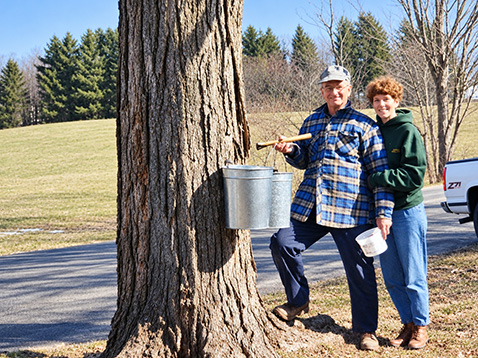
David taught himself many things. He mastered the intricacies of making maple syrup and erected a sugar house for family and friends. He designed equipment for bending mahogany while restoring a beat-up vintage Chris Craft boat. He built a Walton-style dreamhouse for his wife, Connie.
Connie Steward Webb had also grown up in a rural family. She and her family grew their own vegetables and hunted for the meat on their table. By a strange twist of fate, her small Pennsylvania high school taught classes in Russian language and culture. She took them for three years and rocketed to the
top of her class.She was determined to go to college. Connie got into Syracuse University, but her family couldnʼt afford the fifty-dollar deposit to secure her spot. When she explained the situation to the University's head of financial aid, he reassured her that she would receive a full scholarship covering tuition, room, and board. Connie earned a BA and MS, and later joined GE, where she became operations manager and met David.
In 1996, Connie heard that ESF was advertising for a VP of Administration. Female VPs in SUNY were uncommon at the time, but Connie applied. One of the ESF staff who interviewed her was the former Syracuse University head of financial aid who, years earlier, had helped make her education possible. Connie got the job. It included responsibility for capital projects at the Ranger School, whose lone building in the Adirondacks was in serious disrepair. ESF had to choose between shuttering the school or making a massive infrastructure investment. Connie argued for keeping the Ranger School open. It was part of ESFʼs legacy, she said, and there was no place like it. The administration agreed and decided to apply for state funds.
They received millions. For Connie, that victory meant often making the long drive to Wanakena from her home in Pulaski. David, now retired, often accompanied her. When they visited the Ranger School, David was floored. Their hands-on approach to learning perfectly mirrored his own. Connie relates, “He just kept saying, ‘I wish Iʼd known about this place when I was younger. I wish Iʼd graduated from here.’” Throughout the renovation, David and Connie visited the school often and attended annual alumni reunions. David bought them a specialized piece of equipment he knew they needed for making maple syrup. As time went on, the Webbs forged a close bond of mutual respect and admiration with the Ranger School staff, students, and alumni.
One year, an announcement was made at the annual alumni reunion. The Ranger School Alumni Association board had named Connie and David honorary alumni. David finally had his wish. He was officially a Ranger School alumnus.
When Davidʼs health began failing, he and Connie discussed what lay ahead. They owned a number of antique cars, which David, of course, had restored on his own. Connie asked what he wanted her to do with the vehicles. He told her, “I think you should sell them, and use the money to do something for the Ranger School.”
And so the David R. Webb Fund for the Ranger School was born. “David loved the Ranger School,” said Connie. “He would have been so proud that he was able
to help.”