Recent Headlines
- ESF Experts and Students Share Climate Education Resources at Statewide Science Teachers Conference
- National Champs! Mighty Oaks Cross-Country Teams Snag Title
- SUNY Chancellor King Announces Third Year of Internship Exchange Program with University of Puerto Rico and Conservation Organization Para La Naturaleza
- NYSP2I Presents Green Chemistry Workshop for Manufacturers at SUNY ESF
ESF Experts and Students Share Climate Education Resources at Statewide Science Teachers Conference
Presentations on climate change, maple production, K-12 partnerships, and student-led environmental engagement highlighted ESF's leadership in environmental education
SYRACUSE, N.Y. — Nov. 10, 2026 — As New York schools expand climate and environmental education initiatives, experts and students from the SUNY College of Environmental Science and Forestry (ESF) shared resources, research, and real-world experiences with science educators from across the state at the Science Teachers Association of New York State (STANYS) Annual Conference.
Through presentations on climate change, maple production, environmental careers, and partnerships between K-12 schools and higher education institutions, ESF's K-12 Outreach team highlighted practical approaches educators can use to engage students with real-world environmental issues while meeting evolving educational standards.
The conference provided an opportunity for ESF staff and students to connect with educators from across New York and showcase how partnerships between K-12 schools, higher education institutions, and community organizations can strengthen science education and student engagement.
“The STANYS conference gives us an annual opportunity to connect directly with educators from across New York and learn about the needs they're seeing in their classrooms,” said Olivia Whitmarsh, K-12 outreach coordinator. “Whether we're discussing climate change, maple production, or environmental careers, we want teachers to know ESF is a resource and partner for their work.”
During the conference’s pre-conference events, Dan Collins, associate director of ESF in the High School, and Whitmarsh led a session examining how educators can leverage partnerships with colleges and universities to address New York state’s evolving climate change education requirements. The presentation focused on helping teachers identify resources, expertise, and opportunities that support climate education while creating meaningful pathways for student learning.
“Teachers are being asked to help students understand increasingly complex environmental challenges,” Collins said. “Our goal was to share practical ways educators can connect with colleges, researchers, and community partners to bring those topics to life and help students see themselves in future environmental careers.”
Conference attendees also participated in an ESF-led workshop exploring maple production as an indicator of climate change. Developed in collaboration with Jill Rahn, forest resource analyst, the session examined how changing environmental conditions affect maple ecosystems and maple syrup production across the Northeast.
The workshop incorporated multimedia resources created through ESF's Digital Storytelling Studio, including video content developed by Rahn and Jason Kohlbrenner, digital support associate, to help educators bring scientific concepts into their classrooms.
The session also highlighted ongoing efforts to develop an ESF maple curriculum that uses maple production and forest health as a lens for teaching climate science. The project, led by Rahn, Whitmarsh, and Shari Dann, associate professor of environmental studies, builds on the College’s long-standing involvement in New York’s maple industry and seeks to provide educators with locally relevant resources for climate and environmental education.
Extending the College’s presence beyond faculty and staff presentations, ESF students Moss Vilcina and Perle Convey participated in a conference session with The Wild Center, sharing perspectives gained through their summer internships. Their participation highlighted how hands-on experiences in environmental education and climate communication can help prepare students to engage diverse audiences and contribute to real-world sustainability initiatives.
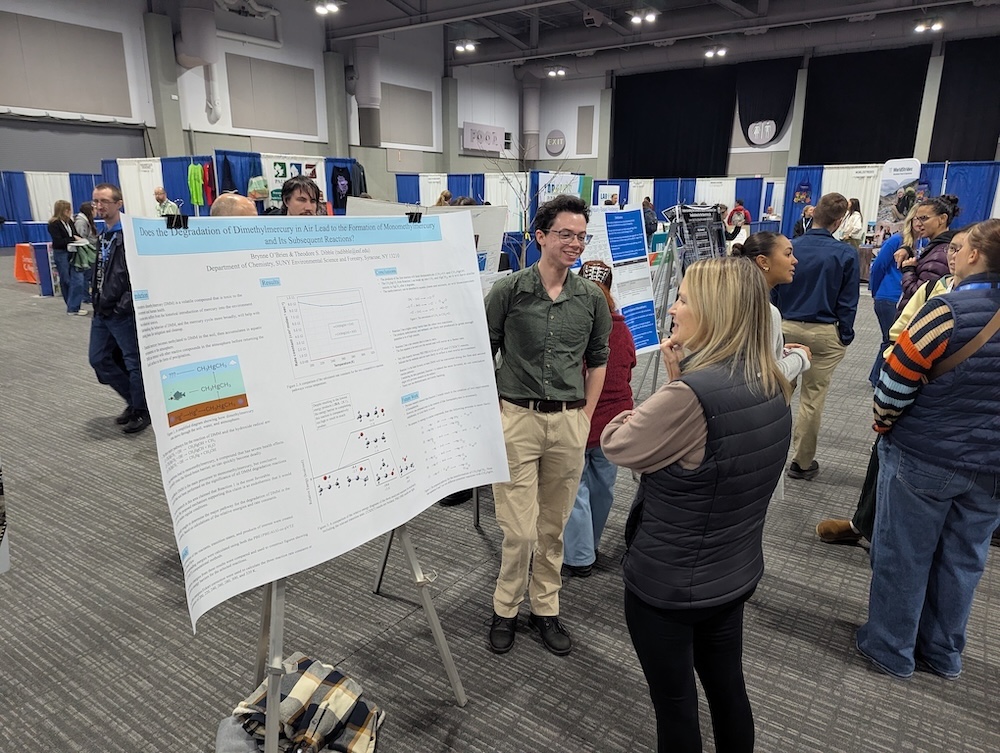
At a poster session on Sunday, students Austin Lucas and Brynne O’Brien presented posters on their research projects, each conducted in the Chemistry Department. This provided teachers with a chance to learn more about current research being done in the topics they are teaching in schools, as well as providing opportunities for students to practice their communication skills with members of the public outside of their academic disciplines.
“The educators attending STANYS are shaping how the next generation understands science, sustainability, and environmental stewardship,” said Joanie Mahoney, president of ESF. “We’re proud to share ESF’s expertise with teachers across New York and to support innovative approaches that help students connect classroom learning with real-world environmental issues.”
The STANYS conference annually brings together science educators, researchers, and education professionals from across New York State to share innovative teaching practices, classroom resources, and emerging developments in science education.
About SUNY ESF
The SUNY College of Environmental Science and Forestry is one of the nation's premier colleges focused on the study of the environment, developing renewable technologies, and building a sustainable future. ESF’s Mission is to educate future environmental leaders of all backgrounds, advance knowledge, and skills necessary to promote scholarship and stewardship of the natural to designed environments, and act both locally and globally to Improve Our World. ESF’s students, faculty, staff, and alumni make a global impact on improving and sustaining the environment. ESF offers a world-class education among a close-knit community of more than 2,000 scholars with common values and a shared sense of purpose. ESF’s tight-knit community is centered alongside Syracuse University in the heart of Central New York and has a system of properties spanning 25,000 acres that broadly represent New York state’s rich ecological diversity for scientific study and instruction. To learn more, visit www.esf.edu.