Recent Headlines
- ESF Associate Professor Deepak Kumar Named 2026 Young Engineer of the Year
- SUNY ESF and Upstate Medical University Reintroduce Upstate Accelerated Scholars Program
- ESF Installs Bird-Strike Mitigation Murals During Peak Migration Season
- Leaders Across Central New York and New York State Reflect on President Joanie Mahoney’s Legacy
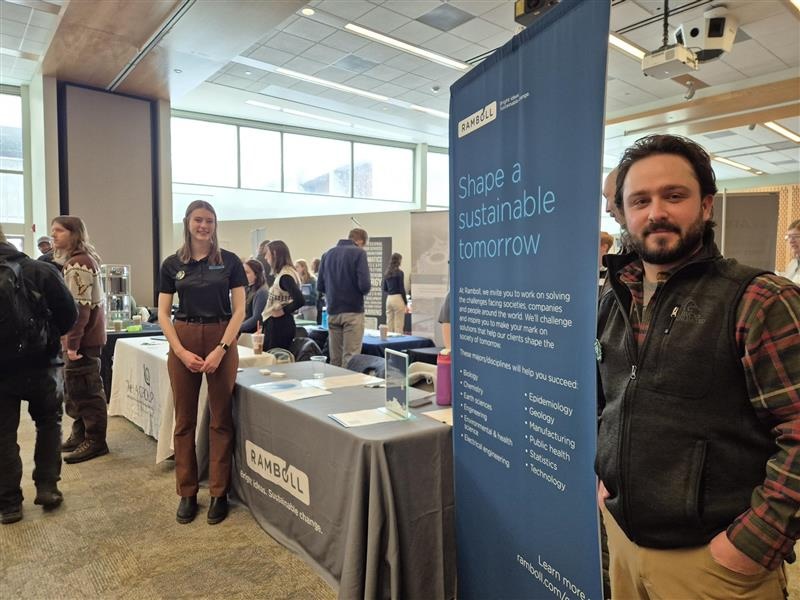
ESF alumni Alyssa Flint, '22, and Matt Dremimiller, '20, represent Ramboll at the ESF Career Fair.
ESF Career Fair Brings Alumni Back to Campus to Recruit and Reconnect
SYRACUSE, N.Y. — Feb. 12, 2026 — The SUNY College of Environmental Science and Forestry’s (ESF) Spring Career and Internship Fair moved beyond a traditional hiring event. It showcased a powerful cycle of connection: alumni returning to campus as employer representatives, students arriving with real-world experience, and shared academic backgrounds.
With more than 90 employers and organizations in attendance — including 20 first-time participants — the fair highlights the growing demand for ESF graduates across environmentally focused fields.
“More than a recruitment event, this fair reflects our mission in action,” said John Turbeville, director of career services and corporate engagement. “Bringing together employers and students to build futures, strengthen communities, and invest in the next generation of environmental leaders.”
At many of the employer tables, familiar faces greeted ESF students as alumni returned to campus as recruiters. At EDR, a multidisciplinary design, engineering, and environmental consulting firm, 18 percent of the company’s workforce holds one or more ESF degrees. That connection was on full display as alumni Matthew Ramano and Max Stamberger engaged with current landscape architecture students.
“The students here know us, which is great. And we also know them because we have so many alums on staff,” said Sarah Hecklau, talent acquisition manager at EDR. “When it’s an ESF student talking with a current staff member who’s an alum, I just sit back and let it happen because they already have so much in common.”
EDR’s ties with campus run deep. Team members have taught classes, offered guest lectures, and hosted students in the field. Many recruits come already equipped with practical experience from programs like Ranger School and Cranberry Lake.
“They just kind of hit the ground running,” Hecklau added. “There’s not as much of a learning curve. They come in knowing how to do wetland delineation, plant and animal surveys. They’ve already been out there.”
At the Ramboll table, a trio of recent ESF alumni welcomed students exploring roles in environmental engineering, wildlife science, and sustainability-focused consulting. Alumna Alyssa Flint said her company returned year after year because they value the hands‑on education ESF delivers.
“There’s a lot of sectors where a student can go in the company,” she said of the global architecture, engineering, and consultancy firm.
For Matt Dreimiller, a 2020 wildlife science graduate, Ramboll opened career paths he hadn’t considered as a student. He now works on major projects, including the incoming Micron development.
The event also served as a reunion for faculty and former students. Dr. Chuck Kroll, from ESF’s Department of Environmental Resources Engineering, stopped by the Ramboll table to talk with his former student, Tara Corr ’25, now a Ramboll employee, and to guide current students toward opportunities.
“I get to see what they’re up to and then I grab our juniors and seniors and I say, ‘Go see this person. Go talk to them,’” Kroll said, transforming the career fair into a multilevel networking hub.
The momentum at the fair was unmistakable. Turbeville noted that one first-time employer was so impressed after just 10 minutes that they vowed never to miss the fair again.
“That was a real testament to our students, the education they receive, and how they are applying it to launching their careers,” he said.
About SUNY ESF
The SUNY College of Environmental Science and Forestry (ESF) is dedicated to the study of the environment, developing renewable technologies, and building a sustainable and resilient future through design, policy, and management of the environment and natural resources. Members of the College community share a passion for protecting the health of the planet and a deep commitment to the rigorous application of science to improve the way humans interact with the world. The College offers academic programs ranging from the associate of applied science to the Doctor of Philosophy. ESF students live, study and do research on the main campus in Syracuse, N.Y., and on 25,000 acres of field stations in a variety of ecosystems across the state.