Recent Headlines
- Leaders Across Central New York and New York State Reflect on President Joanie Mahoney’s Legacy
- ESF President Joanie Mahoney Announces Plans to Retire in 2027
- SUNY ESF, DEC Expand Statewide Internship Partnership with $6.7 Million Agreement Through 2030
- ESF's Destinations & Degrees Draws Record Crowd of Students, Employers and Graduate Schools
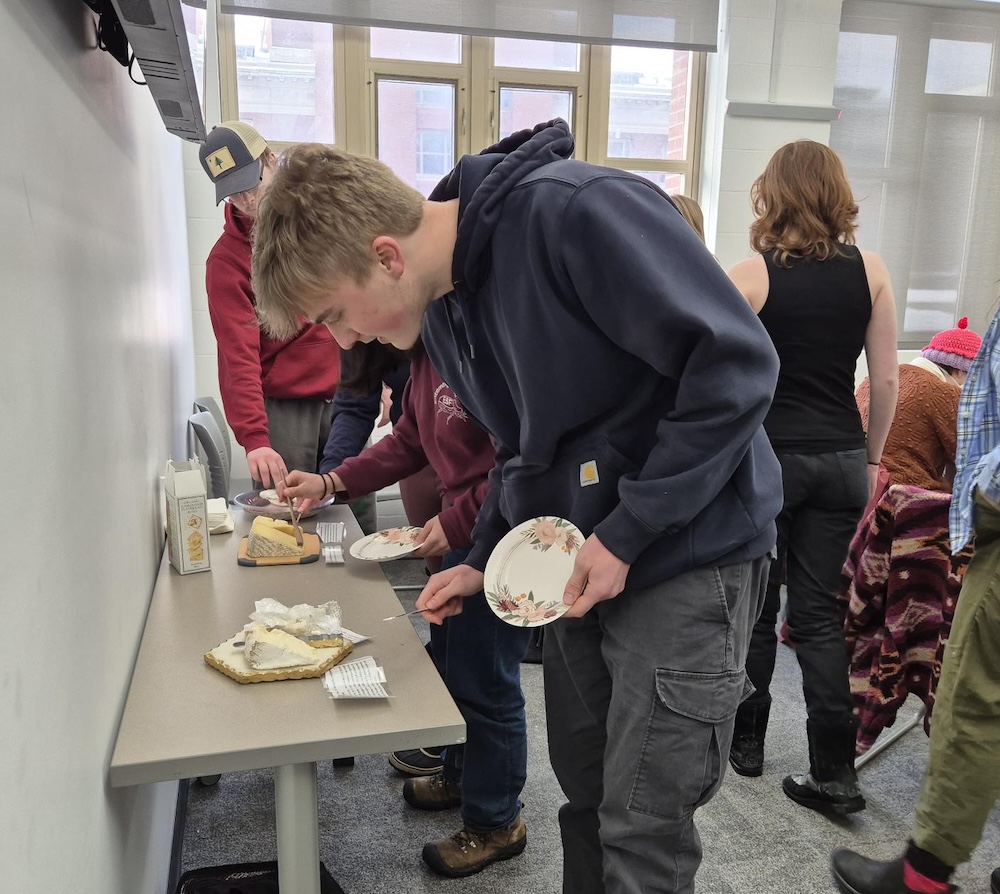
Students gather around a table to sample a variety of cheeses during Dr. Goff's microbial biochemistry class.
“Say cheese!”
Chemistry students learn a tasty lesson about fermentation
SYRAUCSE, N.Y. – Feb. 3, 2026 — The only thing blue in Dr. Jennifer Goff’s microbial biochemistry class this week was the cheese, as students enjoyed a small charcuterie while learning about fermentation at the SUNY College of Environmental Science and Forestry.
“To teach fermentations I like to frame it through cheese,” said Goff. “ I cover all the basics of fermentations work, but placing it in the world of cheese makes it more fun.”
Different cheeses have different ripening processes, Goff explained, so students sampled a variety to see — and taste — the science in action.
There was a Swiss-style cheese with holes created by gas-producing bacteria. There was a soft brie, which develops its flavor through a complex ripening process involving several microbial interactions.
Goff also brought in a blue cheese aged through a fungus that produces its distinctive blue pigment.
The cheeses were locally sourced from The Curd Nerd.
“So we have a wide representation of cheeses, “ she said, “but what we'll talk about is how bacteria or fungi that are living in the cheese take the lactose and sugars and convert them to help develop the cheese’s flavor.”
The cheese tasting is fun, but it also reflects the kind of hands‑on, microbe‑focused learning that defines Goff’s work and the department’s approach. By exploring everyday examples such as cheese fermentation, students get a tangible look at how microorganisms drive chemical processes — insight that connects directly to the biochemical research and applied science they pursue throughout the program.
About SUNY ESF
The SUNY College of Environmental Science and Forestry (ESF) is dedicated to the study of the environment, developing renewable technologies, and building a sustainable and resilient future through design, policy, and management of the environment and natural resources. Members of the College community share a passion for protecting the health of the planet and a deep commitment to the rigorous application of science to improve the way humans interact with the world. The College offers academic programs ranging from the associate of applied science to the Doctor of Philosophy. ESF students live, study and do research on the main campus in Syracuse, N.Y., and on 25,000 acres of field stations in a variety of ecosystems across the state.