Recent Headlines
- SUNY ESF Doctoral Student Earns Prestigious Fellowship from Nation's Oldest Scholarly Society
- SUNY ESF and Upstate Medical University Reintroduce Upstate Accelerated Scholars Program
- ESF Associate Professor Deepak Kumar Named 2026 Young Engineer of the Year
- ESF Installs Bird-Strike Mitigation Murals During Peak Migration Season
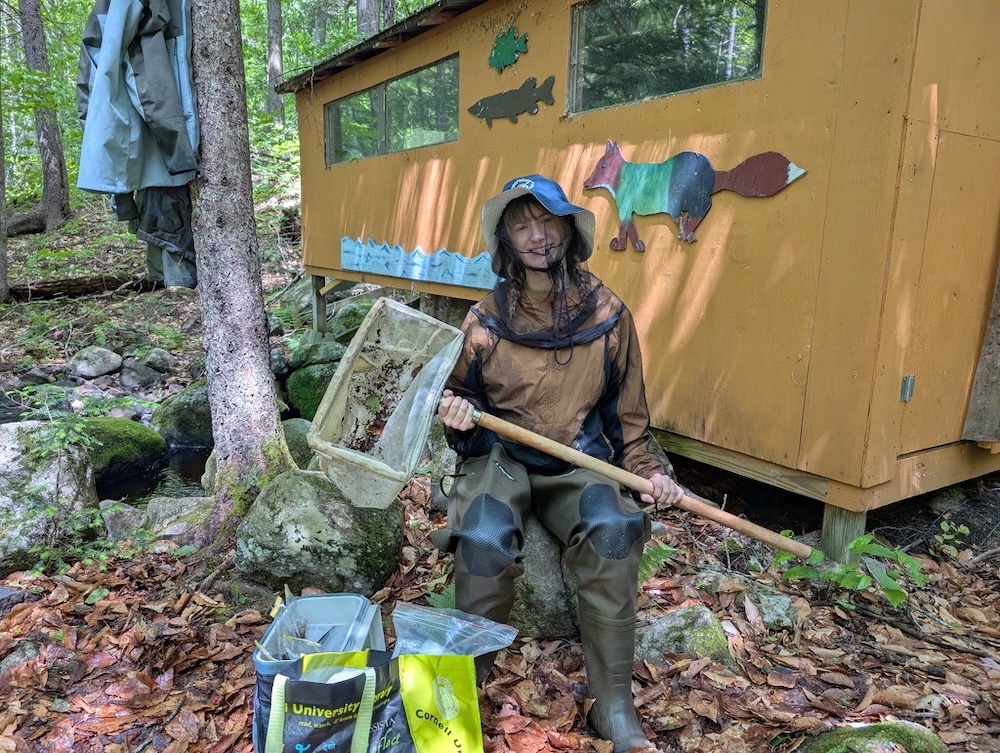
Elise Ruby spent her summer examining contaminants in fish from Buffalo, N.Y. waters. She conducted field work with NYSG, the U.S. Fish and Wildlife Service Lower Great Lakes Fish and Wildlife Conservation Office, and the Razavi Ecotoxicology Lab, helping catch fish and prep them in the lab for contaminant analyses.
Sea Grant Seeks Undergraduates for Summer Science Fellowship Program
SYRACUSE, N.Y. — March 9, 2026 — New York Sea Grant (NYSG) is looking for undergraduates to take part in the Community Engaged Fellowship (CEI), a nationwide program that provides unique opportunities to work with scientists, community groups and government agencies.
This summer, Megan Cochran, NYSG’s Great Lakes Outreach Coordinator, will mentor a student in Buffalo, N.Y., offering hands-on experience in science communication, storytelling, content creation, and partner engagement.
The student will collaborate virtually and in-person with past and current Great Lakes Basin Small Grants recipients to develop a handful of case studies highlighting community-based solutions to issues such as shoreline resilience, habitat restoration, watershed stewardship, and youth engagement. The fellow will conduct short interviews, review project materials, and transform project information into engaging stories and digital content such as graphics and short videos for NYSG’s outreach platforms.
This is one of three CEI opportunities being offered by NYSG statewide. The other two fellowships will be based in the Bronx (wetlands field data collection) and Stony Brook (East End Waterways Ambassador).
Applications for this summer’s 10-week fellowships, which will begin June 1 and include a $6,000 stipend, are being accepted through Tuesday, March 10 at www.seagrant.sunysb.edu/ceifellowships.
Since 2021, NYSG has provided numerous students with opportunities to gain field experience, attend professional development workshops, and engage in outreach that enriches the communities in which they work. Last summer, two ESF students took part in the program: sophomore Elise Ruby, who is working on a degree in environmental biology and junior Veda Keon, who is studying conservation biology with a minor in marine science and environmental writing and rhetoric.
“I got to work on a lot of different projects revolving around contaminant work”, said Ruby, who was mentored by Stacy Furgal, NYSG’s Great Lakes fisheries and ecosystem specialist, and Dr. Roxanne Razavi in the ESF’s Razavi Environmental Toxicology Lab. Her main project focused on comparing contaminants (such as PFAS, a synthetic chemical pollution, and mercury) and nutrient composition in both wild-caught and store-bought fish in Buffalo.
“We went out with partners from the U.S. Fish and Wildlife Service to electrofish for wild-caught fish from the upper Niagara River. Then we went out and purchased fish from five different local stores all around Buffalo.” Ruby and others in the Razavi lab then worked to process the fish samples to prepare them for analysis.
Ruby also assisted with the implementation of a three-day workshop hosted by NYSG and Cornell University, where representatives from government agencies and community organizations worked towards the goal of better aligning fishing regulations and consumption advisories.
As an additional part of the outreach portion of her internship, Ruby also had the opportunity to work on a podcast episode with Razavi for the podcast “Water Bodies.”
One of Ruby’s biggest takeaways from her internship experience was learning that research isn’t always going to be perfect.
“Sometimes you come up with a plan and it doesn't always happen [as expected]. You have to do the best you can with it,” Ruby said, recounting how sometimes plans changed on the fly when out in the field. “That was a big thing for me [as someone with] very little research experience — participating in research and learning that just because you have a plan doesn't necessarily mean you're going to be able to execute it the way you had planned it.”
Looking to the future, Ruby plans on wrapping up field work in the Adirondacks for another research project, finishing her podcast episode with Razavi, and working in the Ecotoxicology Lab this fall conducting lab work and — eventually — research.
Keon, who was mentored by Jessica Kuonen, NYSG’s Hudson Estuary resilience specialist, spent the summer conducting research on microplastic pollution in the Hudson River.
“My research project was comparing microplastic concentrations throughout the water column in the freshwater versus brackish water of the Hudson River,” Keon said. “I tested microplastic concentrations here at Norrie Point and then also down in Yonkers, and then compared those to see their results.”
While overall microplastic concentrations in water are becoming more common knowledge, Keon was specifically researching a different question — whether the concentration of microplastics are evenly distributed vertically through the column.
Keon also spent her summer helping out with numerous educational programs for local studies, including The Education And Microplastics Science Community River Assessment Project (TEAM SCRAP), a community-based program that collects and analyzes microplastic samples, and the 2025 Institute Discovering Environmental Scientists (TIDES), a paid research program for high schoolers.
“The community I was working with was primarily high school students; some of them had some science knowledge, some of them didn't,” Keon explained. “So a big thing that I learned this summer was that I had to really tailor how I was talking to who I was talking to, because not everybody has the same knowledge base that I do when it comes to science.”
About SUNY ESF
The SUNY College of Environmental Science and Forestry (ESF) is dedicated to the study of the environment, developing renewable technologies, and building a sustainable and resilient future through design, policy, and management of the environment and natural resources. Members of the College community share a passion for protecting the health of the planet and a deep commitment to the rigorous application of science to improve the way humans interact with the world. The College offers academic programs ranging from the associate of applied science to the Doctor of Philosophy. ESF students live, study and do research on the main campus in Syracuse, N.Y., and on 25,000 acres of field stations in a variety of ecosystems across the state.