Recent Headlines
- Leaders Across Central New York and New York State Reflect on President Joanie Mahoney’s Legacy
- ESF President Joanie Mahoney Announces Plans to Retire in 2027
- SUNY ESF, DEC Expand Statewide Internship Partnership with $6.7 Million Agreement Through 2030
- ESF's Destinations & Degrees Draws Record Crowd of Students, Employers and Graduate Schools
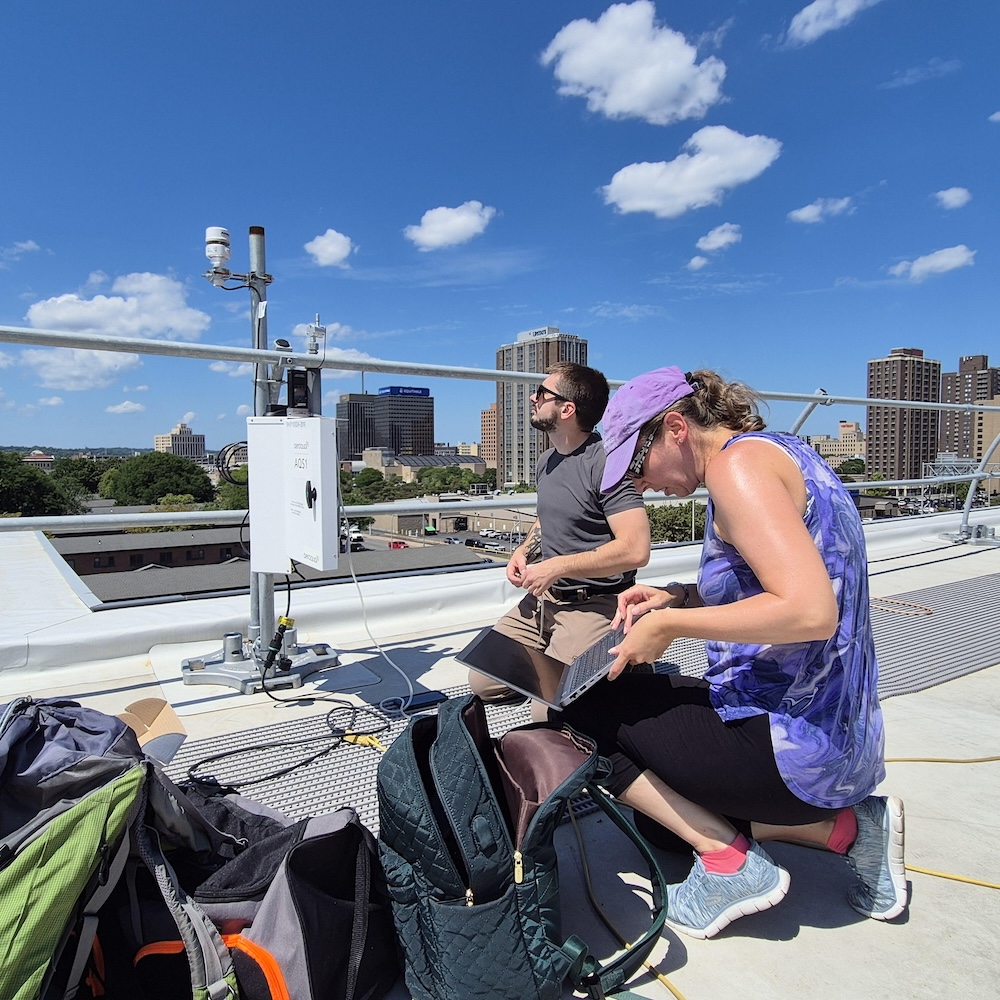
Dr. Jaime Mirowsky, right, and Jacob Wojcik service air quality monitoring station located at Upstate Medical University.
ESF-Led Air Monitoring Network Gives Real-Time Data During I-81 Construction
SYRACUSE, N.Y. — Sept. 21, 2026 — As construction of the Interstate 81 viaduct project continues, Syracuse residents now have access to real-time air quality information through a community-focused monitoring network led by researchers at the SUNY College of Environmental Science and Forestry (ESF). The network, established through a partnership among ESF, the Onondaga Environmental Institute (OEI), Upstate Medical University, Onondaga Earth Corps, Focusing Our Resources on Community Engagement (FORCE), the Syracuse City School District, and the City of Syracuse, provides publicly accessible air quality data from locations surrounding the I-81 construction corridor.
ESF President Joanie Mahoney said the project demonstrates the value of collaboration among educational institutions, community organizations, and public agencies. “The I-81 project presents a unique opportunity for universities, community organizations, and public agencies to work together in service of the public good,” Mahoney said. “Through this partnership, ESF is helping provide transparent, locally relevant air quality data that empowers residents and supports informed decision-making.”
Dr. Jaime Mirowsky, associate professor in ESF's Department of Chemistry, has helped lead the project and said the effort has been years in the making.
“We've spent the last three years building an air quality monitoring network around I-81 to better understand how ongoing construction may affect local air quality and to make that information available to the community,” Mirowsky said.
Recently, Mirowsky and Jacob Wojcik, a project scientist with OEI and an ESF alumnus, serviced one of the monitoring stations located on the roof of Upstate Medical University overlooking the construction corridor. During the visit, they also introduced Upstate medical students to the monitoring equipment and discussed the project's purpose and community impact.
One monitoring station was strategically placed at Upstate because of its proximity to the construction zone. The locations of the other four monitors were selected through a community-driven process that included public workshops and resident feedback.
“We received many location suggestions from community members,” Mirowsky said. “We focused on the sites residents were most interested in and concerned about. Community input was central to determining where the monitors would be located.”
Data from the monitors is available through a public online dashboard at https://www.oei2.org/airacuse/. The platform displays information gathered exclusively from the five Syracuse-area monitors, providing residents with localized air quality data tailored to their neighborhoods.
“We perform quality control on all of the data before making it available through the dashboard,” Mirowsky said. “Residents can view current conditions, track trends over time, and sign up to receive air quality alerts.”
Users can choose to receive alerts by text message or email when air quality conditions change. Mirowsky noted that the system proved particularly valuable in July, when smoke from Canadian wildfires affected air quality across Central New York.
The first monitor was installed in December 2025. With the addition of the latest monitoring stations, the network now includes five publicly accessible sites across Syracuse. Designed with accessibility in mind, the dashboard allows users to view current air quality conditions, explore historical data trends, and download raw data for independent analysis.
“Anyone can access the dashboard and download the data,” Mirowsky said. “Our goal is to make air quality information as transparent, accessible, and useful as possible.”
About SUNY ESF
The SUNY College of Environmental Science and Forestry is one of the nation's premier colleges focused on the study of the environment, developing renewable technologies, and building a sustainable future. ESF’s mission is to educate future environmental leaders of all backgrounds, advance knowledge, and skills necessary to promote scholarship and stewardship of the natural to designed environments, and act both locally and globally to Improve Our World. ESF’s students, faculty, staff, and alumni make a global impact on improving and sustaining the environment. ESF offers a world-class education among a close-knit community of more than 2,000 scholars with common values and a shared sense of purpose. ESF’s tight-knit community is centered alongside Syracuse University in the heart of Central New York and has a system of properties spanning 25,000 acres that broadly represent New York state’s rich ecological diversity for scientific study and instruction. To learn more, visit suny.edu.