Recent Headlines
- SUNY ESF’s Environmental Education & Interpretation Program Receives National Accreditation
- ESF Experts and Students Share Climate Education Resources at Statewide Science Teachers Conference
- National Champs! Mighty Oaks Cross-Country Teams Snag Title
- NYSP2I Presents Green Chemistry Workshop for Manufacturers at SUNY ESF
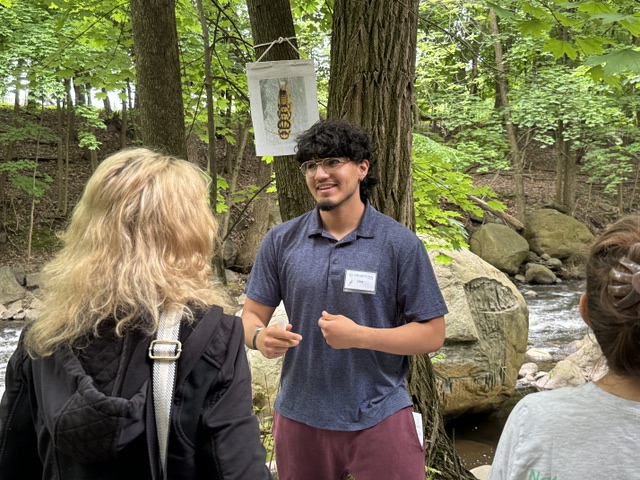
Environmental Education & Interpretation student Cristobal Garcia.
SUNY ESF’s Environmental Education & Interpretation Program Receives National Accreditation
Program is one of only 10 accredited programs nationally, and the only such program in SUNY
SYRACUSE, N.Y. — Nov. 12, 2026 — The Environmental Education and Interpretation (EE&I) program at the SUNY College of Environmental Science and Forestry (ESF) has earned accreditation from the North American Association for Environmental Education (NAAEE), a distinction held by only 10 programs nationwide and no other program in the SUNY system.
Students in the EE&I program learn how to teach people about the environment so they understand how the world around them works and how their actions affect the environment. The NAAEE Higher Education Accreditation recognizes programs that meet nationally recognized standards for high-quality degree programs that prepare environmental educators. The review process evaluates curriculum, faculty expertise, student learning outcomes, assessment practices, and program improvement efforts.
“The national accreditation of our Environmental Education and Interpretation program recognizes the exceptional preparation our students receive at ESF,” said ESF President Joanie Mahoney. “By combining scientific knowledge with communication and community engagement skills, the program prepares graduates to meet environmental challenges and make an immediate impact as educators and environmental leaders.”
EE&I prepares students to become environmental educators and communicators who help people understand issues such as conservation, climate change, and environmental justice. Students gain scientific knowledge and practical communication skills that prepare them to educate and engage people on environmental issues.
The coursework goes beyond the classroom. Through experiential learning — including internships — students have the opportunity to earn professionally-recognized credentials and certifications.
“My conservation biology coursework provided a strong ecological foundation, but the EE&I program is where I gained some of the most practical skills for a career in education,” said senior Julia Payment. Working with the ESF’s Outreach programs and serving as a teaching assistant for two courses, Payment found her calling. “Those experiences have shown me how impactful education can be when you meet people where they are.”
The accreditation highlights the quality of preparation ESF students receive in the program.
“Being one of only 10 accredited programs in the nation places ESF among a select group of institutions recognized for excellence in environmental education preparation,” said Dr. Lindi Quackenbush, provost and vice president for research. “It reflects the strength of the curriculum, the dedication of our faculty, and ESF’s commitment to providing students with a high-quality educational experience.”
As environmental issues continue to dominate the news, it’s increasingly important to have professionals who can help people understand the headlines.
“This recognition highlights the strength and impact of environmental education as a profession,” said Shari Dann, associate professor of environmental studies and an EE&I faculty member. “As environmental issues become increasingly visible in everyday life, there is a growing need for professionals who can communicate science clearly and engage communities in productive conversations.”
The College’s EE&I program has long prepared graduates for careers in the field. Graduates of the program go on to help people connect with and understand the natural world in settings ranging from parks, museums, and zoos to community organizations, conservation groups, and government agencies. They work as educators, interpreters, outreach professionals, and communicators, helping others learn about environmental issues and engage with their communities. The program also provides a strong foundation for graduate study and careers in teaching and other education fields.
You can learn more about the Environmental Education and Interpretation program at ESF here.
About SUNY ESF
The SUNY College of Environmental Science and Forestry is one of the nation's premier colleges focused on the study of the environment, developing renewable technologies, and building a sustainable future. ESF’s mission is to educate future environmental leaders of all backgrounds, advance knowledge, and skills necessary to promote scholarship and stewardship of the natural to designed environments, and act both locally and globally to Improve Our World. ESF’s students, faculty, staff, and alumni make a global impact on improving and sustaining the environment. ESF offers a world-class education among a close-knit community of more than 2,000 scholars with common values and a shared sense of purpose. ESF’s tight-knit community is centered alongside Syracuse University in the heart of Central New York and has a system of properties spanning 25,000 acres that broadly represent New York state’s rich ecological diversity for scientific study and instruction. To learn more, visit suny.edu.