Recent Headlines
- Award-Winning Ocean Research Raises Questions About Global Carbon Estimates
- At ESF, Where There’s Smoke, There’s Prescribed Fire Being Taught
- SUNY ESF Earns National Recognition for Excellence in Student Mental Health and Counseling Services
- ESF Hosts SUNY Academic Momentum Regional Convening Focused on Student Success
Emily Friden
Award-Winning Ocean Research Raises Questions About Global Carbon Estimates
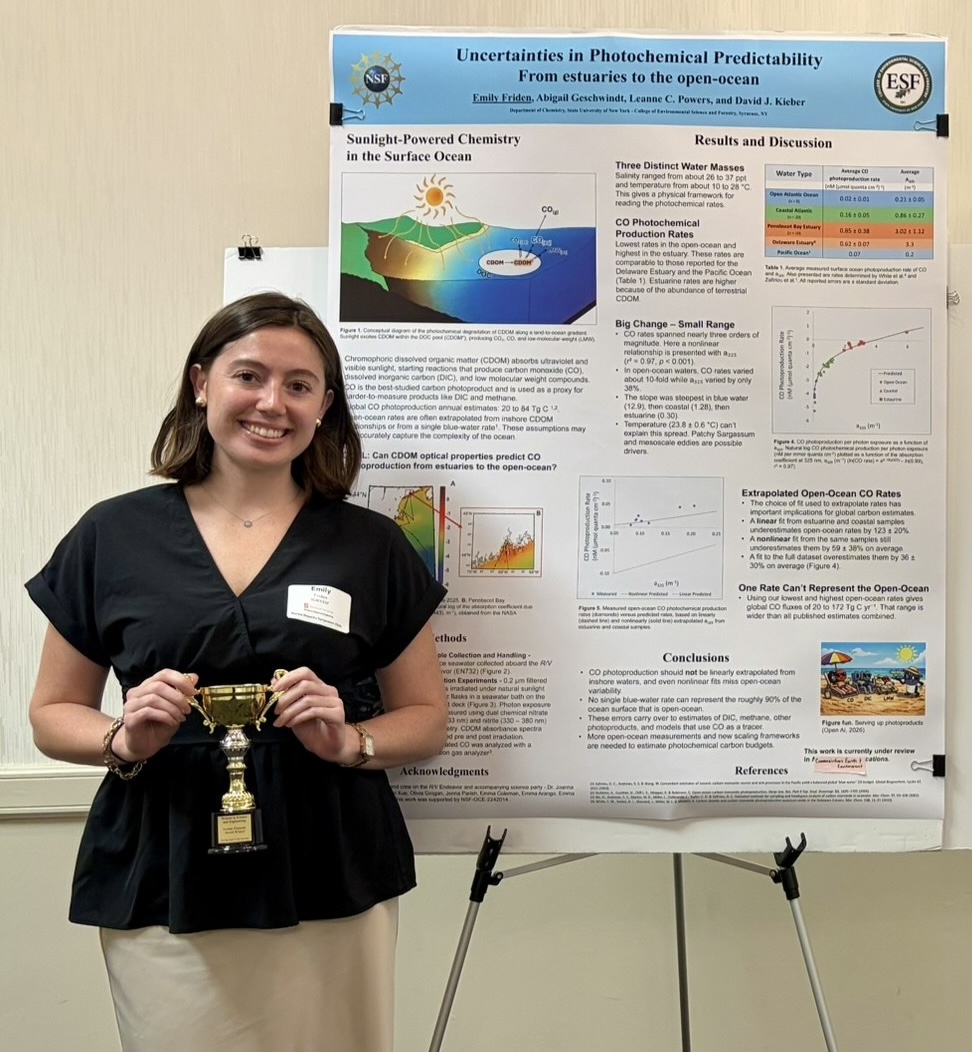
Emily Friden earns second-place honors at the 2026 Norma Slepecky Symposium for research showing that open-ocean carbon cycling may be far less predictable than previously believed.
SYRACUSE, N.Y. – Nov. 3, 2026 – Emily Friden, a doctoral student in the Department of Chemistry at the SUNY College of Environmental Science and Forestry (ESF), earned a second-place trophy at the 2026 Norma Slepecky Symposium for research that challenges long-held assumptions about how sunlight drives carbon cycling across the world's oceans.
Friden, a Ph.D. candidate co-advised by Leanne Powers and David Kieber, presented her research, “Uncertainties in Photochemical Predictability: From Estuaries to the Open Ocean.” Co-authors on the project include Friden, Abigail Geschwindt, Leanne Powers and David Kieber, all of ESF's Department of Chemistry.
“Emily's work is a great example of what makes ESF students so impressive,” said Joanie Mahoney, president of ESF. “Emily is asking important questions, tackling a complex environmental challenge and contributing knowledge that can help us better understand our changing planet. We're thrilled to see Emily recognized with this award.”
The research investigates how sunlight interacts with colored dissolved organic matter (CDOM) in seawater. When sunlight is absorbed by CDOM, it triggers reactions that can convert organic carbon into gases such as carbon dioxide (CO₂) and carbon monoxide (CO). Scientists frequently use CO measurements as a proxy for estimating the amount of carbon transformed through these light-driven processes, but most existing data come from coastal environments.
“Scientists have long relied on coastal measurements to estimate what is happening across the open ocean,” Friden said. “Our results show that approach may introduce much greater uncertainty than previously recognized.”
To explore the issue, Friden collected surface seawater samples during a June 2025 research expedition aboard the R/V Endeavor. Samples were gathered from Maine's Penobscot Bay, locations along the East Coast and the Sargasso Sea. The team exposed the samples to natural sunlight and measured how much carbon monoxide each sample produced.
The findings revealed that open-ocean waters are far more variable than expected. Water samples that appeared nearly identical based on optical properties produced significantly different amounts of carbon monoxide. The study also found that estimates derived from estuarine and coastal waters often failed to accurately predict open-ocean conditions, with some calculations differing by more than 50% and others by more than double.
“Emily has taken on an incredibly challenging research question and approached it with creativity, determination and scientific rigor,” said Lee Newman, associate professor and chair of the Department of Chemistry. “It's exciting to see her work recognized because these findings have the potential to influence how scientists think about carbon cycling across much of the world's oceans.”
Perhaps most significantly, the research suggests existing global estimates of sunlight-driven carbon release from the oceans may be substantially more uncertain than previously believed. Using open-ocean measurements collected during the study, Friden found the potential range of annual carbon release exceeds the uncertainty encompassed by all modern estimates combined.
“About 90 percent of the ocean’s surface is open ocean, yet much of what we know about these processes comes from coastal waters,” Friden said. “To better understand the ocean's role in the global carbon cycle, we need more measurements from the open ocean itself.”
The findings have important implications for ocean carbon budgets and the environmental models used to predict climate-related processes. Because carbon monoxide estimates are often used to infer production of other carbon compounds, including carbon dioxide, uncertainty in one measurement can cascade through broader assessments of ocean carbon cycling.
“What stands out about Emily's research is that it challenges assumptions and pushes the science forward,” said Lindi Quackenbush, provost of ESF. “That's what a great scholarship does. This recognition reflects not only the quality of her work, but also the persistence and curiosity that drive meaningful discovery.”
The research was supported by the National Science Foundation through grant NSF-OCE-2242014. A manuscript based on the work is currently under review at Communications Earth & Environment.
About SUNY ESF
The SUNY College of Environmental Science and Forestry is one of the nation's premier colleges focused on the study of the environment, developing renewable technologies, and building a sustainable future. ESF’s Mission is to educate future environmental leaders of all backgrounds, advance knowledge, and skills necessary to promote scholarship and stewardship of the natural to designed environments, and act both locally and globally to Improve Our World. ESF’s students, faculty, staff, and alumni make a global impact on improving and sustaining the environment. ESF offers a world-class education among a close-knit community of more than 2,000 scholars with common values and a shared sense of purpose. ESF’s tight-knit community is centered alongside Syracuse University in the heart of Central New York and has a system of properties spanning 25,000 acres that broadly represent New York state’s rich ecological diversity for scientific study and instruction. To learn more, visit www.esf.edu.