Recent Headlines
- National Champs! Mighty Oaks Cross-Country Teams Snag Title
- SUNY Chancellor King Announces Third Year of Internship Exchange Program with University of Puerto Rico and Conservation Organization Para La Naturaleza
- NYSP2I Presents Green Chemistry Workshop for Manufacturers at SUNY ESF
- Meet the Faculty - Danielle Kloster
National Champs 2026
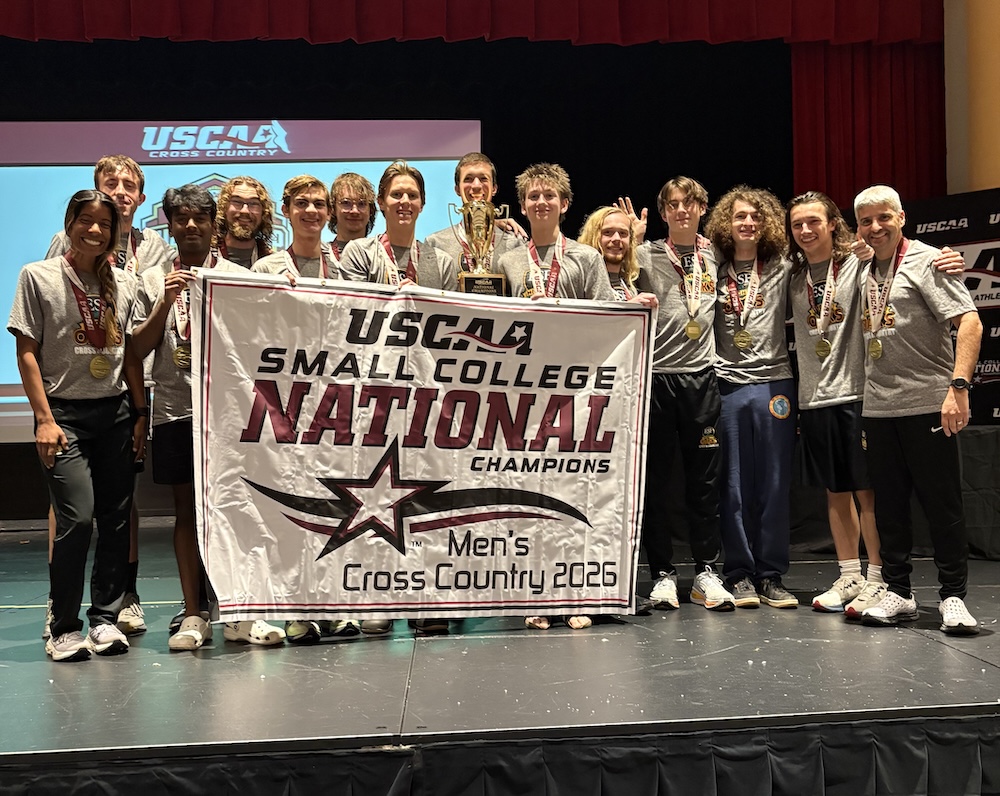
National Champs! Mighty Oaks Cross-Country Teams Snag Title
Men’s team makes history as only team to win six straight
LAMONT FURNACE, Pa. — Nov. 7, 2026 — The ESF women’s and men’s cross country teams ran to first-place finishes at the United States Collegiate Athletic Association (USCAA) National Championship at Penn State Fayette in Lamont, Pennsylvania.
The men’s team made history as the only team in USCAA history to win six consecutive titles in any sport in the association.
In the 6K women’s race, ESF won with 18 points, coming in ahead of Christendom College, 65 points. The ESF team had seven runners finish in the top 10: Tee Atwater, second; Gabrielle McKenzie, third; Erica Angelillo, fifth; Camila Garcia, sixth; Evelyn Corcoran, seventh; Keelyn Simpson, ninth; and Reese Dimon, 10th.
Women runners named to the First Team All-American were Atwater, McKenzie, Angelillo, Garcia, and Corcoran. Second Team All-American runners were Simpson, Dimon, Bailey Townsend, 11th; Maizie Frank, 12th; Grace Tanski, 13th and Ella Roenfeldt, 14th.
In the 8K men’s race, the Mighty Oaks secured victory with 33 points, putting them 45 points ahead of second-place finishers Christendom College. Four ESF runners finished in the top 10: Aidan Watts, fifth; Eric Wilson, sixth; Jack Clyne, seventh and Jonah Kendall, eighth.
Runners named to the First Team All-American were Watts, Wilson and Clyne. Receiving Second Team All-American honors were Kendall and Lee Chandler, 12th.
“To win multiple national titles in any sport, any division is a tough task,” said Coach Mike Melfi. “Our student-athletes step up year after year. Many of our practices are early in the morning when no one is watching. This accomplishment is because of their hard work and dedication, along with the ESF cross-country alumni who did it before them.”
“Our depth really proved to help us today and all season. If someone doesn’t have their best race, we may have two that have great races. We have each other’s backs if things don’t go the way they should for someone,” said team captain Gabrielle McKenzie, a sophomore environmental science major.
“Being on this team has changed my life,” said men’s team captain Robby Slater. “I wasn’t even sure I was going to run or compete after high school and then I came to ESF on a recruiting visit, met the team and coaches and the rest is history.” Slater is a senior majoring in environmental resources engineering.
“We are incredibly proud of our men's and women's cross-country teams,” said ESF President Joanie Mahoney. “Winning the USCAA Small College National Championship for the sixth consecutive year is an amazing accomplishment. Congratulations to all our runners and Coach Mike Melfi on another outstanding season. What a wonderful achievement for ESF!”
About ESF
The SUNY College of Environmental Science and Forestry is one of the nation's premier colleges focused on the study of the environment, developing renewable technologies, and building a sustainable future. ESF’s mission is to educate future environmental leaders of all backgrounds, advance knowledge, and skills necessary to promote scholarship and stewardship of the natural to designed environments, and act both locally and globally to Improve Our World. ESF’s students, faculty, staff, and alumni make a global impact on improving and sustaining the environment. ESF offers a world-class education among a close-knit community of more than 2,000 scholars with common values and a shared sense of purpose. ESF’s tight-knit community is centered alongside Syracuse University in the heart of Central New York and has a system of properties spanning 25,000 acres that broadly represent New York state’s rich ecological diversity for scientific study and instruction. To learn more, visit suny.edu.