Recent Headlines
- Leaders Across Central New York and New York State Reflect on President Joanie Mahoney’s Legacy
- ESF President Joanie Mahoney Announces Plans to Retire in 2027
- SUNY ESF, DEC Expand Statewide Internship Partnership with $6.7 Million Agreement Through 2030
- ESF's Destinations & Degrees Draws Record Crowd of Students, Employers and Graduate Schools
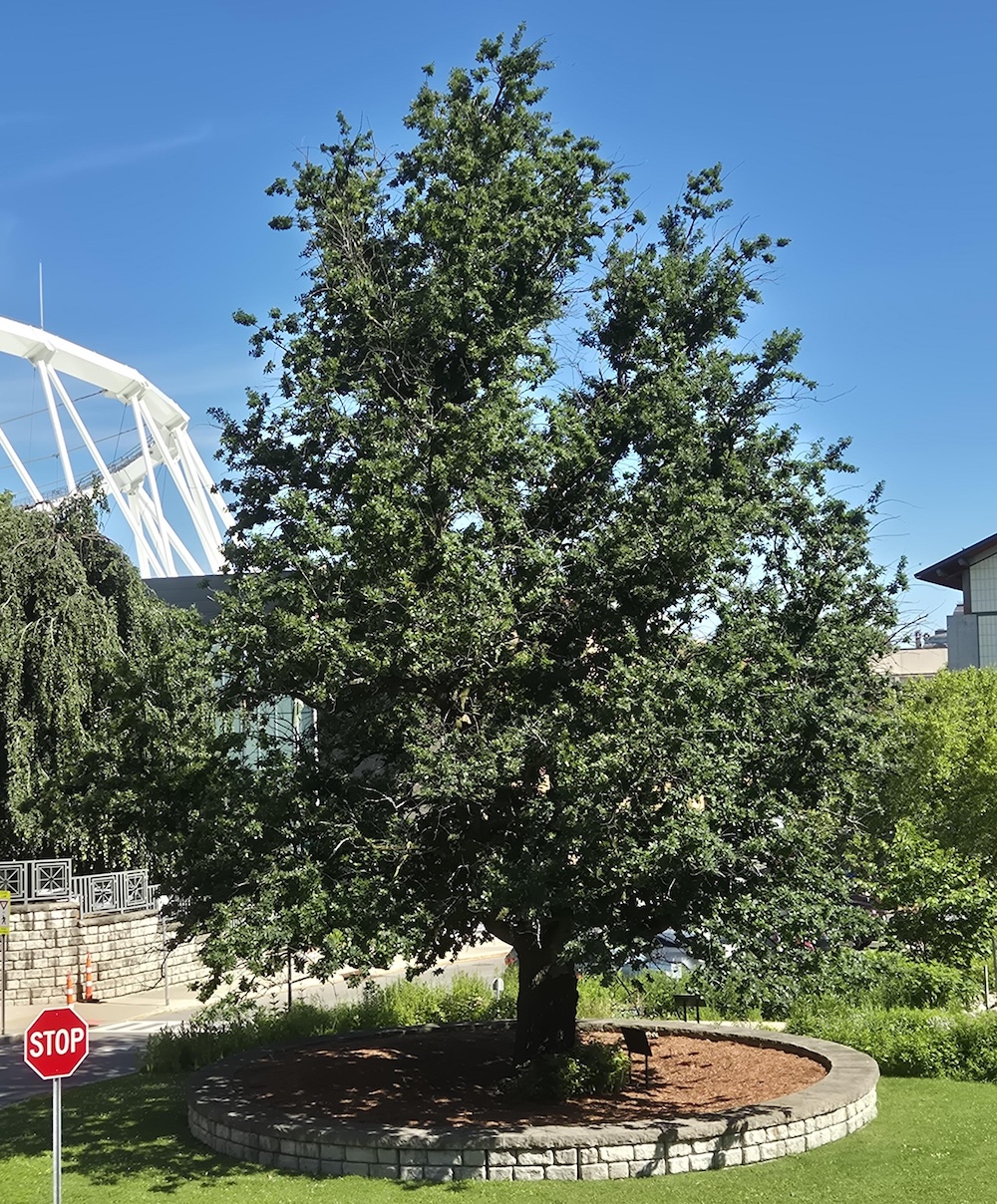
Robin Hood Oak on ESF's Syracuse campus.
From Fallen Giant to Living Legacy: SUNY ESF Carries the Major Oak Forward
SYRACUSE, N.Y. — June 25, 2026 —The Major Oak of Sherwood Forest in England — long believed by legend to have sheltered Robin Hood and his merry men — died on June 16, 2026, at an estimated age of 1,500 years. It is survived by the Robin Hood Oak located on the campus of the SUNY College of Environmental Science and Forestry (ESF).
“Ancient trees such as the Major Oak are irreplaceable ecological and cultural landmarks,” said ESF President Joanie Mahoney. “Their loss is deeply felt, not only because of their age and scale, but because of the stories and identity they carry. At ESF, caring for the Robin Hood Oak allows us to carry that legacy forward through research, conservation, and education for future generations.”
“There’s no doubt about the Major Oak’s size — it was huge and magnificent — and that alone makes it special, regardless of its exact age,” said Distinguished Teaching Professor Donald Leopold.
ESF’s Robin Hood Oak grew from an acorn collected on the ground below the Major Oak in 1926 by Professor Nelson C. Brown of the then College of Forestry.
“Given that the Major Oak is an English oak (Q. robur) and very similar to our native white oak (Q. alba), that acorn would have germinated that fall, making our Robin Hood Oak 100 years old this year,” noted Leopold.
While the loss of the original tree marks the end of a remarkable chapter, its legacy continues at ESF through conservation and propagation efforts.
In addition, ESF alumni have successfully cultivated seedlings from the tree, expanding its living legacy beyond Sherwood Forest and demonstrating the important role that individuals and institutions can play in long-term conservation.
Allison Oakes, ESF alumna, BS ’09, Ph.D. ’15, and assistant teaching professor at Syracuse University, propagated the Robin Hood Oak from tissue culture while working in the late Dr. Chuck Maynard’s tissue culture lab at ESF.
“The harder a plant is to propagate naturally, the harder it is to tissue culture.” Oakes explained.
“Spider plants and strawberries literally do it themselves with runners and are easy to multiply. Oaks — and many hardwoods, such as chestnut — are more difficult because of their high levels of tannins and other phenolic compounds, which are useful to prevent infection or herbivory but can be toxic to delicate tissues.”
Oakes took on the Robin Hood oak project as a "but what if I can make it work?" challenge.
Two of those clones now grace the entrance of ESF’s Moon Library. “That was a fun project, and I really enjoyed working with such a beloved ESF tree,” Oakes said.
Dr. Deb Hilbert used the Robin Hood Oak in her Introduction to Arboriculture and Heritage Tree Management classes. They did a series of risk and health assessments on the tree throughout the semester. They started with low-tech (visual tree assessments, soil testing) and moved to advanced risk assessment tools (hand drill, resistograph). Josh Galiley if Arbor Consulting LLC in Rochester visited the classes and demonstrated the use of resistance drill technology to determine the extent of sound wood vs. decayed wood in a tree.
This fall, her Arboriculture Class will use the newest technology (sonic tomography and Light Detection and Ranging scans, LiDAR). LiDAR is a remote sensing method that uses light in the form of a pulsed laser for measurement.
The LiDAR component will be conducted in partnership with Adbian. The class will conduct the LiDAR scan and Adbian will run the analysis, generating the report and presenting it to the class.
“Given it's the Robin Hood Oak's 100th birthday in 2026, I figured we'd give it a full workup this semester,” Hilbert said.
Leopold noted, “One of the most important lessons when iconic trees die is that it brings attention to trees people often overlook and helps educate the public about tree age and mortality. The idea that trees eventually die is unfamiliar to many people, but every species is different — some die after 100 years, some after 1,000, and some in 5,000 years. That’s one of the many cool things about tree biology.”
About SUNY ESF
The SUNY College of Environmental Science and Forestry (ESF) is dedicated to the study of the environment, developing renewable technologies, and building a sustainable and resilient future through design, policy, and management of the environment and natural resources. Members of the College community share a passion for protecting the health of the planet and a deep commitment to the rigorous application of science to improve the way humans interact with the world. The College offers academic programs ranging from the associate of applied science to the Doctor of Philosophy. ESF students live, study and do research on the main campus in Syracuse, N.Y., and on 25,000 acres of field stations in a variety of ecosystems across the state.