Recent Headlines
- Leaders Across Central New York and New York State Reflect on President Joanie Mahoney’s Legacy
- ESF President Joanie Mahoney Announces Plans to Retire in 2027
- SUNY ESF, DEC Expand Statewide Internship Partnership with $6.7 Million Agreement Through 2030
- ESF's Destinations & Degrees Draws Record Crowd of Students, Employers and Graduate Schools
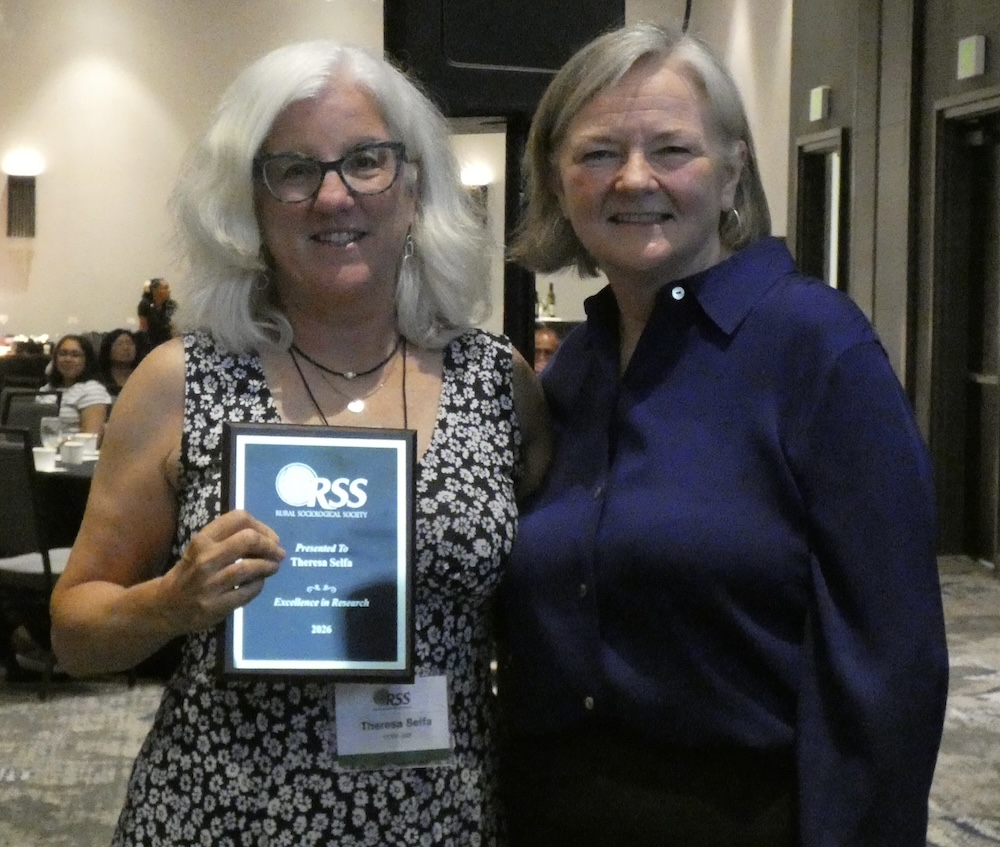
Dr. Theresa Selfa, pictured left.
ESF Professor and Department Chair Theresa Selfa Receives Rural Sociological Society's 2026 Excellence in Research Award
SYRACUSE, N.Y. – Sept. 1, 2026 — Dr. Theresa Selfa, professor and chair of the Department of Environmental Studies at the SUNY College of Environmental Science and Forestry (ESF), has received the 2026 Excellence in Research Award from the Rural Sociological Society (RSS), one of the highest honors in the field of rural sociology. The award recognizes outstanding contributions to rural-oriented research and theory by members of the Society.
Selfa was selected for the award in recognition of her distinguished record of scholarship examining the social dimensions of environmental governance, sustainable agriculture and food systems, rural communities, and emerging technologies in agriculture. Throughout her career, her research has helped shape understanding of how environmental, economic, and social changes affect rural people and places.
“Dr. Selfa’s work exemplifies the interdisciplinary and solutions-oriented research that defines ESF,” said ESF President Joanie Mahoney. “Theresa’s scholarship has advanced understanding of some of the most pressing environmental and societal challenges facing rural communities, while informing policy and practice at local, national, and global scales. We are delighted to see her receive this well-deserved recognition.”
“Dr. Selfa's scholarship demonstrates the highest standards of academic research and public engagement,” said ESF Provost Lindi Quackenbush. “Theresa’s ability to bridge environmental science, social science, and community needs has produced research that is both intellectually rigorous and deeply relevant. In addition to her significant scholarly contributions, she has been an outstanding mentor and leader whose work strengthens ESF's research mission and enriches the student experience.”
The Rural Sociological Society's Excellence in Research Award honors scholars whose work has made exceptional contributions to rural-oriented research and theory. Selfa joins a distinguished group of past recipients whose scholarship has shaped the field of rural sociology for decades.
A nationally and internationally recognized scholar, Selfa's research focuses on environmental governance, sustainability, agriculture and food systems, science and technology studies, and rural development. Her work has examined topics ranging from sustainable agriculture and bioenergy development to public trust in emerging agricultural technologies and the impacts of environmental change on communities and natural resource systems.
“I am honored to receive this award from the Rural Sociological Society,” Selfa said. “Rural communities and landscapes have been used as sites of resource extraction, but the environmental and community impacts in rural areas often receive less attention. My research has highlighted these issues in order to support more equitable and sustainable futures in rural communities.”
As chair of ESF's Department of Environmental Studies, Selfa has mentored graduate and undergraduate students while leading externally funded research projects that connect social science perspectives with environmental problem-solving. Her work embodies ESF's commitment to interdisciplinary research and public impact.
The Rural Sociological Society, founded in 1937, is an international professional association dedicated to advancing social scientific understanding of rural people, places, and environments. Through research, education, and public engagement, the Society promotes scholarship that informs policy and contributes to the well-being of rural communities.
About SUNY ESF
The SUNY College of Environmental Science and Forestry (ESF) is dedicated to the study of the environment, developing renewable technologies, and building a sustainable and resilient future through design, policy, and management of the environment and natural resources. Members of the College community share a passion for protecting the health of the planet and a deep commitment to the rigorous application of science to improve the way humans interact with the world. The College offers academic programs ranging from the associate of applied science to the Doctor of Philosophy. ESF students live, study, and conduct research on the main campus in Syracuse, N.Y., and on 25,000 acres of field stations in a variety of ecosystems across New York state.