Recent Headlines
- ESF to Honor Rhea Jezer and Damian Vanetti with 2026 Sol Feinstone Environmental Award
- SUNY ESF Doctoral Student Earns Prestigious Fellowship from Nation's Oldest Scholarly Society
- SUNY ESF and Upstate Medical University Reintroduce Upstate Accelerated Scholars Program
- ESF Associate Professor Deepak Kumar Named 2026 Young Engineer of the Year
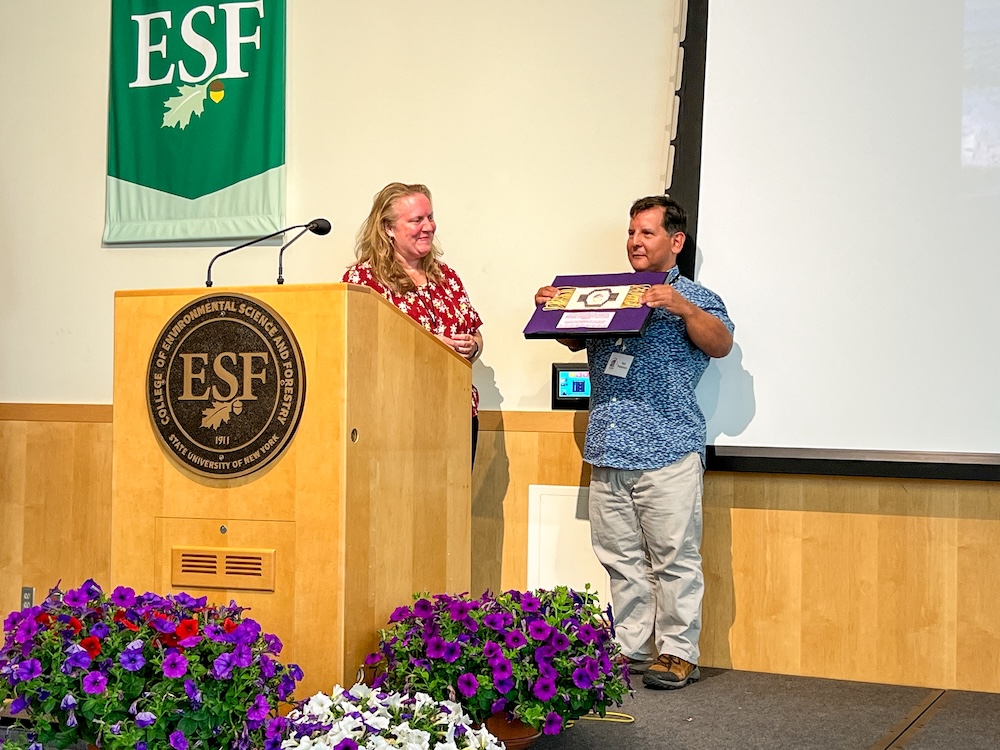
Dr. Rebecca Rundell, left, and Neil Patterson, Center for Native Peoples and the Environment director
ESF Hosts National Malacology Meeting Highlighting Indigenous Wampum Exchange and Mollusk Traditions
SYRACUSE, N.Y. — June 16, 2026 — Highlighting Indigenous knowledge and wampum exchange, the 92nd annual meeting of the American Malacological Society (AMS) is being held June 15–19 at the SUNY College of Environmental Science and Forestry (ESF) in Syracuse, bringing scientists and students together to explore the cultural and ecological significance of mollusks.
The meeting opened with a symposium presented in collaboration with ESF’s Center for Native Peoples and the Environment (CNPE) that emphasizes Indigenous relationships with mollusks and the enduring importance of wampum in Haudenosaunee culture and history.
A central moment of the opening program was the presentation of a specially created wampum belt to the AMS and CNPE Tuesday morning in ESF’s Gateway Center. Neil Patterson, CNPE director, accepted the wampum belt on behalf of the Center. The belt will be used as a special teaching tool with students and for outreach in the community.
Crafted by Richard Hamell for the meeting, the belt features a polished central Mercenaria shell and recognizes Syracuse’s place within the Haudenosaunee Confederacy, whose Central Fire is located with the Onondaga Nation. Wampum belts, including historic treaties such as the Two Row Wampum, have long served as records of agreements, relationships and responsibilities.
The opening symposium, “Indigenous mollusk research, uses, and relationships,” featured keynote speaker Michael Galban, a wampum expert and historic site manager of Ganondagan Historic Site and director of the Seneca Art and Culture Center. Additional speakers include Shavonne Smith of the Shinnecock Nation, who will discuss shellfish traditions and restoration, and Mike McCann of the Billion Oyster Project, who will examine the ecological and cultural impacts of historical oyster harvesting and current restoration efforts.
“This meeting reflects both the scientific importance of mollusks and their deep cultural significance,” said Dr. Rebecca Rundell, AMS president and associate professor in ESF’s Department of Environmental Biology. “By centering Indigenous knowledge and traditions such as wampum exchange, we aim to foster dialogue that connects science, history and stewardship.”
Programming continues with a panel discussion on collaborating with Indigenous researchers, knowledge keepers and communities, reflecting growing interest among AMS members in ethical and meaningful partnerships. The panel includes representatives from ESF, the American Museum of Natural History, Syracuse University, and the Onondaga Environmental Institute.
Attendees will also have opportunities to engage more deeply with these themes through informal interactions with speakers and the presence of Haudenosaunee vendors offering Indigenous-made crafts during meeting events.
The conference includes additional scientific sessions on topics ranging from Pacific Island land snail conservation to a New York–focused case study on the endangered Chittenango ovate amber snail. Field experiences, workshops and tours, including visits to Chittenango Falls State Park and the Museum of the Earth in Ithaca, round out the program.
The AMS meeting draws 81 registrants and features 55 scientific abstracts presented as talks and posters. Organizers say hosting the event at ESF strengthens connections between research, place and community.
“ESF is honored to host the American Malacological Society and welcome scholars from across the country to Syracuse,” said ESF President Joanie Mahoney. “This meeting is especially meaningful as it recognizes the cultural and ecological connections between people and the natural world, including the enduring significance of wampum. As a college located on the ancestral lands of the Haudenosaunee, we are proud to support this exchange of knowledge and to help foster respectful partnerships that honor Indigenous traditions and stewardship.”
About SUNY ESF
The SUNY College of Environmental Science and Forestry (ESF) is dedicated to the study of the environment, developing renewable technologies, and building a sustainable and resilient future through design, policy, and management of the environment and natural resources. Members of the College community share a passion for protecting the health of the planet and a deep commitment to the rigorous application of science to improve the way humans interact with the world. The College offers academic programs ranging from the associate of applied science to the Doctor of Philosophy. ESF students live, study and do research on the main campus in Syracuse, N.Y., and on 25,000 acres of field stations in a variety of ecosystems across the state.