Recent Headlines
- From Research Field to Public Art: ESF-Donated Willow Shapes New Thornden Park Installation
- CNY ASM Conference Brings Microbiologists from Central New York and Beyond Together
- ESF Honors Rhea Jezer and Damian Vanetti with 2026 Sol Feinstone Environmental Award
- SUNY ESF Doctoral Student Earns Prestigious Fellowship from Nation's Oldest Scholarly Society
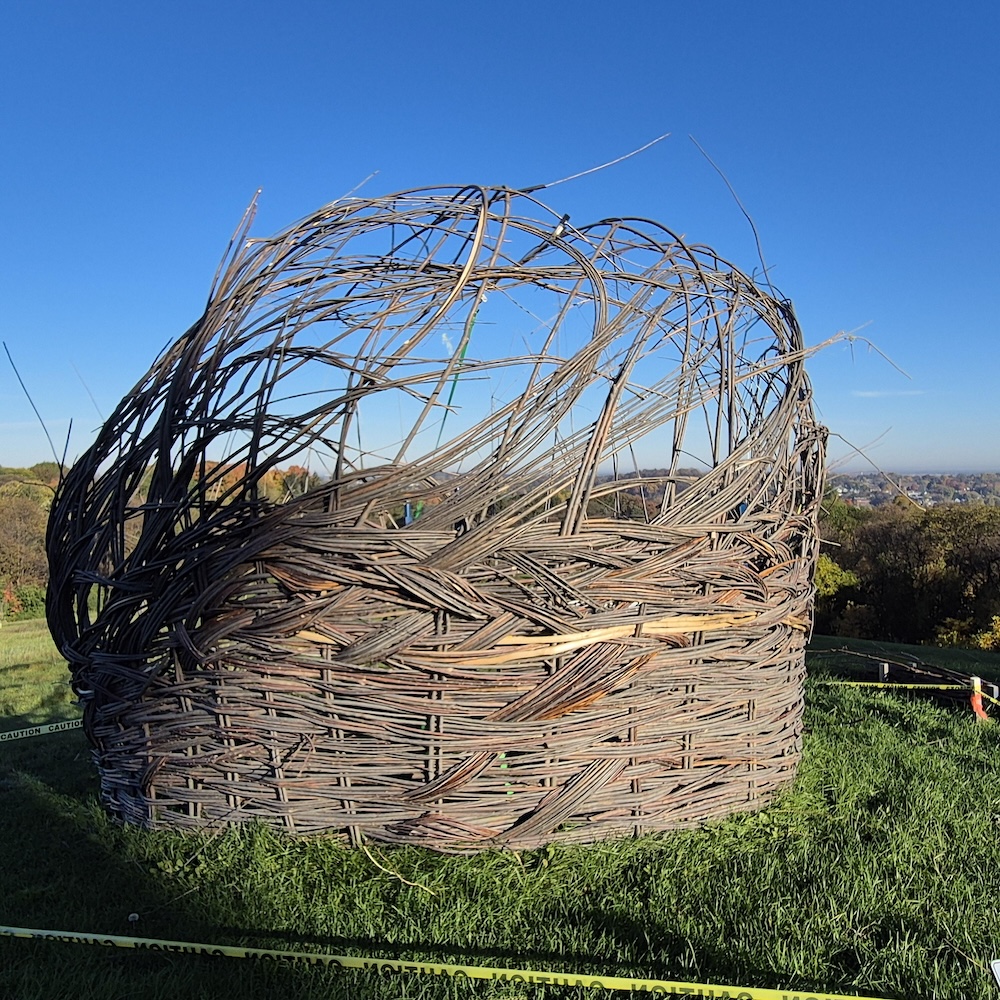
The Paths We Weave
From Research Field to Public Art: ESF-Donated Willow Shapes New Thornden Park Installation
The Paths We Weave highlights the intersection of sustainability, research, design, and community partnership
SYRACUSE, N.Y. – Oct. 28, 2026 – Visitors to Thornden Park can now experience a unique blend of art, landscape, and environmental stewardship through The Paths We Weave, a new public art installation featuring monumental woven willow sculptures crafted with willow donated by the SUNY College of Environmental Science and Forestry (ESF). The immersive artwork transforms the hillside below the park’s iconic water tower into a place for reflection, exploration, and community connection.
Created by artists Sydney Schultz and Laura Reeder, the installation combines large-scale woven willow forms with winding meadow pathways inspired by the Central New York landscape. The project was developed in partnership with the Thornden Park Association and the City of Syracuse Department of Parks, Recreation and Youth Programs.
The willow used in the installation was harvested from ESF’s Tully Field Station, home to the College’s long-running Willow Project. Since 1986, ESF researchers have worked with partners across academia, industry, nonprofit organizations, and government agencies to develop shrub willow for renewable energy production and environmental applications. Research conducted through the project has demonstrated willow’s value in biomass production, habitat creation, soil conservation, water quality protection, streambank stabilization, and ecological restoration.
“This project shows what's possible when research, creativity, and community partnerships come together,” said Joanie Mahoney, president of ESF. “We're proud that willow grown at ESF's Tully Field Station found a second life as a public artwork that invites people to experience the landscape in a new way.”
The installation offers a visible example of how research, stewardship, and creative activities can extend beyond the classroom, laboratory, and field. By connecting sustainable materials with creative placemaking, the project demonstrates the many ways environmental resources can enrich communities.
“Most people know willow as a plant, but at ESF we’ve spent decades studying its potential as a renewable resource,” said Tim Volk, professor, director of the Willow Project and associate chair of the Department of Sustainable Resources Management. “Seeing material from our willow plantings become part of a public art installation highlights just how versatile and valuable this resource can be.”
ESF’s contribution to the project also reflects the College’s commitment to design education and the role thoughtful landscapes play in building vibrant communities. The installation encourages visitors to slow down, engage with their surroundings, and view the landscape through a different lens.
“Great public spaces encourage people to connect with their surroundings and with one another,” said Aidan Ackerman, associate professor and chair of the Department of Landscape Architecture. “The Paths We Weave demonstrates how art and landscape can work together to create memorable experiences rooted in a sense of place.”
According to project organizers, the installation required more than 300 hours of hand weaving and was conceived as a contemplative experience rather than a traditional maze, inviting visitors to follow a continuous path through meadow grasses and around the woven willow forms.
The project has been supported by a coalition of artists, community organizations, and partners, including ESF. For the College, the installation represents another example of how partnerships can connect research, sustainability, design, and public engagement in ways that benefit the broader community.
The Paths We Weave is open to the public in Thornden Park.
About the Willow Project at SUNY ESF
Based at ESF’s Tully Field Station, the Willow Project researches and develops shrub willow systems for renewable energy and environmental applications. Shrub willow is a fast-growing, short-rotation woody crop that can be repeatedly harvested and provides benefits including renewable biomass production, wildlife habitat, biodiversity habitat, pollinator resources, erosion control, and water quality protection. The program collaborates with partners throughout the United States and Canada to advance sustainable land management, bioenergy, and environmental restoration initiatives.
About SUNY ESF
The SUNY College of Environmental Science and Forestry is one of the nation's premier colleges focused on the study of the environment, developing renewable technologies, and building a sustainable future. ESF’s Mission is to educate future environmental leaders of all backgrounds, advance knowledge, and skills necessary to promote scholarship and stewardship of the natural to designed environments, and act both locally and globally to Improve Our World. ESF’s students, faculty, staff, and alumni make a global impact on improving and sustaining the environment. ESF offers a world-class education among a close-knit community of more than 2,000 scholars with common values and a shared sense of purpose. ESF’s tight-knit community is centered alongside Syracuse University in the heart of Central New York and has a system of properties spanning 25,000 acres that broadly represent New York state’s rich ecological diversity for scientific study and instruction. To learn more, visit www.esf.edu.