The American Chestnut Project
Enhanced Blight Resistance in Transgenic American Chestnut

Small Stem Assay
The small stem assay is a straightforward way to assess for infection by Cryphonectria parasitica, the chestnut blight fungus. It starts with an actively growing culture of the fungus, such as strain EP155, which was used in the demonstration videos below. Two marks are made on the stem with a felt pen, 5 mm apart (1), and a vertical wound is cut carefully between them (2). A #2 cork borer is used to take a mycelial plug from the leading edge of the fungal colony (3), where growth is most active. The plug is set mycelial side up on a piece of pre-stretched parafilm (4), then pressed against the wound and held firmly in place (5). The parafilm is wrapped tightly around the stem to keep the plug from drying out (6), and the stem is left for 7 to 21 days before the results are assessed.
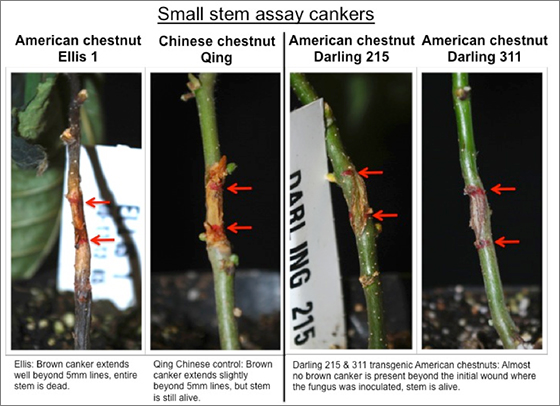
From left to right: Ellis 1, a blight-susceptible wild-type American chestnut (C. dentata); 'Qing,' a blight-tolerant Chinese chestnut (C. mollissima); and two transgenic American chestnut lines, Darling 215 and Darling 311. Ellis 1 and 'Qing' serve as controls, showing the typical contrast between susceptible and tolerant trees in the wild. The transgenic lines were derived from Ellis 1, so they are identical to it except for a wheat oxalate oxidase gene added to enhance blight tolerance. Watch the video as the wild-type American chestnut succumbs to the blight while Darling 215 and 311 survive as well as the Chinese chestnut. Turn your sound on for the full effect.
Assay on even smaller stems
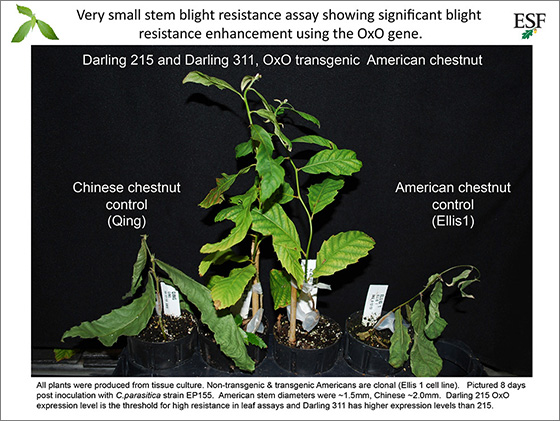
The possibility that the transgenic American chestnut trees have higher levels of blight resistance than the 'Qing' Chinese chestnut control is supported by another experiment, this one using trees with even smaller stems (figure below) and a novel inoculation assay developed in our lab. In this "very small stem assay," both the Ellis American chestnut control and the 'Qing' Chinese chestnut died, while both Darling American chestnut lines survived. The Chinese chestnut likely died because the stem was so small that the fungus could overwhelm it more easily. The oxalate oxidase gene in the Darling trees, however, appears to have been enough to block the fungus even on these very small stems. These results suggest that the transgenic American chestnut trees may have higher levels of resistance than the 'Qing' Chinese control.
References
1. Powell, W. A., P. Morley, M. King and C. A. Maynard. 2007. Small stem chestnut blight resistance assay. Journal of The American chestnut Foundation 21(2): 34-38
2. Zhang B, AD Oakes, AE Newhouse, KM Baier, CA Maynard and WA Powell. 2013. A threshold level of oxalate oxidase transgene expression reduces Cryphonectria parasitica - induced necrosis in a transgenic American chestnut (Castanea dentata) leaf bioassay. Transgenic Research 22, Issue 5 (2013), Page 973-982