The American Chestnut Project
Research

Tissue Culture and Transformation
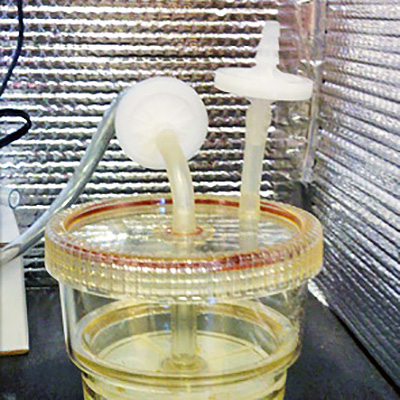 Plant tissue culture (micropropagation) is a method of propagating plants asexually
in aseptic conditions. The four main steps of micropropagation are establishment,
multiplication, rooting and acclimatization. An additional step, regeneration, is
needed for embryo tissue culture.
Plant tissue culture (micropropagation) is a method of propagating plants asexually
in aseptic conditions. The four main steps of micropropagation are establishment,
multiplication, rooting and acclimatization. An additional step, regeneration, is
needed for embryo tissue culture.
Tissue culture process for American chestnut somatic embryos
The Search for Blight Tolerance-Enhancing Genes
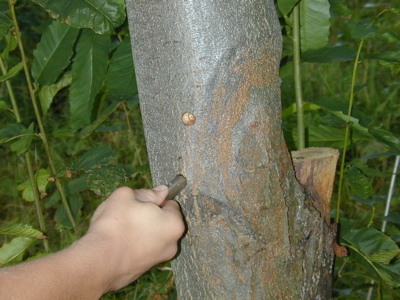 To enhance blight tolerance in the American chestnut tree, we are studying several
gene products, regulatory regions of genes to control expression (promoters), and
the possibility of combining two or more genes (called stacking or pyramiding) for
better and more sustainable resistance.
To enhance blight tolerance in the American chestnut tree, we are studying several
gene products, regulatory regions of genes to control expression (promoters), and
the possibility of combining two or more genes (called stacking or pyramiding) for
better and more sustainable resistance.
Search for tolerance-enhancing genes
Small Stem Assay
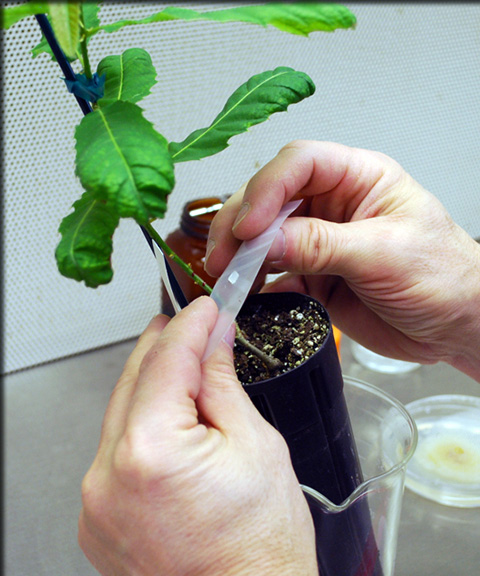 Controlled inoculations of chestnut stems with the blight fungus have confirmed that
Darling trees with OxO have consistently smaller cankers than their non-transgenic
relatives. These results, drawn from repeated stem-inoculation assays comparing susceptible
American chestnuts, resistant Chinese chestnuts, and transgenic Darling lines, support
the case that the added gene provides meaningful blight tolerance.
Controlled inoculations of chestnut stems with the blight fungus have confirmed that
Darling trees with OxO have consistently smaller cankers than their non-transgenic
relatives. These results, drawn from repeated stem-inoculation assays comparing susceptible
American chestnuts, resistant Chinese chestnuts, and transgenic Darling lines, support
the case that the added gene provides meaningful blight tolerance.
Environmental Interactions
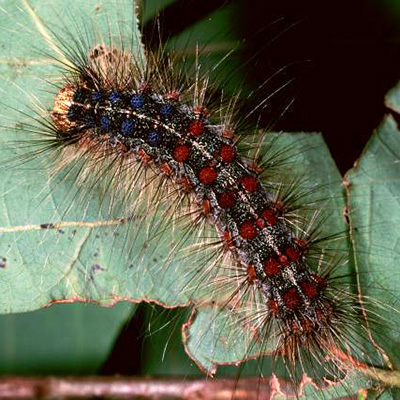 We have run a wide range of tests to confirm that Darling transgenic American chestnuts
do not pose new risks to the environment. By comparing transgenic and non-transgenic
trees, we have looked at how the trees affect insects, pollinators, amphibians, soil
fungi, and neighboring plants. In our tests, the trees show no ecological differences
from wild-type American chestnuts apart from blight tolerance.
We have run a wide range of tests to confirm that Darling transgenic American chestnuts
do not pose new risks to the environment. By comparing transgenic and non-transgenic
trees, we have looked at how the trees affect insects, pollinators, amphibians, soil
fungi, and neighboring plants. In our tests, the trees show no ecological differences
from wild-type American chestnuts apart from blight tolerance.