Faculty Profile
Christopher Briggs

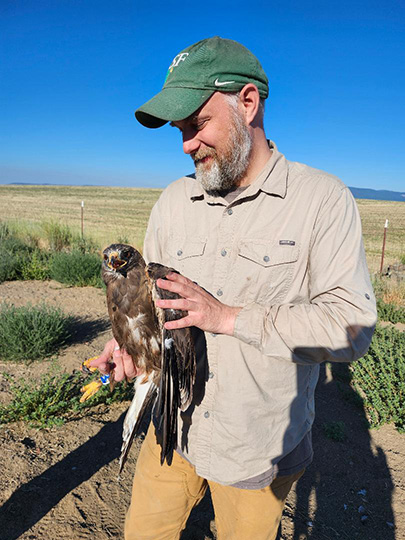
Instructor
Department of Environmental Biology
135 Illick Hall
Education
PhD - Ecology, Evolution, and Conservation Biology, University of Nevada, Reno 2011
MSc - Natural Resources and Environmental Science, University of Nevada, Reno 2007
BS Biology, Virginia Tech 2001
Courses Taught
EFB 101 General Biology I
EFB 102 General Biology I Lab
EFB 103 General Biology II
EFB 104 General Biology II Lab
EFB 100 Survey of Biology Lab
Research
Why do some species exhibit striking color variations—rufous versus dark Swainson's hawks, tan-striped versus white-striped sparrows—instead of evolving toward a single "optimal" form? My research examine this question by investigating the genetic, ecological, and behavioral mechanisms that maintain plumage polymorphisms in wild bird populations. Using an integrative approach that combines long-term field studies, museum collections, community science data, and cutting-edge analytical techniques, my lab explores questions at the intersection of evolutionary biology, behavioral ecology, and conservation science. Current projects span multiple scales, from understanding continental patterns of pigmentation in raptors to investigating how chromosomal inversions drive mate choice and disease dynamics in sparrows.
Beyond polymorphism research, my lab investigates how environmental factors shape population dynamics and demographic processes in bird populations. This includes examining how diet influences body condition and reproduction, how early-life conditions affect recruitment into breeding populations, and how anthropogenic landscapes—from agricultural intensification to urban heat islands—impact species persistence and adaptation. By leveraging unique long-term datasets, including a 45+ year study of California Swainson's hawks and a long-term white-throated sparrow population at Cranberry Lake Biological Station, this work addresses both fundamental questions about evolution and ecology and applied conservation challenges. Collaborative partnerships provide access to specialized techniques, from isotopic analysis of diet composition to advanced microscopy for reproductive trait assessment, enabling research that bridges traditional fieldwork with innovative analytical approaches.
Publications
Ely, T.E., R.P. Bourbour, B.M. Dudek, A.M. Fish, A.C. Hull, B.L. Matrinico, S.S. Skalos, L.E. Souza, and C.W. Briggs. 2025. Rings and pings: Band encounters and Motus elucidate the overwintering locations and movements of sharp-shinned hawks in western North America. Journal of Raptor Research.
Briggs, C.W., E.J. Zellar‡, A.M.Fish, T.E. Ely. 2025. Relationship between red-tailed hawk polymorphism and ectoparasite load. Journal of Raptor Research.
Vennum, C.R., A. Gilmore, C.P. Wells, C.W. Briggs, and D.N. Koons. 2025. Morphometric sex determination across nestling age classes of Swainson's hawks. Journal of Raptor Research 59: 1-10.
Briggs, C.W., C. Farner, M.G. Hunt, and C.R. Vennum. Temporal dynamics and diet of Swainson’s hawk prey delivery. 2024. Journal of Raptor Research 58:505-512.
Bourbour†, R.P., C.M. Alyward, T.D. Meehan, B.L. Martinico†, A.M. Goodbla, A.M. Fish, T.E. Ely, C.W. Briggs, and E.M. Hull. 2024. Feeding enroute: Prey availability and traits influence prey selection by a sexually dimorphic avian predator on migration. Journal of Animal Ecology 93:1176-1191.
Brodman, R.S., E.A. Wommack, E.D. Meisman†, L.A. Echavez†, K.M. Fanucchi‡, T.E. Ely, and C.W. Briggs. 2024. Sexual dimorphism in plumage coloration in Swainson’s hawks. Journal of Raptor Research 58:355-361.
Vennum, C.R., M.W. Collopy, B. Woodbridge, and C.W. Briggs. 2024. Inequality among offspring, correlates of recruitment and lifetime reproductive success. Journal of Ornithology 165:681-690.
Briggs, C.W., E.A. Wommack, S.E. Sawtelle^, C. Reynolds, and A. Amar. 2023. A population bottleneck did not affect polymorphism rates in California Swainson’s hawks. Journal of Raptor Research 57:61-68.
Briggs, C.W., K.E. Dudus†, T.E. Ely†, L.A. Kwasnoski‡, and C.J Downs. 2023. Hemolytic parasites affect survival in migrating red-tailed hawks. Conservation Physiology 10: coac075.
Wysinger‡, J.A., E.J. Dean‡, and C.W. Briggs. 2022. Seed size selection in black-capped chickadees (Poecile atricapillus). Wilson Journal of Ornithology 134:521-526.
Claunch†, N.M., C.J. Downs, L.A. Schoenle, S.J. Oakey, T.E. Ely, C. Romagosa, and C.W. Briggs. 2022. Snap-freezing in the field: effect of sample holding time on performance of bactericidal assays. Integrative and Comparative Biology 62:1693-1699.
Pericoli^, R.V., E.L. Karsten‡, A.M. Fish, and C.W. Briggs. 2021. Nesting biology of a Cooper’s hawk population in Berkeley, CA. Western Birds 50: 301-307.
Jimenez, A.G., K.J. Tobin‡, K.N. Anderson‡, M.K. McCann‡, and C.W. Briggs. 2020. Differences in oxidative stress across seasons and ability to cope with environmental mismatch in muscle and brain of black-capped chickadees (Poecile atricapillus). and rock pigeons (Columba livia). Journal of Avian Biology 51:5.
Kane‡, S.A., C.R. Vennum†, B. Woodbridge, M.W. Collopy, P.H. Bloom, and C.W. Briggs. 2020. Age distribution and longevity in a breeding population of Swainson’s hawks, Buteo swainsoni. Journal of Avian Biology 161:885-891.
Briggs, C.W., A.C. Hull, J.M. Hull, J.A. Harley^, P.H. Bloom, R.N. Rosenfield, and A.M. Fish. 2020. Natal dispersal and population origins of migrant red-tailed hawks and Cooper’s hawks. Journal of Raptor Research 54:47-56.
‡Undergraduate student author
†Graduate student author
^Community scientist author
Current Graduate Advisees
 Dora Donacik
[email protected]
- Degree Sought: MS
- Graduate Advisor(s): Briggs
Graduate Research Topic
Diet Ecology of Nesting Swainson's Hawks Using Stable Isotope Analysis
 Brooke Weiss
[email protected]
- Degree Sought: PHD
- Graduate Advisor(s): Briggs
Graduate Research Topic
Diet and ecoimmunology using a tree swallow nest box system near Cranberry Lake, NY