A Gift of Gratitude
By Judy Gelman Myers
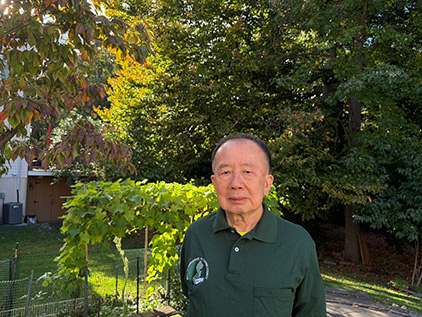 Twenty years after earning a Ph.D. in Forest and Environmental Biology at ESF, Dr.
Chin Yang, ’84, made a gift to the College that would establish the Center for Biotechnology
and Biodiversity.
Dr. Yangʼs generosity reflected his gratitude for the support he received as a student at ESF. Newly arrived in Syracuse, he heard that the College granted tuition waivers to students in need. “That was the first benefit I received from the College,” he said. “I was tremendously appreciative of that support, and it put in my mind the idea to give back when I could.”
Dr. Yang received further assistance from ESF. While working on his Ph.D. on the symbiosis between fungi and pine roots, Dr. Yang joined Dr. Hugh Wilcoxʼs research group and received a scholarship as a research assistant. Unlimited access to libraries, computer centers, and costly lab equipment helped him appreciate how expensive it was to do research. “That made me additionally grateful for the resources the College had to offer,” he said.
Over the next forty years, Dr. Yang became a highly sought-after expert on fungal and bacterial exposures in indoor environments. He worked for the U. S. Public Health Service in Philadelphia, sat on four EPA proposal review panels, and authored or co-authored more than a hundred publications.
In 1994, Dr. Yang established his own laboratory, testing for airborne allergens, and fungi. In 2004, his business was acquired by a larger company. “When I got the money from the sale, I knew I was finally able to give back to ESF,” he said.
With Dr. Yangʼs generous gift, the College established the Center for Applied Microbiology, with the goal of promoting high-level faculty and student research. The Center is now called the Center for Biotechnology and Biodiversity, but its goal is the same as it serves as a hub for scientists in the Departments of Biology, Chemistry, and Environmental Resources Engineering.
Under the directorship of Professor Christopher Whipps, the Center connects facultyʼs
independent research labs and the students who work in them. Rather than the Center
deciding specific research ideas, Dr. Whipps encourages the scientists to bring their
own projects to the Center. He chooses proposals
based on their potential for subsequent funding, opportunities for student research,
and use of biotechnologies such as DNA sequencing and genetic engineering. Says Dr.
Whipps, “These tools are a global emerging technology that fosters better research
and garners bigger grants.”
The Center has extended its global reach in other ways as well. ESF has had a long-standing student exchange program with Tunghai University in Taiwan, where Dr. Yang earned BS and MS degrees in Biology/Botany. With additional support from Dr. Yang, Dr. Whipps has initiated a more formal partnership between Tunghai and the Center for Biotechnology and Biodiversity, which includes funds for students to engage in a summer research internship, obtain research supplies, or pay conference fees.
Dr. Yang has continued to provide the Center with professional expertise and philanthropic support as it has grown over the years. During the Campaign for SUNY ESF, he made over $275,000 in donations to further grow the Centerʼs endowment. Says Dr. Yang, “As I found out, high-quality research requires a lot of funding. I want to continue the schoolʼs excellent research in my areas of microbiology and biology, but the College has many other programs. I hope my fellow alumni can support the College in their areas, too.”