Recent Headlines
- ESF Associate Professor Deepak Kumar Named 2026 Young Engineer of the Year
- SUNY ESF and Upstate Medical University Reintroduce Upstate Accelerated Scholars Program
- ESF Installs Bird-Strike Mitigation Murals During Peak Migration Season
- Leaders Across Central New York and New York State Reflect on President Joanie Mahoney’s Legacy
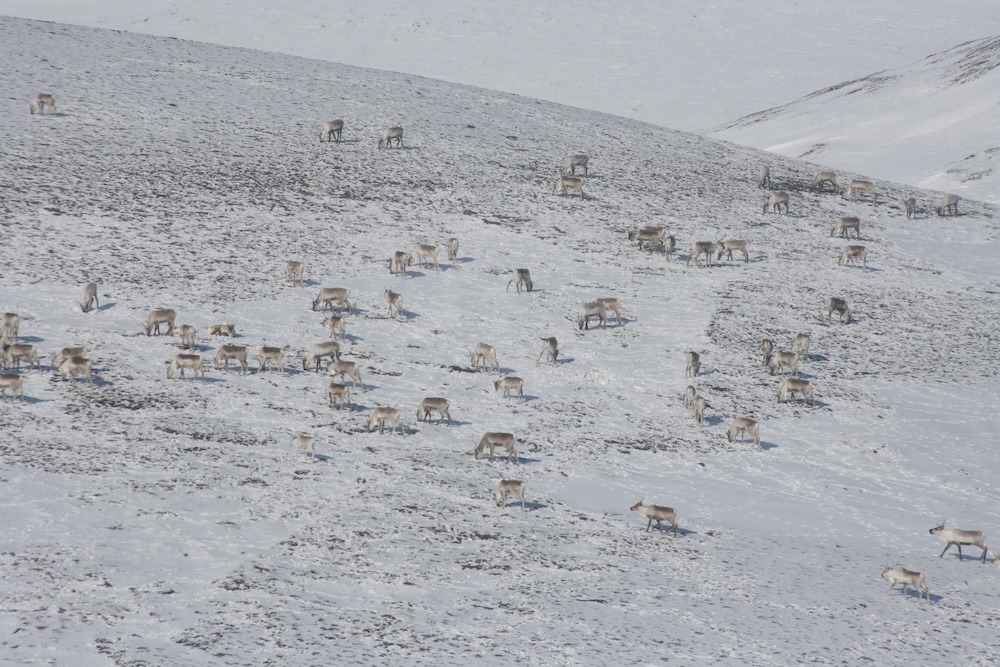
Photo courtesy of Kyle Joly, National Park Service
Buried Bounty: Caribou Survival Depends on Lichen and Snow
SYRACUSE, N.Y. — March 27, 2026 — A study by researchers at the SUNY College of Environmental Science and Forestry indicates that if lichen continues to decline across the Arctic, caribou populations could struggle to survive the winter.
In the study, “Winter survival shaped by forage abundance and snow depth for a long‐distance migratory ungulate,” ESF Ph.D. candidate Chloe Beaupré and her advisor, Dr. Elie Gurarie, examined the relationship between winter forage, snow conditions, and caribou survival. The study is open access.
Caribou are one of the few animals that can eat and digest lichen (also called ‘reindeer moss’). In winter, when other foods are scarce, caribou rely almost entirely on this resource. To understand how essential lichen is for caribou survival, researchers analyzed tracking data from the Western Arctic Herd.
Their analysis revealed that caribou living in areas with abundant lichen were up to nine times more likely to survive the winter than those in regions with sparse lichen. However, snow depth significantly affected access to this critical food.
“Caribou dig through snow in a behavior known as ‘cratering,’ but once snow exceeds about 50 centimeters, even high-lichen areas become inaccessible,” said Beaupré. “When snow is too deep for caribou to reach lichen, the survival advantage disappears.”
Using GPS telemetry data from 1,067 caribou winters between 2009 and 2024, the study found that higher lichen cover significantly improves survival, but only when snow conditions allow access.
“As Arctic conditions continue to change, both lichen availability and snow depth will play a critical role in determining whether caribou can survive the winter,” said Beaupré.
Beaupré and Gurarie collaborated with the National Park Service, University of Alaska Fairbanks, and University of Maryland on the study.
About SUNY ESF
The SUNY College of Environmental Science and Forestry (ESF) is dedicated to the study of the environment, developing renewable technologies, and building a sustainable and resilient future through design, policy, and management of the environment and natural resources. Members of the College community share a passion for protecting the health of the planet and a deep commitment to the rigorous application of science to improve the way humans interact with the world. The College offers academic programs ranging from the associate of applied science to the Doctor of Philosophy. ESF students live, study and do research on the main campus in Syracuse, N.Y., and on 25,000 acres of field stations in a variety of ecosystems across the state.