Recent Headlines
- SUNY ESF Doctoral Student Earns Prestigious Fellowship from Nation's Oldest Scholarly Society
- SUNY ESF and Upstate Medical University Reintroduce Upstate Accelerated Scholars Program
- ESF Associate Professor Deepak Kumar Named 2026 Young Engineer of the Year
- ESF Installs Bird-Strike Mitigation Murals During Peak Migration Season
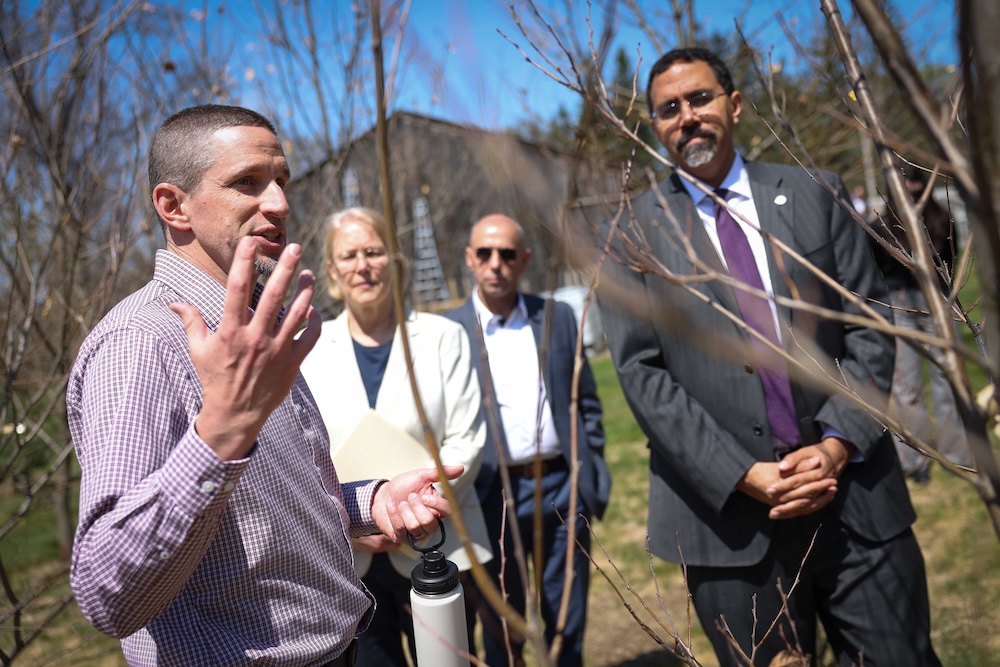
Dr. Andrew Newhouse, pictured left, discusses ESF's American chestnut restoration program with SUNY Chancellor John B. King Jr., pictured right. ESF President Joanie Mahoney and Rustan Petrela, executive director of sustainable facilities operations, are in the background.
SUNY Chancellor King Celebrates Arbor Day During ESF Visit
ABLANY, N.Y. — April 22, 2026 — SUNY Chancellor John B. King Jr. joined ESF President Joanie Mahoney at ESF's Lafayette Road Experiment Station on Arbor Day to announce a capital project in support of the College's American Chestnut Program.
King Jr. highlighted the efforts of students, faculty, and staff to promote climate actions and celebrate Arbor Day. Throughout the SUNY system, campuses have been hosting tree plantings and events to celebrate the holiday, highlighting the benefits of natural carbon sequestration through trees and using tree shade to help mitigate heat impacts on campus.
The station is used extensively for teaching and research and is home to 50 different tree species. It is part of the American Chestnut Research & Restoration Project at ESF to grow blight-tolerant American chestnuts with the goal of restoring them to their previous forest ecosystems.
“SUNY ESF is a gem of the SUNY System and a leader in the state’s climate change and sustainability efforts. It was wonderful to celebrate Arbor Day with students and campus leaders at SUNY ESF during the groundbreaking of the Lafayette Road Experiment Station, which will act as a vital resource to support SUNY ESF’s research on the American chestnut tree,” said King. “As part of Arbor Day celebrations statewide, SUNY students, faculty, and staff also took action to support campus climate resilience efforts by planting trees, helping create cleaner air, mitigate climate impacts, and keep their campuses at cooler temperatures. I commend the efforts of our dedicated students who took part in this small effort that will deliver meaningful long-term results.”
“Arbor Day reminds us of the vital role trees play in strengthening our communities and advancing climate solutions,” said Mahoney. “It was especially meaningful to celebrate this day with the ceremonial groundbreaking at our Lafayette Road Experiment Station, a facility central to ESF’s teaching and research mission and a key site for our American chestnut restoration efforts. We are pleased to have Chancellor King join us and share in this important moment, and we appreciate his continued leadership and support of sustainability across SUNY.”
The $5 million renovation of the greenhouse at ESF’s Lafayette Road Experiment Station includes renovations to the lab portion of the building, as well as the greenhouse on the site. Renovations will include replacement of the greenhouse glass and roof vent system, roof replacement, new ceilings, as well as lighting and power upgrades, and an emergency backup generator. The construction project will help support SUNY ESF’s research into the American chestnut tree, and other research projects taking place on campus.
“The new station will continue to make SUNY ESF a leader in learning and research in forestry. This Arbor Day it is important to remember the importance of forests to the health of our environment,” said State Assemblymember William B. Magnarelli.
About SUNY ESF
The SUNY College of Environmental Science and Forestry (ESF) is dedicated to the study of the environment, developing renewable technologies, and building a sustainable and resilient future through design, policy, and management of the environment and natural resources. Members of the College community share a passion for protecting the health of the planet and a deep commitment to the rigorous application of science to improve the way humans interact with the world. The College offers academic programs ranging from the associate of applied science to the Doctor of Philosophy. ESF students live, study and do research on the main campus in Syracuse, N.Y., and on 25,000 acres of field stations in a variety of ecosystems across the state.
About SUNY
The State University of New York is the largest comprehensive system of higher education in the United States, and more than 95 percent of all New Yorkers live within 30 miles of any one of SUNY’s 64 colleges and universities. Across the system, SUNY has four academic health centers, five hospitals, four medical schools, two dental schools, a law school, the country’s oldest school of maritime, the state's only college of optometry, 12 Educational Opportunity Centers, over 30 ATTAIN digital literacy labs, and manages one US Department of Energy National Laboratory. In total, SUNY serves about 1.7 million students across its portfolio of credit- and non-credit-bearing courses and programs, continuing education, and community outreach programs. SUNY oversees nearly a quarter of academic research in New York. Research expenditures system-wide are nearly $1.5 billion in fiscal year 2025, including significant contributions from students and faculty. There are more than three million SUNY alumni worldwide, and annually one in three New Yorkers who earn a college degree is a SUNY alum. To learn more about how SUNY creates opportunities, visit suny.edu.