Recent Headlines
- ESF Associate Professor Deepak Kumar Named 2026 Young Engineer of the Year
- SUNY ESF and Upstate Medical University Reintroduce Upstate Accelerated Scholars Program
- ESF Installs Bird-Strike Mitigation Murals During Peak Migration Season
- Leaders Across Central New York and New York State Reflect on President Joanie Mahoney’s Legacy
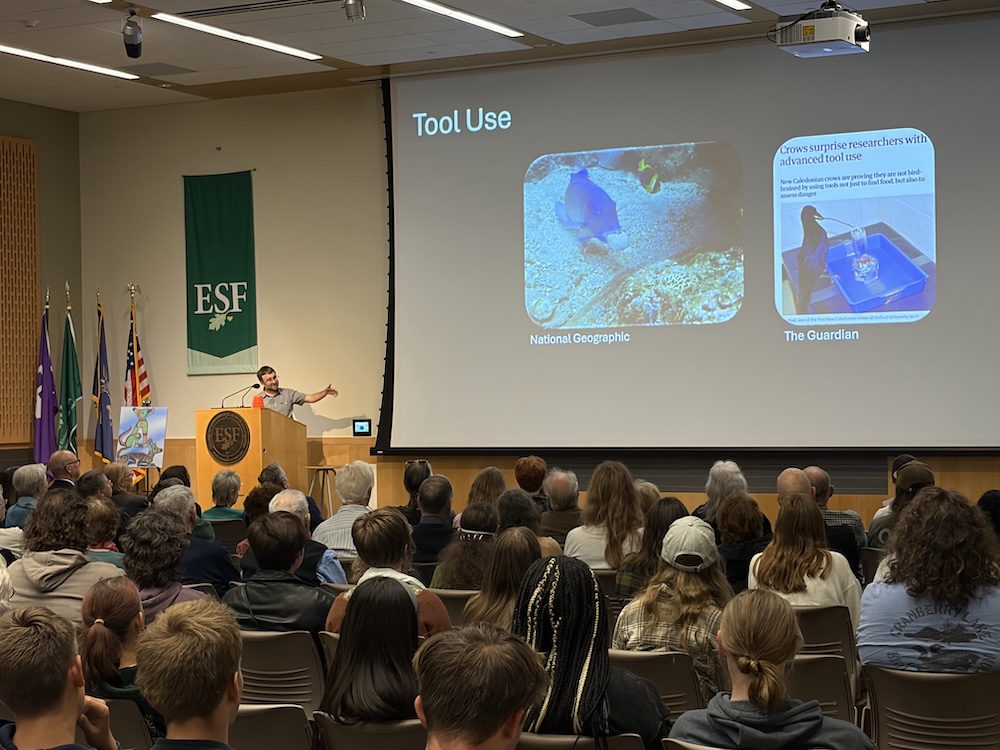
ESF Assistant Professor Kyle Artelle presents “Discover the Place of Wolves” during the Dale L. Travis Lecture Series on Sept. 24. The lecture explored groundbreaking research that led to the first recorded evidence of tool use by wild wolves.
ESF's Dale Travis Lecture Explores Groundbreaking Wolf Research and Indigenous Partnerships
SYRACUSE, N.Y. – Sept. 25, 2026 – A video of a wolf hauling a crab trap out of the water stunned viewers around the world, sparking headlines and raising new questions about animal intelligence and behavior. SUNY College of Environmental Science and Forestry (ESF) Assistant Professor Kyle Artelle took audiences beyond the viral moment to reveal the remarkable story behind the footage and the place, people, and wolves that made it and ongoing research possible as this year’s speaker for the Dale L. Travis Lecture Series.
Describing the Place of Wolves: Haíɫzaqv Wolf and Biodiversity Project, Artelle discussed how the team follows an approach called M̓ṇúxvʔit, coined by Q̓íx̌itasu Elroy White. The project understands the Haíɫzaqv Nation's knowledge systems, laws, governance, and stewardship of Haíɫzaqv Territory as the foundation of the project, using academic collaboration to contribute to the Nation’s deep understanding of wolves, biodiversity, and relationships between people and the natural world. The work highlights Indigenous leadership in generating and applying knowledge about conservation and ecological stewardship.
Artelle is an assistant professor in the College’s Department of Environmental Biology and faculty co-director of ESF's Center for Native Peoples and the Environment. His research focuses on wildlife conservation, environmental policy, and the relationships between people and nature.
The lecture explored how partnerships with Indigenous communities are helping researchers better understand wolves while offering valuable lessons for conservation efforts and environmental stewardship.
“Nearly every well-studied wolf population faces human persecution or pressures, so our understanding about wolf ecology and behavior may be limited by that context: a portrait of wolves under duress. Haíɫzaqv Territory is one of the few places where that isn't the case: where wolves live lives largely free of persecution, and where wolves can grow old,” noted Artelle. “Importantly, this is not a story of a ‘wilderness’ devoid of people – wolves and people live side-by-side here, as they have for thousands of years.”
“Dr. Artelle's work exemplifies the innovative, collaborative research happening at ESF,” said ESF President Joanie Mahoney. “By bringing together scientific inquiry and Indigenous knowledge, this project is expanding our understanding of the natural world while highlighting the importance of partnership in addressing conservation challenges. We were excited to share this remarkable story with our community.”
The Dale L. Travis Lecture Series is made possible through the generosity of Dale L. Travis '59 and was established to help the broader community learn about the impactful research and scholarship taking place at ESF. Featuring world-class faculty members and renowned field experts, the series highlights how researchers are advancing knowledge and addressing some of society's most pressing environmental challenges.
About SUNY ESF
The SUNY College of Environmental Science and Forestry is one of the nation's premier colleges focused on the study of the environment, developing renewable technologies, and building a sustainable future. ESF’s mission is to educate future environmental leaders of all backgrounds, advance knowledge, and skills necessary to promote scholarship and stewardship of the natural to designed environments, and act both locally and globally to Improve Our World. ESF’s students, faculty, staff, and alumni make a global impact on improving and sustaining the environment. ESF offers a world-class education among a close-knit community of more than 2,000 scholars with common values and a shared sense of purpose. ESF’s tight-knit community is centered alongside Syracuse University in the heart of Central New York and has a system of properties spanning 25,000 acres that broadly represent New York state’s rich ecological diversity for scientific study and instruction. To learn more, visit suny.edu.