Recent Headlines
- Award-Winning Ocean Research Raises Questions About Global Carbon Estimates
- At ESF, Where There’s Smoke, There’s Prescribed Fire Being Taught
- SUNY ESF Earns National Recognition for Excellence in Student Mental Health and Counseling Services
- ESF Hosts SUNY Academic Momentum Regional Convening Focused on Student Success
At ESF, Where There’s Smoke, There’s Prescribed Fire Being Taught
Hands-on prescribed burns teach future foresters, rangers, and conservation officers how fire can be used to manage and restore ecosystems
TULLY, N.Y. — Nov. 3, 2026 — Students in Dr. Andrew Vander Yacht’s forest ecology and management class have spent the semester learning how fire interacts with native plant communities, how it can be used as a management tool to achieve specific objectives, and how fire cycles alter ecosystems.
"The majority of the class has been focused on fire ecology and management science, including how fire behaves, its effects on wildlife and plants, and the objectives for using fire as a management tool,” said Vander Yacht.
This included learning the steps involved in implementing a prescribed burn.
"First and foremost, the objective is to teach our students how to properly, safely, and effectively use fire in land management," said Vander Yacht.
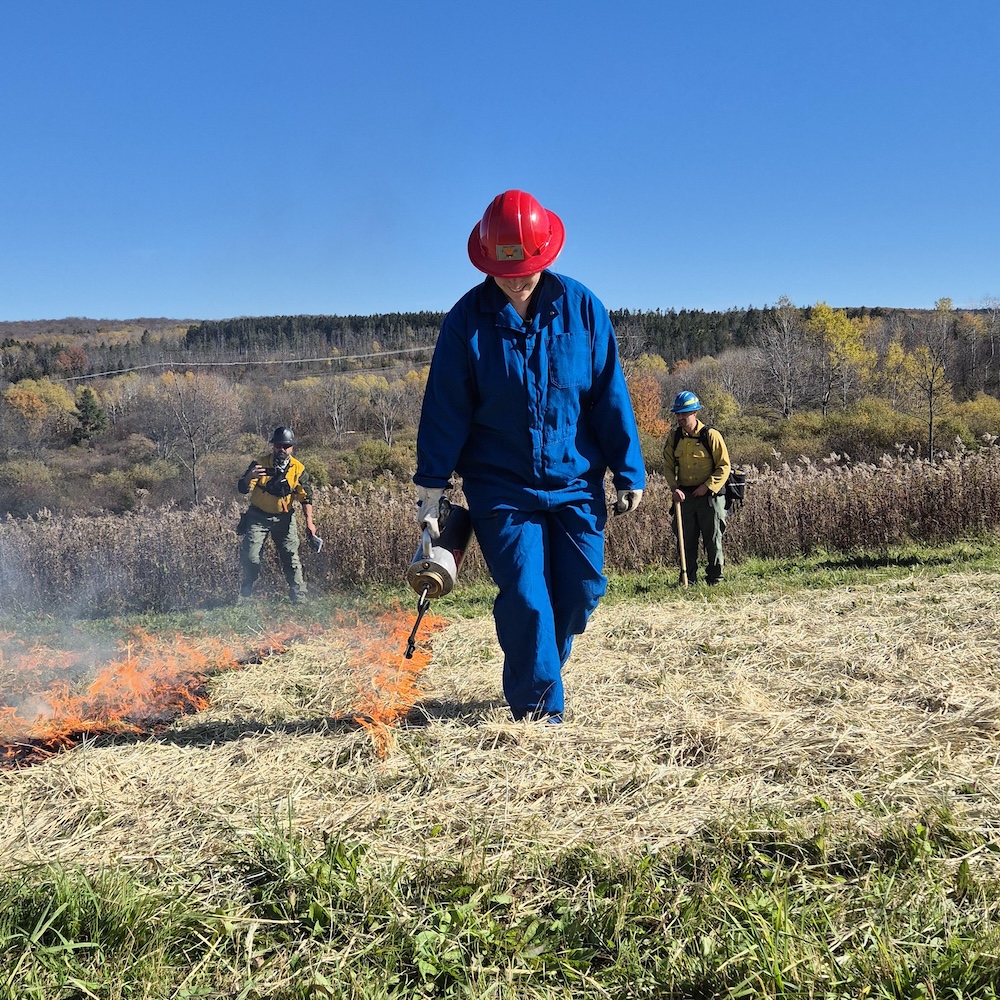
Recently the assistant professor took his students to ESF’s Heiberg Memorial Forest in Tully, where they put what they learned into practice in the field.
To prepare for the prescribed burn — where they go into the field and set it ablaze — students learned how to write a burn plan, a multi-page document that needs approval from several agencies before a single flame is produced. The plans cover burn goals, fuel loads, equipment and personnel, smoke management and notifications, contingency plans, and more.
The plans must then be approved by the New York State Department of Environmental Conservation (DEC). They also outline procedures for coordinating communication with 911 dispatch and local fire departments and tracking weather conditions. For the Heiberg burn, Vander Yacht wrote the plan and collected the appropriate approvals.
On-site on a sunny Saturday, students received instructions from Vander Yacht, his Ph.D. student and teaching assistant Sam Gilvarg, and Maria Loughran – a former master’s student in Vander Yacht’s Applied Forest and Fire Ecology Lab and now natural resources team leader for Cornell Cooperative Extension of Onondaga County. Filling and igniting the drip torches, hand tool use, fuel moisture determinations, monitoring fire behavior, and weather conditions, and reporting the data were all covered before a single flame was lit.
The Tully hillside is sectioned into 20 100-by-100-foot plots that are actively being restored to a diversity of wildflowers and grasses to provide a setting where a variety of burn techniques can be demonstrated.
Vander Yacht worked with Sam Quinn, who oversees the Conservation on Private Lands Initiative with ESF’s Restoration Science Center and meadow expert, to transition these study areas away from former agricultural land toward a more prairie-like flora . Together they tested different site-preparation methods, including combinations of burning, dragging, and seeding. Quinn introduced warm-season grasses to these plots in large part to make them more flammable and introduce species that add some pollinator value.
The project produced better-than-expected establishment of the grasses, according to Quinn. “We got way better results than we thought in terms of germination in some areas,” said Quinn. “I was hoping for 2 percent germination success given the techniques we used, but in many areas, it is much higher than that.”
Quinn’s interest in the prescribed burns goes beyond the plant communities. "I'm interested in the biodiversity aspect of what's going on underground with soil arthropods, and with the relationship between soil fungi and root systems, and how fire changes the soil chemistry,” said Quinn.
Students brought their own reasons for taking fire ecology.
Nichole Connal, a senior natural resources management major, said she enrolled in the class for the hands-on field experience and the opportunity to learn how fire can benefit ecosystems. She hopes to become an arborist after graduation and is also interested in participating in prescribed fire work.
For some, the class directly impacts their career plans. "The class provides a great certification for future career options," said Andrew Hahn, a senior natural resources management major, who is hoping to become an environmental conservation officer (ECO). "I know the Rangers do most of that (fire management), but from the ECOs I’ve talked to if you have that certification, especially from ESF, you're more likely to help out at times when they need it."
Jarrod Bush took a fire class at ESF’s Ranger School in Wanakena where they also did a prescribed burn. Bush earned an associate degree in forest technology at the Ranger School and returned to the Syracuse campus to continue his education. "My advisor said if I wanted to become a forest ranger, I should learn more about the effects of what happens with fire in certain regimes. The class also allows me to potentially re-certify myself."
To become certified as Type II Wildland Firefighters according to National Wildfire Coordinating Group standards, students complete the course, online training modules, an additional field day with DEC and US Wildland Fire Service staff, and complete a pack test carrying a 45-pound pack, the weight of fire suppression equipment, for three miles.
It’s not only students learning about prescribed burns at ESF. Thirty NYS Department of Environmental Conservation (DEC) regional foresters are coming to ESF in November to learn how to write and evaluate burn plans for prescribed burn management. This event is being coordinated by DEC in collaboration with Tall Timbers – a non-profit dedicated to restoring “good” fire to forested landscapes just like the students and faculty at ESF.
“At ESF, students don't just study land management, they practice it, said ESF President Joanie Mahoney. “While our students gain firsthand experience with prescribed burns, our faculty are also equipping forestry professionals with the knowledge and skills to use fire as a science-based tool for restoring and sustaining healthy ecosystems.”
About SUNY ESF
The SUNY College of Environmental Science and Forestry is one of the nation's premier colleges focused on the study of the environment, developing renewable technologies, and building a sustainable future. ESF’s Mission is to educate future environmental leaders of all backgrounds, advance knowledge, and skills necessary to promote scholarship and stewardship of the natural to designed environments, and act both locally and globally to Improve Our World. ESF’s students, faculty, staff, and alumni make a global impact on improving and sustaining the environment. ESF offers a world-class education among a close-knit community of more than 2,000 scholars with common values and a shared sense of purpose. ESF’s tight-knit community is centered alongside Syracuse University in the heart of Central New York and has a system of properties spanning 25,000 acres that broadly represent New York state’s rich ecological diversity for scientific study and instruction. To learn more, visit www.esf.edu.