Recent Headlines
- SUNY ESF Doctoral Student Earns Prestigious Fellowship from Nation's Oldest Scholarly Society
- SUNY ESF and Upstate Medical University Reintroduce Upstate Accelerated Scholars Program
- ESF Associate Professor Deepak Kumar Named 2026 Young Engineer of the Year
- ESF Installs Bird-Strike Mitigation Murals During Peak Migration Season
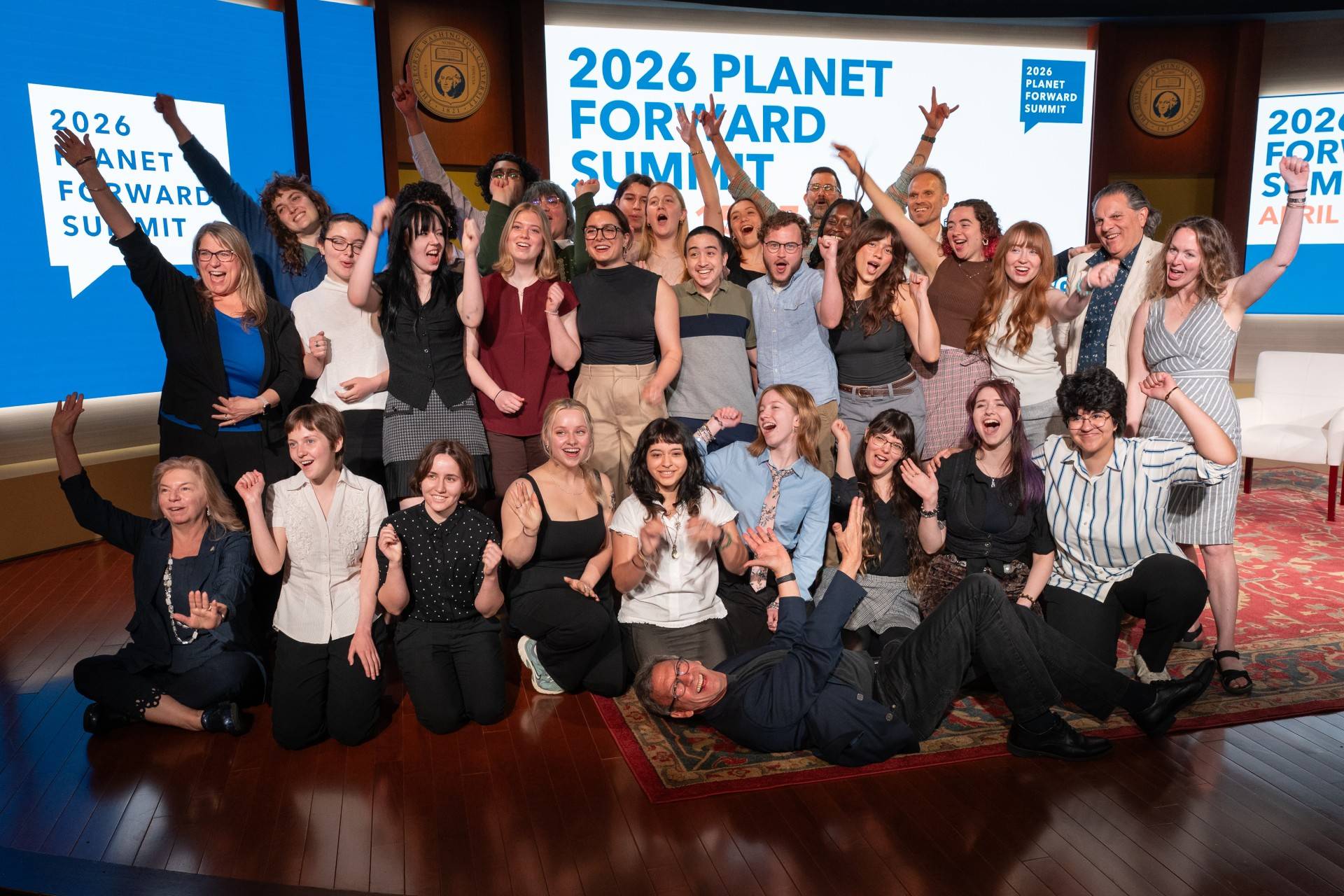
ESF students with Frank Sesno at Planet Forward
ESF Students Spotlight Climate Storytelling at Planet Forward Summit in Washington, D.C.
SYRACUSE, N.Y. — April 24, 2026 — Twenty-five students from the SUNY College of Environmental Science and Forestry (ESF) immersed themselves in three days of multimedia storytelling at the 2026 Planet Forward Summit in Washington, D.C. earlier this month.
Planet Forward, based at George Washington University, is a multimedia platform that engages students worldwide in climate, sustainability, environmental justice and solutions‑focused storytelling. Several ESF students were finalists or received honorable mention for their submissions to StoryFest, the key event of the summit. They include Abbey Leibert, also a Planet Forward Correspondent; Isaac Moore, Mariel Flint and Margaret Ryan.
Each year, students are encouraged to create and submit stories to Planet Forward’s Storyfest, which usually has a deadline of early February. The annual summit, which takes place in April, is where it all comes together. The summit is hosted by Frank Sesno, Emmy Award–winning journalist, professor at George Washington University, and founder of Planet Forward. Sesno visited ESF in early April to discuss with students the role of storytelling in addressing today’s environmental challenges. As part of his visit, he lectured in classes taught by Dr. Patrice Kohl, Tyler Dorholt, and Jason Kohlbrenner. He discussed how to creatively use data in storytelling, how to enhance character perspective, and how to navigate uncertainty in story.
Sesno also met with ESF leadership while on campus.
“Frank’s visit reinforced ESF’s role as a national leader in climate communication, applied sustainability and experiential learning,” said ESF President Joanie Mahoney. “We’re fortunate to have such a meaningful, long-standing relationship with Planet Forward.”
Sesno’s visit built excitement among the students attending the summit where they participated in workshops, a live podcast of FORKED, and shared in several expert panels with a theme of “Pass the Mic, Share the Story.” Guest speakers and panelists included documentary filmmakers, key members of the Smithsonian, NPR, and environmental nonprofit organizations.
Molly McGarity, who serves as Mighty Oak Student Assembly vice president and president of the Environmental Studies Student Organization, has attended for four years and was recognized for her commitment to environmental storytelling. "One of my favorite parts of Planet Forward is the community that we create while at the conference and exploring DC,” said McGarity. “It is so special to see our group, which this year spanned from freshman to PhD students and represented at least 5 majors, become closer over the four days of the trip. We all leave this trip with new knowledge and inspiration for the work that we do, but we also leave it with new friends and cherished memories. Planet Forward is a great reminder of why we do what we do."
Since 2015, hundreds of ESF students have taken part in Planet Forward activities, including submitting entries to Storyfest, serving as Planet Forward correspondents, and traveling to destinations such as the Ford plant in Dearborn, Michigan, and Vermejo, a Ted Turner Reserve in New Mexico.
ESF is one of Planet Forward’s most active and long‑standing partners, and this relationship allows ESF students to see how far-reaching their work while in college and after graduation can be.
“Planet Forward’s interdisciplinary focus on bridging journalism, sustainability, communication, and public policy empowers the next generation of environmental storytellers. ESF remains vital in this relationship,” said Dorholt, executive director of communications and marketing.
“Frank validated something I already believe, that work staying behind a paywall or inside academia isn't reaching the people it should,” said Nora Yousefi, a junior studying conservation biology who connected with Sesno on his visit. “Hearing him speak to how we have to keep adapting to an ever-changing media landscape was a reminder that how we tell our stories is just as critical as the science itself."
About SUNY ESF
The SUNY College of Environmental Science and Forestry (ESF) is dedicated to the study of the environment, developing renewable technologies, and building a sustainable and resilient future through design, policy, and management of the environment and natural resources. Members of the College community share a passion for protecting the health of the planet and a deep commitment to the rigorous application of science to improve the way humans interact with the world. The College offers academic programs ranging from the associate of applied science to the Doctor of Philosophy. ESF students live, study and do research on the main campus in Syracuse, N.Y., and on 25,000 acres of field stations in a variety of ecosystems across the state.