Recent Headlines
- Leaders Across Central New York and New York State Reflect on President Joanie Mahoney’s Legacy
- ESF President Joanie Mahoney Announces Plans to Retire in 2027
- SUNY ESF, DEC Expand Statewide Internship Partnership with $6.7 Million Agreement Through 2030
- ESF's Destinations & Degrees Draws Record Crowd of Students, Employers and Graduate Schools
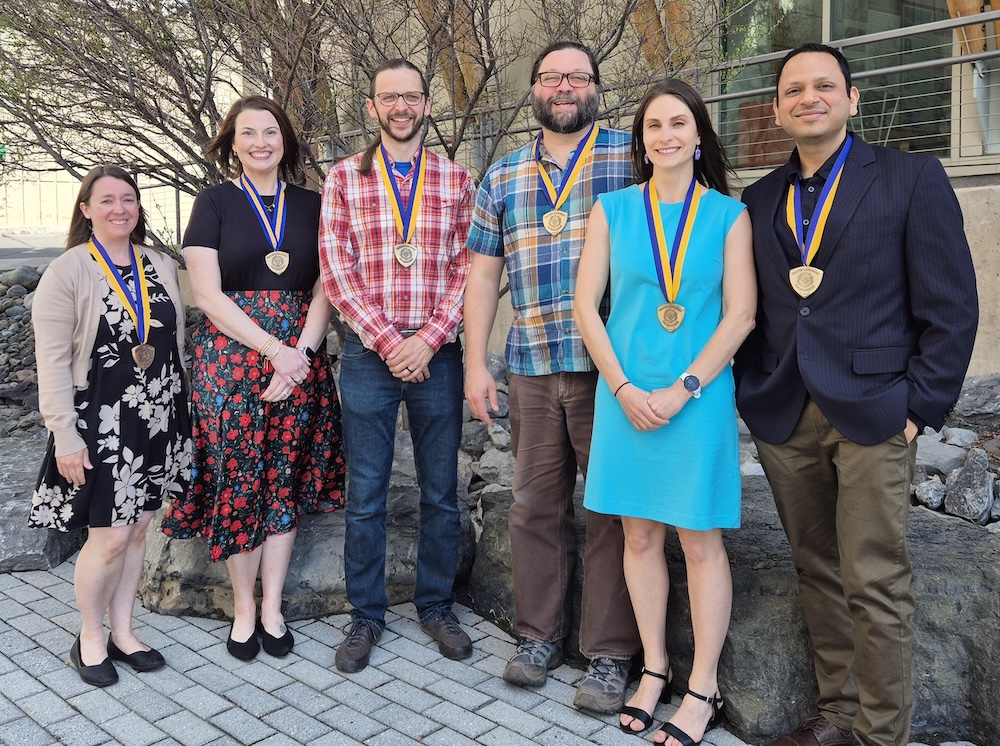
SUNY Chancellor Awards for Excellence honorees, pictured from left, Ruth M. Owens, Megan Thurston, Dr. John E. Drake, Dr. Colin M. Beier, Sue Fassler and Dr. Deepak Kumar.
SUNY Chancellor Honors Six ESF Faculty and Staff for Excellence
SYRACUSE, N.Y. – May 5, 2026 – Six employees of the SUNY College of Environmental Science and Forestry (ESF) were honored by Chancellor John B. King, Jr. for outstanding service to the State University of New York.
This year’s honorees are Dr. Colin M. Beier for Excellence in Faculty Service, Dr. John E. Drake for Excellence in Teaching, Sue Fassler for Excellence in Professional Service, Dr. Deepak Kumar for Excellence in Scholarship and Creative Activities, Ruth M. Owens, Excellence for Librarianship, and Megan Thurston for Excellence in Classified Service.
“Each of ESF’s honorees exemplifies the dedication, creativity, and leadership that define the College’s mission,” said ESF President Joanie Mahoney. “Through their excellence in teaching, scholarship, service, and support, they strengthen our academic community and expand the impact of SUNY across New York and beyond. We are proud to celebrate their achievements and grateful for the lasting contributions they make to our students, our campus, and the public good.”
Excellence in Faculty Service — Dr. Colin M. Beier
Dr. Colin Beier, Professor in the Department of Sustainable Resources Management, is recognized for sustained excellence in faculty service distinguished by transformational leadership, principled governance, and broad engagement that advances the College’s academic mission and public impact. Appointed as an Associate Professor in 2015 and promoted to Professor in 2025, Beier has demonstrated more than two decades of service leadership at ESF, contributing at the programmatic, institutional, system, and community levels.
Since 2017, Beier has provided foundational leadership for the Forest Ecosystem Science program. He has advised nearly all undergraduate students, revised capstone coursework, and chaired a comprehensive curriculum redesign approved in 2022. These efforts strengthened learning outcomes, clarified degree pathways, and contributed to a doubling of incoming class sizes, reflecting his lasting impact on student success and program vitality.
At the graduate level, Beier led the Coupled Natural and Human Systems section of the Graduate Program in Environmental Studies for eight years. In this role, he oversaw admissions, funding, and student progress while implementing transparent and equitable practices that improved recruitment and retention for dozens of graduate students across disciplines.
Beier’s commitment to inclusive excellence is exemplified through his work as a founding affiliate of the Center for Native Peoples and the Environment. He co-led USDA-funded initiatives supporting Indigenous graduate students, developed cross-cultural coursework, and helped position ESF as one of only ten institutions nationwide in the Sloan Indigenous Graduate Partnership.
From 2018-20, Beier served as Acting Secretary and Acting Executive Chair of Academic Governance, restoring stability and trust while authoring procedures that strengthened shared governance. He continues this advocacy as Vice President for Academics in ESF’s chapter of United University Professions, representing faculty interests and advancing fair workloads and job security.
Excellence in Teaching — Dr. John E. Drake
Dr. John Drake is an innovative educator in the Department of Sustainable Resources Management whose teaching reflects a strong commitment to student-centered, inquiry-based learning. Since joining ESF in 2017, Drake has taught seven undergraduate and graduate courses, revitalizing existing curricula and designing new learning experiences. He also developed a new course, Tree Structure and Function, to support two of ESF’s degree programs.
Drake’s teaching is grounded in interactive, problem-based inquiry. When the COVID-19 pandemic disrupted field-based instruction, he quickly adapted — retooling his courses into virtual labs built around videos, interactive datasets, and hybrid delivery. Those experiences continue to shape his pedagogy. Drake consistently uses flipped classrooms, active learning, participatory science, and the Four-Dimensional Ecology Education Framework (4DEE), which integrates ecological practices, core concepts, human–environment interactions, and cross-cutting themes. His sustained excellence is reflected in course evaluations averaging 4.65 on a 0–5 scale since 2017.
A hallmark of Drake’s teaching is his creativity in making complex ecological concepts accessible. A widely praised example is his M&M Model Active Learning Exercise, which uses candies to demonstrate dispersal limitation, predation, and competitive exclusion in community ecology. Students simulate ecological processes by “dispersing” candies into jars and acting as generalist predators — an approach that has proven both memorable and effective. Drake assesses learning gains through pre- and post-activity quizzes and exam questions, using the results to continually refine his teaching.
Drake exemplifies the teacher-scholar model by integrating his research into the classroom and mentoring students through independent studies, honors theses, and paid internships. He actively engages with the scholarship of teaching and learning, participates in ESF’s Teaching and Learning Center workshops, and presents teaching-focused work at scientific conferences.
Committed to student success, Drake maintains high academic standards while remaining deeply accessible. He incentivizes the use of office hours, provides extensive mentoring to undergraduate and graduate students, and participates in diversity-focused initiatives such as the Summer Undergraduate Research Fellowship Program. He serves as faculty mentor for the ESF Climbing Club and is frequently sought out by students for guidance and support, connecting them to campus resources when needed.
Excellence in Professional Service — Sue Fassler
Sue Fassler, Director of Sustainability, is recognized for exemplary professional service and leadership that have advanced institutional effectiveness, operational excellence, and system-wide sustainability. Through progressively responsible roles at ESF, including sustainable facilities manager, director of sustainable operations, and director of sustainability, Fassler has delivered transformative outcomes that extend well beyond her formal responsibilities.
Central to her impact is Fassler’s leadership in positioning ESF as a national model for sustainability. She led the team that achieved platinum status in the Association for the Advancement of Sustainability in Higher Education’s Sustainability Tracking, Assessment, and Rating System (STARS). Among 387 rated institutions nationwide, ESF is one of only nine — and the only SUNY institution — to reach this distinction, joining Cornell University as the sole New York state institutions at the platinum level.
Within her role, Fassler leads college-wide sustainability, zero-waste, and circularity initiatives that have produced measurable results. Under her direction, ESF substantially increased waste diversion, reduced landfill and incineration disposal, implemented campus-wide composting, standardized waste and recycling infrastructure, and modernized surplus property practices, diverting more than 11,600 pounds of materials and facilitating nearly $70,000 in value exchange since mid-2024. As a certified TRUE Advisor, she also led ESF’s successful TRUE certification effort and ensures compliance with state and system-wide sustainability reporting requirements.
Beyond campus, Fassler is a trusted SUNY and New York state sustainability leader, serving as a liaison to the SUNY Office of Sustainability, co-leading system-wide working groups, and contributing to statewide policy and planning efforts. Her ability to integrate strategic vision with practical execution, through facilities partnerships, capital projects, workforce well-being, and community engagement, exemplifies the highest standards of professional service envisioned by the SUNY Chancellor’s Award.
Excellence in Scholarship and Creative Activities — Dr. Deepak Kumar
Dr. Deepak Kumar, Associate Professor in the Department of Chemical Engineering, is recognized for an exceptional record of scholarship marked by sustained research productivity, major external funding success, and national and international recognition. Since joining ESF in fall 2019, Kumar has established a highly visible and externally funded research program that has strengthened the College’s reputation in chemical and bioprocess engineering. His promotion to Associate Professor in fall 2025 reflects the strength and consistency of his scholarly impact.
Kumar’s research advances the circular bioeconomy through the conversion of low-value lignocellulosic biomass and agro‑industrial waste into high‑value bioproducts and biofuels. His work addresses critical challenges in sustainability, engineering, and materials innovation and is organized around four interconnected themes: biodegradable bioplastics, advanced nano‑adsorbents for PFAS removal, techno‑economic analysis to guide scale‑up, and multi‑product biorefineries that enable efficient biomass utilization. Together, these efforts form a cohesive and influential research portfolio unified by a focus on environmental sustainability.
Kumar has authored or coauthored 105 peer‑reviewed publications, more than 75 of them since 2020, with over 6,200 citations and an H‑index of 39. His work appears in leading journals such as Bioresource Technology, Chemical Engineering Journal, Renewable & Sustainable Energy Reviews, and Industrial & Engineering Chemistry Research. He has also edited two scholarly books published by Elsevier and Springer Nature. His influence has been recognized through inclusion among the top 2 percent of cited scientists globally in the field of energy from 2022-24.
He has secured more than 20 externally funded grants totaling approximately $68 million, with $16.5 million awarded to ESF, supported by agencies including NSF, USDA, DOE, NYSERDA, and others. He is also a dedicated mentor, having graduated five Ph.D. and three M.S. students while contributing to graduate education across the institution.
Excellence for Librarianship — Ruth M. Owens
Ruth Owens, Associate Librarian at the F. Franklin Moon Library, is recognized for excellence in librarianship through sustained leadership, innovation, and service that have strengthened ESF’s academic mission and institutional effectiveness. Since joining ESF in 2013, Owens has demonstrated exceptional skill in library operations, instruction, governance, and professional engagement, consistently exceeding the standards of her role.
Owens’s operational leadership is defined by data-driven decision-making and strategic stewardship of library resources. As the long-standing manager of interlibrary loan services, she has optimized efficiency, achieving a 17.5 percent reduction in borrowing turnaround time in 2023–24 followed by an additional 28 percent improvement in 2024–25. She guided these services through the disruptions of the COVID-19 pandemic and helped establish a shared Empire Library Delivery stop with regional partners, resulting in cost savings and improved service. Under her leadership, Moon Library was named part of OCLC’s Express digital delivery program for consistently rapid article fulfillment.
Her role in collection development has been equally impactful. Owens systematically analyzes interlibrary loan data to guide acquisitions, led major weeding projects that reshaped library space for student use, and managed hundreds of donations and purchases. During a budget reduction in 2024–25, she canceled low-use subscriptions while increasing individual article fulfillment by 172 percent, ensuring continuity of faculty research through a just‑in‑time access model. She has also led key system upgrades, including modernization of ILLiad interfaces, migration to SUNY-wide Alma and Primo systems, and implementation of SAML authentication.
Owens extends librarianship into the classroom as the primary instructor for ESF 200: Information Literacy, where she has continuously refined course design and pedagogy. She collaborates extensively with faculty across disciplines to integrate research instruction into the curriculum and has expanded information literacy instruction into additional core courses.
She plays a central role in academic governance, chairing the Academic Affairs Committee and serving on assessment bodies critical to institutional effectiveness.
Excellence in Classified Service — Megan Thurston
Megan Thurston has been an outstanding member of the ESF community since 2007. Her professionalism, reliability and genuine care for others are evident in all she does. She is often the calm, steady presence colleagues, students and families turn to for guidance, problem-solving and support.
Thurston plays a vital role in many of the College’s most important events, including orientation, Family Weekend and commencement. She approaches each event with care and attention to detail, ensuring participants feel supported as they navigate significant milestones. Her work frequently requires flexibility, as she coordinates last-minute schedule and logistics changes while helping the Division of Student Affairs adapt to evolving circumstances.
A long-time ESF employee, Thurston brings exceptional knowledge of campus systems and personnel, enabling her to quickly connect people with resources and develop effective solutions. She has become the campus expert on Jaggaer, ESF’s new purchasing system, mastering the platform and training others to use it efficiently.
Known for her strong customer service and thoughtful approach, Thurston assists others through both routine and complex situations with patience and kindness. Her dedication, adaptability and supportive attitude make her an essential part of the ESF community and a deserving recipient of this recognition.
About SUNY ESF
The SUNY College of Environmental Science and Forestry (ESF) is dedicated to the study of the environment, developing renewable technologies, and building a sustainable and resilient future through design, policy, and management of the environment and natural resources. Members of the College community share a passion for protecting the health of the planet and a deep commitment to the rigorous application of science to improve the way humans interact with the world. The College offers academic programs ranging from the associate of applied science to the Doctor of Philosophy. ESF students live, study and do research on the main campus in Syracuse, N.Y., and on 25,000 acres of field stations in a variety of ecosystems across the state.