Recent Headlines
- ESF Associate Professor Deepak Kumar Named 2026 Young Engineer of the Year
- SUNY ESF and Upstate Medical University Reintroduce Upstate Accelerated Scholars Program
- ESF Installs Bird-Strike Mitigation Murals During Peak Migration Season
- Leaders Across Central New York and New York State Reflect on President Joanie Mahoney’s Legacy
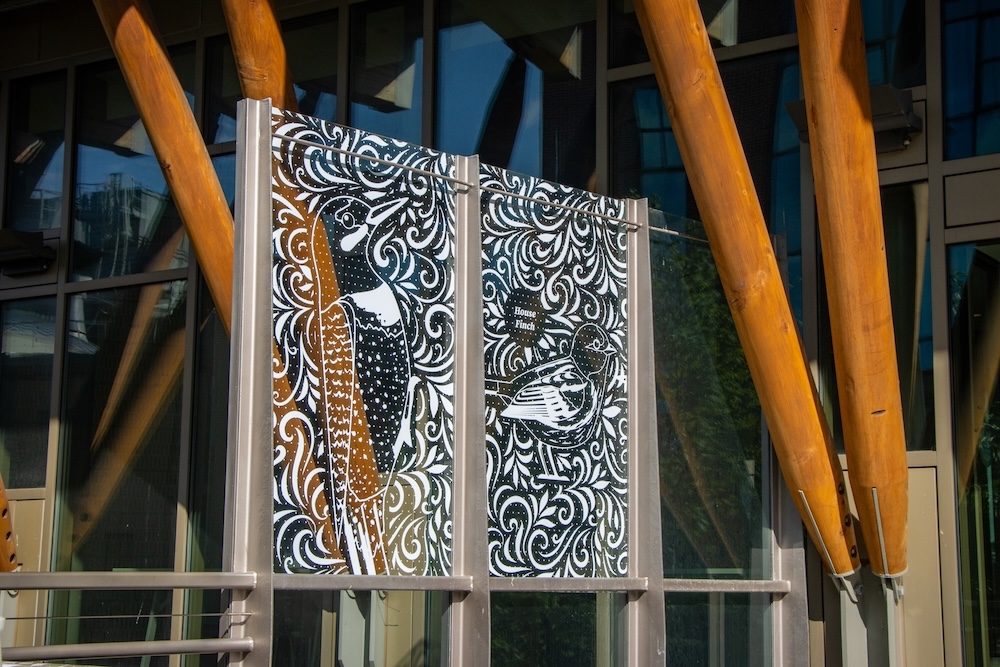
These two bird-strike mitigation murals are located outside of the Gateway Center.
ESF Installs Bird-Strike Mitigation Murals During Peak Migration Season
SYRACUSE, N.Y. — Oct. 15, 2026 — A new installation on the SUNY ESF campus is literally for the birds. New bird-strike mitigation panels combine research-based design, sustainability, and public art to make campus safer for birds, especially during peak migration season.
As billions of birds migrate across North America, including through Onondaga County, this fall, the SUNY College of Environmental Science and Forestry (ESF) has installed bird-strike mitigation murals to protect birds from fatal building collisions. The project started in 2025 with five transparent windscreens on campus treated with temporary hand-painted, nature-themed designs using water-resistant acrylic paint and paint pens, to create “contrast visual markers” that reduce collisions between birds and buildings. The markers help birds to recognize the glass as a solid object and avoid fatal crashes.
This fall, semi-permanent murals depicting New York-native birds were installed that will last 10 to 15 years. Five additional spaces have been identified for future murals. The murals provide “visual noise” that alerts birds to the presence of a solid surface and can reduce building strikes by at least 90%.
Every year over 1 billion birds die in the United States after colliding with windows and other glassy surfaces. Most victims are songbirds who momentarily mistake glass reflections for habitat.
ESF began treating glass windscreens on its Syracuse campus in 2025 to make campus more bird-friendly. In 2026, the College adopted a bird-friendly action item in its Sustainability Action Plan requiring all new buildings and retrofits on campus to incorporate bird-friendly building design.
“This puts ESF in league with other universities and colleges such as Yale University and the University of Pennsylvania that have also committed to making their campuses safer for birds,” said ESF Ph.D. candidate Meredith Barges, who researches bird-friendly building policies for her dissertation and who initiated ESF’s mitigation mural project.
The murals are the result of years of student-led research, collision monitoring, campus collaboration, and conservation advocacy aimed at addressing one of the leading human-caused sources of bird mortality. Barges and Emily McClary (BS ‘26) led the student-driven project in partnership with ESF’s Office of Sustainable Facilities Operations.
Collaborative data collection and research helped bring the panels to fruition. ESF’s Guy A. Baldassarre Birding Club created an ESF community collision-monitoring project on iNaturalist, a free online social network and citizen-science platform. Community members can submit photos, species information, and locations to iNaturalist which synthesizes the data. That information was then used to identify collision hotspots, guiding the placement of mitigation measures.
The murals highlight the diversity of birds that inhabit the region, inviting people to notice species they may otherwise overlook. The designs feature bird species native to New York including migratory and year-round resident birds. While all birds are susceptible to collisions, the featured species are among those most commonly affected by window collisions. Using QR codes, visitors learn about ESF’s bird-friendly campus project.
Building on artwork created for the pilot project by environmental illustrator Katie Mulligan and Barges, the final mural designs were developed by Robyn Jonick, ESF graphic designer, with input from project committee members.
"Everyone who sees ESF's new mitigation murals will know that something special is happening on our campus: we're saving birds with art. The murals demonstrate that building safer spaces for birds can also be beautiful and tell a story.” said Barges.
Along with helping birds, the project supports ESF’s sustainability initiatives. The mitigation film is made from 100% recycled-content PET material, contributes to campus biodiversity goals, and helps advance state and institutional sustainability objectives, according to Rochelle Strassner, sustainability outreach and engagement manager.
“Protecting biodiversity and pursuing sustainability go hand in hand. This project reflects ESF's commitment to solving environmental challenges in ways that consider both wildlife and the built environment,” said Strassner.
With the murals installed, monitoring will continue to show the effectiveness of the panels and collected data will be used to inform decisions regarding future mitigation projects.
“The goal was not simply to respond to a problem once, but to create lasting infrastructure that protects birds while informing future building and renovation projects,” said Strassner.
About SUNY ESF
The SUNY College of Environmental Science and Forestry is one of the nation's premier colleges focused on the study of the environment, developing renewable technologies, and building a sustainable future. ESF’s mission is to educate future environmental leaders of all backgrounds, advance knowledge, and skills necessary to promote scholarship and stewardship of the natural to designed environments, and act both locally and globally to Improve Our World. ESF’s students, faculty, staff, and alumni make a global impact on improving and sustaining the environment. ESF offers a world-class education among a close-knit community of more than 2,000 scholars with common values and a shared sense of purpose. ESF’s tight-knit community is centered alongside Syracuse University in the heart of Central New York and has a system of properties spanning 25,000 acres that broadly represent New York state’s rich ecological diversity for scientific study and instruction. To learn more, visit suny.edu.