Projects
Center for Community and Regional Design
CCRD works with communities to carry out planning and design projects rooted in the communities’ own stories. These stories of place reflect local history, current circumstances, and unique, place-specific opportunities that can be carried forward.
Some CCRD projects are carried out in design studios. Our design studios are based in Landscape Architecture and draw upon an interdisciplinary group of students from across the ESF campus, CCRD mentors students to develop innovative regional and community design. Our planners- and designers-in-training, working with a community’s leaders, volunteers, citizen scientists, and other interested parties, document community needs and values, conduct field studies, identify significant community and site-specific features, and create alternatives for design interventions. This work is produced iteratively with community input and then shared in the form of text and graphic representations of landscape analysis, needs assessment, and planning and design scenarios.
All studio work is student conceptual design developed for discussion. It does not include engineered plans and the proposals have not been adopted unless noted.
Selected Studio Projects
Partner: Syracuse Regional Market staff
The need. The Market has a long history as a weekend venue, and current planning seeks to expand and update its infrastructure so that it can support week-long activities and anchor a redeveloped neighborhood.
What we did. Students worked with Market staff to develop proposals for infill development on the site, including options for locating a major agricultural processing facility where local products could be cut, packaged, and distributed. Responding to staff interest in higher-density, mixed-use development, they also developed alternative plans for multifamily housing and new commercial development on the large site.
What happened. The students’ design studies have been used to support the Market’s grant writing process.
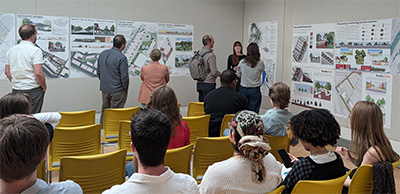
Regional Market staff looking at drawings before the critique. Student work for LSA
326, Spring
2026. Instructors: Jocelyn Gavitt, Sarah Krisch, and Margaret Bryant. Image credit:
Sarah
Krisch.
Partners: New York State Department of Environmental Conservation, Region 7 and Oswego County
The need. DEC Region 7 identified a need for improved angler access and more sustainable trail management in the Lower Salmon River State Forest.
What we did. Students examined access and trails issues within the context of the ecological and socioeconomic systems of the State Forest, adjacent lands, and Oswego County. They included consideration of how the surrounding landscape contributes to the tourism experience and how recreational uses could expand in ways compatible with angling, the primary use. Working with Region 7 staff, they identified new routes for angler access trails, including a “highland” route, to reduce pressure on trails that run directly beside the river, some of which contribute to erosion. Coordinating with county staff, they considered the relationship to surrounding private land and the land use regulations that will shape whether future development fits the character of the river. Regional, county, and town economic development goals were taken into account.
What happened. DEC requested a follow-up study to field check the highland trail route and supply GPS coordinates of the alignment. Two graduate students completed that work in the summer following the studio.
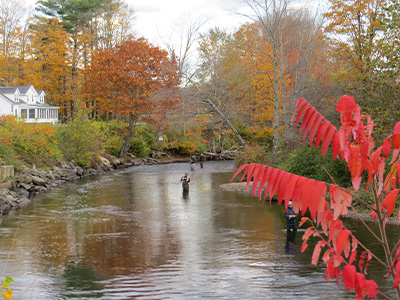
Anglers in the Salmon River. Image credit: Margaret Bryant.
Partner: Village of Fayetteville Parks Commission
The need. The Parks Commission works to set priorities for future investment in the Village’s parks. They sought input into their Master Plan process which was just beginning.
What we did. Students got to know the Village through site visits, meetings with Parks Commission volunteers and local leaders, public survey information, maps, and existing reports. They began by understanding the natural and cultural systems that form the Village’s context, then explored designs for specific sites and the connections between them, such as pathways,trails, and bike lanes, asking how the system works and what changes would help it function better.
What happened. Parks Commission members reviewed the work, which is expected to support their Master Plan.
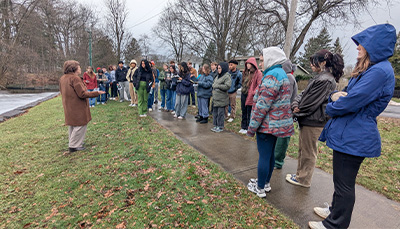
Professor Bryant giving a Fayetteville tour in LSA 326. Image credit: Sarah Krisch.
Beyond the region
Partners: ViequesLove, Inc. and Proyecto Comunitario La Ceiba
The needs. The Great Ceiba of Vieques (Ceiba pentandra), estimated to be more than 300 years old, is among the island’s oldest living trees and has become an important natural, cultural, and spiritual landmark for Vieques. The Ceiba itself carries deep significance throughout Puerto Rico, the Caribbean, and other tropical cultures. The larger Parque La Ceiba de Vieques and proposed Nature Reserve protect far more than the tree itself. The community-led environmental restoration project includes a coastal landscape encompassing mangrove wetlands, coconut forests, estuaries, beaches, coral reefs, green-turtle nesting areas, and habitat for numerous species of flora and fauna, including endangered species. Its stated vision combines conservation with public access, environmental education, cultural activities, recreation, and responsible tourism. The specific needs that the CCRD project addressed were visual communication materials for presenting the Nature Reserve proposal to the Legislature and conceptual site design for Parque La Ceiba.
What we did. Working with Proyecto Comunitario La Ceiba, CCRD staff and students summarized existing documentation and produced slides in Spanish and English for use in a presentation of Nature Reserve proposal to the Puerto Rico Legislature. CCRD also prepared spatial analysis and conceptual designs for the Ceiba Tree Park, the centerpiece of the reserve. The location is currently a municipal park.
What happened. Proyecto Comunitario La Ceiba led the effort to gain support for the reserve, and legislation was introduced at their request. “La Ceiba Park Nature Reserve of Vieques Act” (Senate Bill 1366) was introduced and approved by the Puerto Rico Legislative Assembly in June 2024. Governor Pierluisi issued a pocket veto after failing to sign the measure within the 30-day constitutional window, so the bill did not become law. Vieques community organizations continue to seek protection for the reserve.
We provide analysis and design to the organizations we work with. The positions they take are their own.
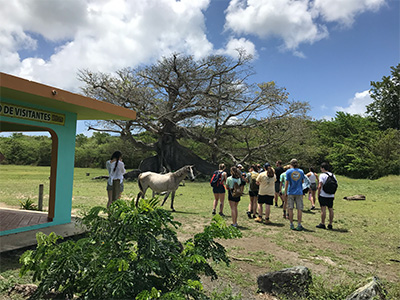
SUNY ESF students visiting the Ceiba Tree in Vieques, Puerto Rico. Image credit: Margaret Bryant.